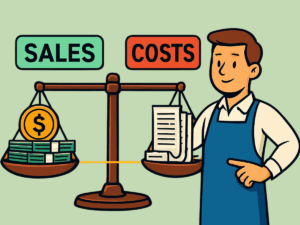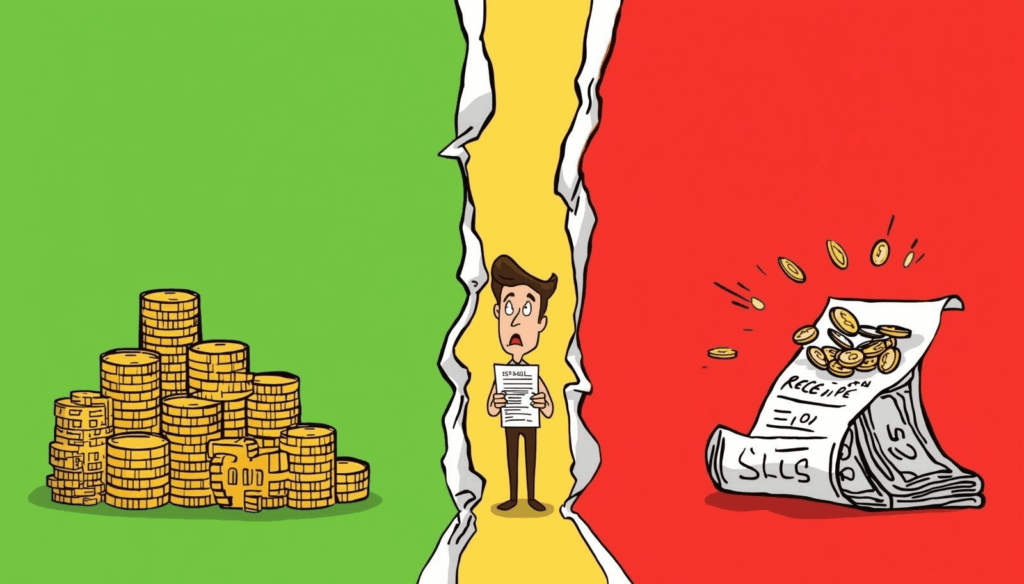
A bakery owner watched her sales climb for the third month in a row. Orders were up, the phone kept ringing, and foot traffic had doubled since spring. Then she opened her bank statement and saw the number that made her stomach drop. After paying her suppliers, her two employees, her rent, and her utility bills, she had less money in the account than she did six months earlier. Her sales were growing. Her business was shrinking.
This is the quiet crisis that destroys more small businesses than any single bad decision. Owners chase revenue, celebrate it, and measure success, while the business’s actual health erodes beneath them. The gap between revenue and profit is where most small businesses go to die, and most owners never see it coming because they are looking at the wrong number.
Understanding the difference between the two changes how you read your own business. It changes what you celebrate, what you worry about, and what you do next. This article walks through both concepts in plain language, shows how they appear on an income statement, and explains why business owners who only track revenue are often the last to know their business is in trouble.
Watch the Money Nudge YouTube Video about the definition of Finance:
Prefer to watch instead of read?
Subscribe to The Money Nudge on YouTube for plain-English videos on money, investing, and economic topics.
Table of Contents
What Revenue Actually Means in a Business
Every dollar a customer hands over during a given period adds up to one number: Revenue. It captures a business’s full sales activity across any timeframe you measure, whether a week, a month, or a full year. Nothing gets deducted at this stage. Costs, taxes, and any money flowing back out of the business are all ignored. It tracks only the inflow.
Harbor Kitchen serves around 300 customers a week. The average ticket is forty dollars. That means the restaurant generates roughly $12,000 in weekly revenue, or about $48,000 per month. That number represents every dollar customers hand over, swipe, or tap at the register. Nothing has been subtracted yet.
Dana runs her freelance agency from a home office. She charges clients a monthly retainer of $2,500 and currently works with 6 clients. Her monthly revenue sits at $15,000. Just like Harbor Kitchen, this number only reflects money flowing in. It says nothing about whether her business is actually making money.
It sometimes goes by other names on financial documents. Sales, gross sales, top-line, and turnover all describe the same basic idea. Accountants call it the top line because it appears at the very top of the income statement, before any costs. The phrase “top-line growth” means revenue is increasing.
New business owners often fixate on it because it is the easiest number to track and the most satisfying to watch grow. Big revenue feels like success. It fills up your sales dashboard, looks impressive on social media, and gives you something to brag about. The problem is, alone tells you almost nothing about whether your business can survive.
This Is How Business Actually Makes Money…
Read Article →What Profit Actually Means in a Business
Profit is what remains after all costs of running the business have been subtracted from revenue. Profit is the money the business actually keeps. It pays the owner, funds growth, covers slow months, and determines whether the business has a future.
The basic formula is simple: Revenue minus Expenses equals profit. A business that brings in $50,000 and spends $48,000 to operate ends the month with $2,000 in profit. A business that brings in $50,000 and spends $52,000 ends the month with a $2,000 loss, regardless of how impressive the revenue looks.
Harbor Kitchen generates $48,000 in monthly revenue. The owner pays roughly $14,000 for food ingredients, $18,000 for kitchen and front-of-house staff, $4,500 for rent, $1,200 for utilities, $800 for insurance, $600 for credit card processing fees, and $2,000 for miscellaneous supplies and maintenance. Her total monthly expenses add up to about $41,100. Her actual profit is $6,900 per month.
Dana’s freelance agency looks very different on the expense side. She pays $400 a month for software subscriptions, $300 for a bookkeeper, $150 for her business phone and internet allocation, and $1,500 to a contract designer she works with on client projects. Her total monthly expenses are $2,350. Her profit is $12,650 on $15,000 in revenue.
Two businesses. Roughly comparable owner income. Completely different revenue numbers. This is the first clue that revenue alone is a terrible way to measure business success.

If You Don’t Know The Difference Between Fixed and Variables Expenses You Should Stop Right Now…
Read Article →Why Revenue and Profit Are Not the Same Thing
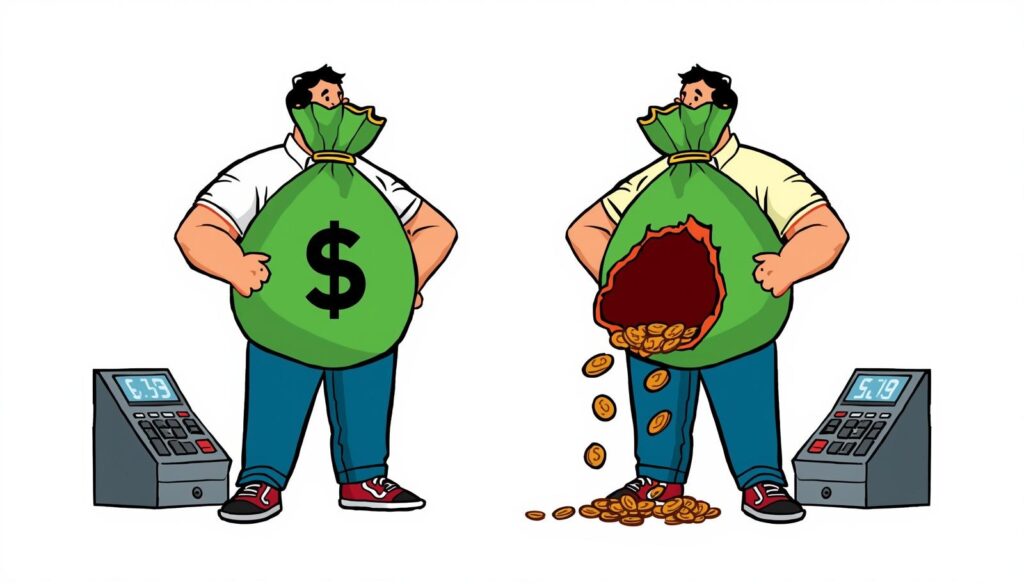
The distinction between revenue and profit matters because they answer two entirely different questions. Revenue answers the question: how much business am I doing? Profit answers the question: how much money am I actually keeping? A business can have strong answers to the first question and terrifying answers to the second.
New business owners confuse the two because the word “making money” gets used to describe both. Someone says their business made $500,000 last year, and the listener cannot tell whether that is revenue or profit. The difference between those two interpretations could mean the business is thriving or that the owner is working eighty-hour weeks and taking home almost nothing.
Revenue is always bigger than profit. In healthy businesses, the gap between the two is manageable and predictable. In struggling businesses, the gap swallows everything. A restaurant with $1 million in annual revenue might keep only $40,000 in profit, which works out to 4%. A software business with the same revenue might keep $300,000 in profit. Both businesses have the same top line. They are not remotely the same business.
The gap between revenue and profit also explains why some industries are brutally hard, and others are forgiving. Restaurants, grocery stores, and retail shops typically operate on thin margins, which means most of their revenue is immediately consumed by expenses. Professional services, software, and digital businesses often keep a much larger percentage of revenue as profit. Two owners with identical revenue can live in completely different financial worlds.
The Three Types of Profit, Explained Without the Accounting Headache
Profit is not a single number. Accountants break it into three categories, each of which tells you something different about how the business is performing. Understanding the three types helps owners pinpoint exactly where money is being made or lost.
Start with gross profit, the first of the three. What you spent to make or deliver the thing you sold is subtracted from revenue, leaving gross profit. For Harbor Kitchen, the direct cost is food ingredients. The restaurant brings in $48,000 in revenue and spends $14,000 on food, leaving $34,000 in gross profit. For Dana’s agency, the direct cost is her contract designer, who helps her deliver client work. She has $15,000 in revenue and $1,500 in designer costs, leaving $13,500 in gross profit. Gross profit tells you whether your core product or service is priced high enough to cover the cost of delivering it.
The second type is operating profit. Operating profit subtracts all the other costs of running the business: rent, utilities, staff, software, insurance, marketing, and so on. These are the costs you pay to keep the lights on, regardless of how much you sell. Harbor Kitchen’s operating profit is $6,900 after all expenses are subtracted from revenue. Dana’s operating profit is $12,650. Operating profit tells you whether the business model itself works.
The third type is net profit. Net profit is what remains after absolutely everything has been subtracted, including taxes, loan interest, and any other financial obligations. Net profit is the final take-home number for the business. It is the truest measure of whether the business made money during a given period. For most small businesses, net profit either ends up in the owner’s pocket or is reinvested in the business.
The reason all three matter is that each one exposes a different problem. A business with weak gross profit has a pricing problem. A business with solid gross profit but weak operating profit has a spending problem. A business with solid operating profit but weak net profit often has a debt or tax problem. Knowing which profit is suffering tells you exactly what to fix.
What is Gross Margin And How To Calculate…
Read Article →How a Business Can Have High Revenue and Still Lose Money
This is the scenario that breaks small businesses, and it happens more often than most owners realize. A business grows revenue aggressively, adds staff, takes on larger clients or bigger orders, and watches the top-line number climb. The owner feels successful. Meanwhile, costs grow faster than revenue, and every new sale quietly worsens the problem.
Imagine Harbor Kitchen decides to expand. The owner opens a second location with higher rent, hires six new employees, and increases food orders to match the new space. Monthly revenue jumps from $48,000 to $85,000. On paper, the business nearly doubled. The owner celebrates. Sales are up. Customers love both locations.
Now look at the expense side. Rent doubled to $9,000. Staff costs jumped to $32,000. Food costs climbed to $26,000 because volume increased and some ingredients were more expensive at the new location. Utilities went up. Insurance went up. Credit card fees went up. Total monthly expenses hit $88,000. The restaurant is now losing $3,000 a month despite revenue growing by more than 75 percent.
This happens in service businesses, too. Imagine Dana lands three new clients and her revenue climbs from $15,000 to $30,000 a month. To handle the workload, she hires two contractors at a combined cost of $8,000, upgrades her software to a more expensive plan, and brings on a part-time project manager for $3,000 a month. Her revenue doubled, but her costs grew by roughly $12,000. Her profit barely moved, and she now works twice as hard to earn roughly the same income.
The lesson is that growth is not automatically good. Growth that outpaces your ability to manage costs is often worse than no growth at all. Business revenue climbing without a matching climb in profit is a warning sign, not a success.
What the Income Statement Is and How Revenue and Profit Appear On It
The income statement shows whether a business is making money. It goes by a few names. Some accountants call it the profit and loss statement, or P&L for short. Others call it the statement of operations. They all describe the same thing: a summary of revenue, expenses, and profit over a specific period.
The income statement reads from top to bottom in a specific order, and that order is important. Revenue sits at the top. This is why people call it the top line. Directly below revenue, you see the direct cost of goods or services, which accountants call cost of goods sold or cost of revenue. Subtracting that from revenue gives you gross profit.
Operating expenses appear next on the statement, sitting directly under gross profit. Rent, salaries, utilities, marketing, and insurance all live in this section, along with every other cost tied to keeping the business running day to day. Take gross profit, subtract operating expenses, and what remains is operating profit.
Finally, at the bottom of the statement, you see interest, taxes, and any other remaining costs. Subtracting those gives you net profit, which sits at the very bottom of the page. This is why profit is called the bottom line. When someone says a business is focused on the bottom line, they literally mean the number at the bottom of the income statement.
For a small business owner, the income statement is the single most important document to read every month. It tells the complete story that a sales report cannot. A sales report only shows revenue. An income statement shows revenue, every cost, and what actually remains. Reading it regularly is how owners catch problems before those problems become emergencies.
Why Only Tracking Revenue Is a Small Business Killer
One of the most common financial mistakes small business owners make is watching revenue closely while almost entirely ignoring profit. This happens for understandable reasons. Revenue is easy to track. Every point-of-sale system, invoicing tool, and bank deposit clearly shows revenue. Profit requires adding up every expense and doing subtraction, and many owners do not make time for it.
The result is a dangerous blind spot. Owners assume that if sales are growing, the business is healthy. They raise prices slowly, if at all, because they do not want to lose customers. They take on bigger projects without carefully calculating the extra costs. They add staff based on how busy they feel, not based on whether the revenue can support the payroll. By the time the profit problem becomes obvious, the business is often already in crisis.
Revenue growth without profit tracking also distorts decision-making. A restaurant owner who sees rising revenue might decide to open a second location, not realizing that the first location’s profit margin is razor-thin. A freelance agency owner might take on a large client at a discounted rate to boost revenue, unaware that the client will consume so much time that other profitable work is dropped. In both cases, the decision feels smart because revenue is moving in the right direction. Still, the underlying math tells a different story.
The fix is simple in concept and harder in practice. Owners need to review their income statement at least once a month, not just their sales numbers. They need to know their gross profit, operating profit, and net profit as specific dollar amounts and as percentages of revenue. Knowing that you have a 15% net profit margin changes how you think about a price increase or a new hire. Not knowing means you are guessing.
How Understanding Revenue vs Profit Changes Your Business Decisions
Once an owner truly understands the relationship between revenue and profit, three specific types of decisions improve almost immediately.
The first is pricing. Owners who focus solely on revenue often underprice their products or services to drive volume. Owners who understand profit know that a small price increase can dramatically change the bottom line without destroying demand. Harbor Kitchen raising entree prices by just two dollars could add thousands of dollars in monthly profit without meaningfully affecting how many customers walk through the door. Dana raising her retainer from $2,500 to $2,800 could add nearly $2,000 in monthly profit with almost no additional work. These kinds of adjustments become obvious once profit is the focus.
The second is expense management. When owners only track revenue, expenses feel like inevitable background noise. When they track profit, every expense becomes a specific choice. Does this software subscription actually help us earn more? Does this marketing spend produce results? Is this staffing level matched to actual demand? These questions get asked more rigorously when the owner knows exactly how much each expense eats into profit.
The third is growth. Understanding revenue vs. profit helps owners grow intentionally rather than chaotically. A restaurant owner who knows her profit margin per meal can calculate whether a second location is actually worth opening. A freelance consultant who knows her profit per client can decide whether to take on a new account or raise prices on an existing one. Growth decisions stop being about how busy the business feels and start being about what actually adds to the bottom line.
Profit-focused owners also survive downturns better. When revenue drops, they already know where the non-essential expenses are hiding. They have already stress-tested their numbers. They understand which parts of the business actually generate profit and which generate activity. That clarity is what separates businesses that survive tough seasons from businesses that do not.
The Quiet Truth About Revenue and Profit
Revenue is the most exciting number in a business. It is the one customers create, the one marketing drives, and the one that makes a business feel alive. Profit is the quieter number. It does not make headlines. It does not feel like momentum. But profit is the number that determines whether the business exists in five years.
Harbor Kitchen and Dana’s freelance agency are different in almost every way. One sells food to walk-in customers—the other sells a strategy to corporate clients. But the math that decides whether either business thrives is the same. Revenue pays for the work. Profit pays for the future.
Owners who grasp the difference between revenue and profit start running their businesses differently. They ask different questions. They celebrate different wins. They notice problems earlier and make calmer decisions. They stop being surprised by their bank account because they already know what it will say.
The bakery owner, as mentioned in the opening of this article, eventually figured it out. She sat down with her numbers, tracked her expenses line by line, and realized her food costs had crept up while her prices had stayed flat for two years. A small price adjustment and a renegotiated supplier contract turned her business around within a few months. Her revenue barely changed. Her profit nearly tripled. That is the power of understanding the difference.
Revenue gets you noticed. Profit keeps you in business. Every small business owner who wants to build something that lasts needs to stop asking “how much did we sell?” and start asking “how much did we keep?” The answer to that second question is what the business is really worth.
Watch It Instead
The Money Nudge — YouTube Channel
Prefer watching over reading? Every topic on this blog also comes to life as an animated video on our YouTube channel — where we make money talk even more simply.
Visit Our Channel