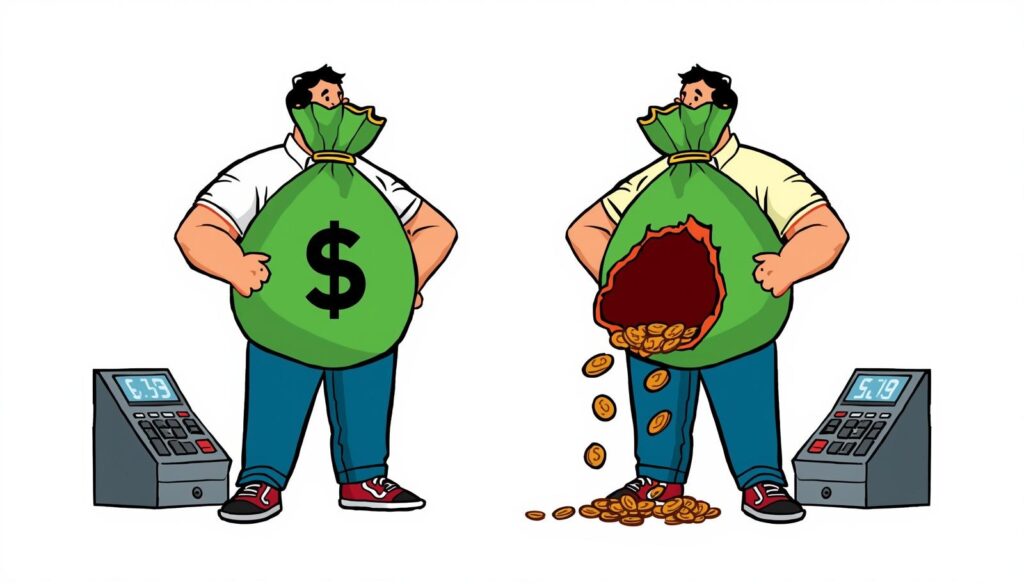
Two bakeries sit on the same busy street. Both pull in $500,000 in annual revenue. From the outside, they look equally successful. But behind the counter, one owner takes home a comfortable living while the other struggles to make payroll every month. The difference between these two businesses comes down to a single number that most people outside the business world never think about: gross margin.
Gross margin reveals the truth about whether a business actually makes money from the thing it sells. Revenue grabs the headlines, but this single metric tells the real story. Once the concept clicks, every business you walk into starts to look different. You begin to see why some companies thrive on thin margins while others collapse despite record sales. This article explains what gross margin is, how to calculate gross profit margin, and why this single number shapes nearly every decision a business owner makes.
Watch the Money Nudge YouTube Video about the definition of a Recession:
Prefer to watch instead of read?
Subscribe to The Money Nudge on YouTube for plain-English videos on money, investing, and economic topics.
Table of Contents
What Gross Margin Actually Measures
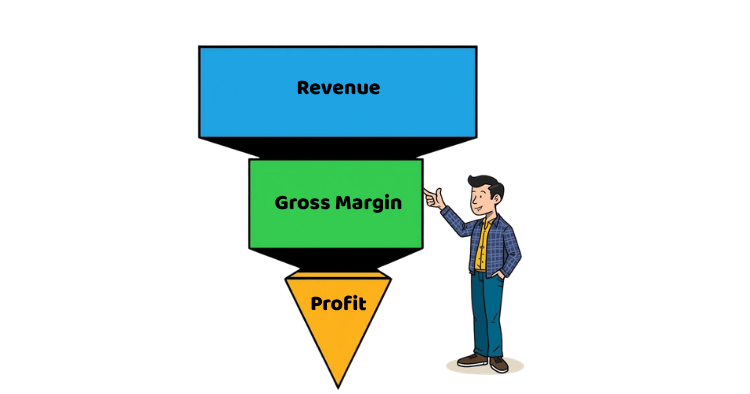
Gross margin measures how much money a business keeps from each sale after covering the direct costs of producing or delivering the product. It strips away everything except the core transaction: what did the customer pay, and what did it cost the business to create or acquire the thing the customer bought?
Those direct costs go by a specific name in accounting: cost of goods sold, often shortened to COGS. For a bakery, COGS includes flour, sugar, butter, eggs, and the bakers’ wages for mixing and shaping the dough. For a software company, COGS might include server hosting fees and the cost of customer support staff who help users get started.
Gross margin sits between revenue and profit on the financial spectrum. Revenue is the total money coming in the door. This metric captures what remains after subtracting the costs directly tied to producing the product. Net profit is what remains after subtracting everything else, including rent, marketing, insurance, taxes, and administrative salaries. Think of it as the first filter. If a business cannot pass this filter with healthy numbers, nothing that comes after it will save the company.

What Is The Real Definition Of Finance?
Read Article →Gross Margin Is Not Revenue, and It Is Not Net Profit
This distinction matters more than most people realize. Many first-time business owners celebrate growing revenue without realizing their gross margin is shrinking at the same time. That combination is a recipe for financial disaster.
Consider a simple example using the bakery on our busy street. Suppose Sunrise Bakery sells 10,000 loaves of bread in a year at $5 per loaf. That produces $50,000 in revenue. The ingredients and direct labor for those loaves cost $30,000. That leaves $20,000 in gross profit. The gross margin in this case is 40 percent, meaning Sunrise Bakery keeps 40 cents of every dollar earned from bread sales before paying for rent, utilities, marketing, and other expenses.
Now compare that to CloudSync, a small software company that sells a project management tool. CloudSync earns $50,000 in annual subscription revenue from its customers. Its COGS, which includes server costs and a part-time support agent, totals $10,000. That leaves $40,000 in gross profit and a 80% gross margin. CloudSync keeps 80 cents of every revenue dollar before covering its other expenses.
Both businesses earn identical revenue. But CloudSync retains twice as much money from each sale. That difference determines how much room each company has to invest in growth, absorb unexpected costs, and ultimately survive. Revenue alone would tell you these businesses are the same size. Gross margin tells you they operate in completely different financial realities.
Net profit, meanwhile, comes after all remaining expenses are subtracted from gross profit. If Sunrise Bakery pays $15,000 in rent, utilities, and other overhead, its net profit drops to $5,000. If CloudSync pays $25,000 in marketing, salaries, and office expenses, its net profit drops to $15,000. Gross margin is not the final answer, but it sets the ceiling for everything that follows.

This Difference Between Variable Vs. Fixed Expenses Will Change How You Think…
Read Article →How to Calculate Gross Margin: The Formula Explained Step by Step
Determining gross margin requires two pieces of information: total revenue and cost of goods sold. The calculation itself takes seconds, but the insight it provides can reshape how a business owner thinks about pricing, costs, and growth. Here is the gross margin calculation in its simplest form:
Gross Margin (%) = ((Revenue – Cost of Goods Sold) / Revenue) x 100
The number in the middle of that formula, (Revenue – Cost of Goods Sold), is called gross profit. The margin percentage expresses gross profit as a percentage of revenue. The percentage format makes this metric so useful because it allows comparisons across businesses of completely different sizes.
Walking Through the Formula With Sunrise Bakery
Sunrise Bakery earns $50,000 in revenue and spends $30,000 on ingredients and baker wages.
Step one: subtract COGS from revenue. $50,000 minus $30,000 equals $20,000. That is the gross profit.
Gross Profit = $50,000 – $30,000
Step two: Divide gross profit by revenue. $20,000 divided by $50,000 equals 0.40.
Gross Margin = $20,000/$50,000 = 0.40
Step three: multiply by 100 to convert to a percentage. 0.40 times 100 equals 40 percent.
Gross Margin = 0.40 x 100
Gross Margin = 40.0%
Sunrise Bakery operates at a 40 percent gross margin. For every dollar of bread sold, the bakery retains 40 cents to cover overhead, reinvest, or take as profit.
Walking Through the Formula With CloudSync
CloudSync earns $50,000 in subscription revenue and spends $10,000 on servers and support.
Step one: $50,000 minus $10,000 equals $40,000 in gross profit.
Step two: $40,000 divided by $50,000 equals 0.80.
Step three: 0.80 times 100 equals 80 percent.
CloudSync operates at an 80 percent gross margin. Every revenue dollar leaves 80 cents available for the company to spend on growth, salaries, or savings. This is why software companies attract so much investor attention. The economics of delivering a digital product create a fundamentally different cost structure than selling a physical good. Figuring out gross margin for any business follows this same three-step process, regardless of industry.
Cash Flow: This One Simple Change Can Determine The Direction Of The Business…
Read Article →What a Healthy Gross Margin Looks Like
There is no single “good” number that applies to every business. The healthy range depends entirely on the industry, the business model, and the cost structure involved in delivering the product or service. Comparing a restaurant to a software company on gross margin alone would be misleading without understanding why they differ.
Restaurants typically operate with margins of 60-70 percent on food items. However, some run lower depending on ingredient quality and menu pricing. That sounds healthy until you factor in the extremely high overhead that restaurants face: rent in commercial zones, large staff, equipment maintenance, and food waste. A restaurant with a 65 percent gross margin might struggle to reach a 5 percent net profit margin because so many additional costs pile on after the gross level.
Software companies, by contrast, often report margins of 70-90 percent. Their product costs almost nothing to replicate once it exists. Sending one more copy of a software tool to a new customer incurs virtually no additional production expense. That high gross margin provides significant room for the company to invest in marketing, engineering, and expansion while remaining profitable.
Retail businesses and e-commerce stores typically land between 25 and 50 percent, depending on whether they manufacture their own products or resell goods purchased from wholesalers. A clothing retailer that designs and produces its own line will usually achieve a higher margin than one that buys finished garments at wholesale prices and marks them up.
Consulting agencies and law practices rely almost entirely on people to deliver their work. That labor-intensive model typically produces margins of 50 to 70 percent, since few raw materials or physical goods are eating into revenue.
The key takeaway is not that one industry is better than another. This metric must always be evaluated in context. A bakery earning a 40 percent gross margin might be performing well for its category, while a software company at the same level would be in serious trouble.
This is where You Will Find The Real Difference Between Finance and Accounting…
Read Article →Why Gross Margin Is One of the Most Important Numbers in Any Business
Revenue tells you how much money flows through the door. Gross margin tells you how much of that money actually sticks. That distinction makes it one of the most revealing indicators of a company’s financial health. Business owners who focus only on revenue often find themselves growing their way into bankruptcy, a pattern that happens more frequently than most people expect.
It Reveals Pricing Power
A strong gross margin signals that a business charges enough for its products relative to the cost of producing them. If a company’s margin shrinks over time, it usually means one of two things: either production costs are rising, or competitors are forcing the company to lower prices. Both scenarios demand attention. Figuring profit margin at the gross level over multiple quarters or years creates a trendline that shows whether a business is gaining or losing control over its pricing.
Sunrise Bakery, for instance, might notice its margin dropping from 40 percent to 32 percent over two years. That decline could signal rising ingredient costs, a price war with a new competitor, or a shift toward lower-margin menu items. Without tracking this number, the owner might not notice the problem until cash flow dries up.
Wait a Minute… Do You Know What Opportunity Cost Is?
Read Article →It Exposes Hidden Cost Problems
Sometimes revenue grows while margins quietly erode. A business might celebrate a 20 percent increase in sales without realizing that production costs rose 35 percent over the same period. The gross margin calculation catches that mismatch immediately. Revenue growth that comes at the expense of margin health is not real growth. It is a treadmill that speeds up faster and faster without actually moving.
It Shapes How Much a Business Can Spend on Everything Else
Every expense that sits below gross profit on the income statement, including marketing, salaries, rent, research, and administration, must be funded by what the margin provides. A business with a 30 percent margin at the gross level has far less room to invest in growth than a business with a 75 percent margin. That constraint affects hiring decisions, marketing budgets, expansion plans, and even how aggressively a company can pursue new customers. Understanding this number helps a business owner set realistic expectations for what the company can and cannot afford.
What Contribution Margin Means and How It Connects to Gross Margin
Contribution margin narrows the focus to a single product or service rather than the entire business. It isolates how much one item earns after covering only the variable costs tied directly to producing and selling it.
Variable costs are expenses that change based on the volume of production. For Sunrise Bakery, the flour, eggs, and butter used per loaf are variable costs. If the bakery produces more loaves, those costs go up proportionally. Rent and insurance do not move when production volume changes. The bakery pays the same amount for those expenses whether it produces 100 loaves or 1,000.
The contribution margin formula looks like this:
Contribution margin = Revenue per Unit – Variable Cost per Unit
If Sunrise Bakery sells a loaf for $5 and the variable costs per loaf total $2.50, the contribution margin is $2.50 per loaf. That $2.50 is what each loaf “contributes” toward covering the bakery’s fixed costs and generating profit.
Contribution margin’s meaning becomes especially useful when a business sells multiple products. Suppose Sunrise Bakery also sells specialty cakes for $40 each, with variable costs of $18 per cake. The contribution margin on each cake is $22. Comparing the $2.50 contribution per loaf against the $22 contribution per cake shows the owner which products generate the most value per sale and helps guide decisions about where to focus marketing efforts or production capacity.
Gross margin looks at the entire business. Contribution margin looks at individual items. Together, they give a business owner a complete picture of which products pull their weight and which drag down the overall numbers. A business might have a healthy overall margin while carrying several products with poor contribution margins. Identifying those weak spots is essential for determining gross margin improvements over time.
How Gross Margin Helps Business Owners Make Better Decisions
Understanding gross margin does more than satisfy curiosity. It directly improves the quality of three critical business decisions: pricing, cost management, and growth strategy.
Pricing Decisions
Setting prices without understanding gross margin is like driving without a speedometer. A business owner might feel like the price is right, but without the numbers, there is no way to confirm it. This metric provides the feedback loop. If the margin is too thin, the business needs to raise prices, reduce production costs, or both. If the margin is strong, the business can experiment with promotional pricing, bundle deals, or volume discounts without risking profitability.
CloudSync could offer a discounted annual subscription to attract long-term customers. Before making that decision, the leadership team should examine whether the reduced price still preserves enough margin to cover the company’s operating expenses and growth plans. The gross margin calculation makes that analysis concrete instead of speculative.
Cost Management
Gross margin also highlights where cost savings will have the most impact. A bakery owner reviewing a 35 percent figure might discover that switching flour suppliers could reduce ingredient costs by 10 percent without affecting quality. That single change could lift the margin to 38 or 39 percent, creating thousands of dollars in additional gross profit over the course of a year. Without tracking this number, that opportunity stays invisible.
For CloudSync, cost management at the gross level might involve negotiating better rates with the cloud hosting provider or automating portions of customer support to reduce labor expenses. Every dollar removed from COGS flows directly into gross profit, making cost management at this level one of the highest-leverage activities a business can pursue.
Growth Strategy
Gross margin determines whether growth is financially sustainable. A business with a 20 percent margin that doubles its revenue will still struggle to cover overhead if operating expenses grow at a similar rate. A business with a 70 percent margin that doubles its revenue sees a massive increase in gross profit, which can fund hiring, marketing, and product development.
This is why investors and lenders scrutinize this metric before funding a company. A business that grows revenue quickly but cannot maintain or improve its margin is a risky bet. A strong number at the gross level signals that the underlying business model works and that scaling up will produce real financial returns, not just bigger top-line numbers.
What Happens When a Business Ignores Gross Margin
The most dangerous version of business growth is revenue growth without margin discipline. Companies that chase sales volume without tracking their margins often discover, too late, that they have sold products at unsustainable margins.
The Revenue Trap
Consider Sunrise Bakery deciding to compete on price. The owner drops bread prices from $5 to $3.50 per loaf to attract more customers. Volume increases by 40 percent. Revenue looks healthy. But the ingredient and labor costs per loaf remain at $3. At the new $3.50 price point, the gross profit per loaf is only $0.50, compared to the previous $2. The gross margin plummets from 40 percent to roughly 14 percent.
Even with significantly more customers walking through the door, the bakery now keeps only 14 cents of every dollar earned. After paying rent, utilities, and other operating costs, the owner is losing money on every loaf. More sales actually accelerate the losses. This is the revenue trap, and it catches businesses that treat revenue as the only measure of success.
Real-World Consequences
Businesses caught in this cycle often respond by trying to sell even more, hoping that volume will compensate for thin margins. But volume without margin creates more work, more complexity, and more financial stress. Staff burnout follows. Quality slips. Customers start noticing. The business enters a downward spiral that began with a single mistake: ignoring the margin.
CloudSync could fall into a similar trap by offering deep discounts on annual subscriptions to hit a revenue milestone. If those discounts push the subscription price below the cost of delivering the service, including server costs and support, every new customer becomes a financial liability. The company might celebrate reaching 1,000 subscribers while quietly bleeding cash on every single account.
The lesson is consistent across every industry. Revenue without a healthy margin is not growth. It is an activity. And activity without profitability is a path toward closing the doors.
Gross Margin Across Different Business Models: A Quick Comparison
Understanding why gross margins differ so dramatically across industries helps clarify what realistic targets look like. Here is a comparison using broad industry averages:
| Business Type | Typical Gross Margin Range | Why |
| Software / SaaS | 70% to 90% | Minimal cost to deliver each additional unit |
| Professional Services | 50% to 70% | Primary cost is labor, no physical materials |
| Retail (own brand) | 40% to 60% | Controls production, higher markup possible |
| Retail (reseller) | 25% to 45% | Buys from wholesalers, limited markup room |
| Restaurants | 55% to 70% | Food costs are controlled, but waste is a factor |
| Manufacturing | 25% to 40% | Raw materials and labor drive costs higher |
| Grocery Stores | 25% to 35% | High volume, very thin margins per item |
These ranges are approximate and vary widely depending on the specific business, its location, and its competitive environment. The table reinforces one critical point: a margin number only makes sense when compared to others in the same industry. A 30 percent figure would be excellent for a grocery chain and alarming for a software company.
Figuring Profit Margin: Gross Margin as the Starting Point
Many people use the phrase “profit margin” loosely, but in business finance, there are actually several layers of margin. Gross margin is the first and most fundamental layer. It establishes the baseline from which all other profitability measures flow.
After the gross level comes operating margin, which subtracts operating expenses like rent, marketing, and administrative costs from gross profit. Then comes net margin, which subtracts interest, taxes, and any remaining expenses to arrive at the final bottom-line profit.
Figuring a profit margin accurately starts at the gross level. If the margin here is weak, no amount of cost-cutting in operations or overhead will produce a sustainably profitable business. The foundation has to be solid. A business owner who skips the gross margin calculation and jumps straight to net profit misses the most important diagnostic number in the entire financial statement.
For Sunrise Bakery, the path from gross margin to net profit might look like this:
Revenue: $50,000 COGS: $30,000 Gross Profit: $20,000 (40% gross margin) Operating Expenses: $12,000 Operating Profit: $8,000 (16% operating margin) Taxes and Interest: $2,000 Net Profit: $6,000 (12% net margin)
Every layer of margin peels back another layer of cost. But the first layer, the gross level, is the one that determines whether the business model itself is viable. Everything built on a weak foundation here is on unstable ground.
A Practical Framework for Using Gross Margin in Any Business
Whether someone runs a bakery, a software startup, or a consulting firm, gross margin should be one of the first numbers reviewed every month. Here is a simple framework for putting it to use.
Track it monthly. Calculate the margin at the end of every month. Look for trends. A steady or rising number indicates that the business model is working. A declining margin is an early warning signal that demands investigation before it becomes a crisis.
Compare against industry benchmarks. Knowing where the business stands relative to competitors and industry averages provides context. A 45 percent gross margin means something very different for a restaurant than it does for a software company. Industry data from trade associations, business publications, and financial databases provides the reference points needed for meaningful comparison.
Break it down by product or service. Use contribution margin analysis to identify which products are the strongest performers and which ones are dragging the average down. Not every product needs to be a margin leader. Still, the business should know which items carry the load and which exist for other strategic reasons, such as customer acquisition or market positioning.
Use it to stress-test decisions. Before changing prices, adding a product, or entering a new market, run the calculation on the projected numbers. If a new product line would lower the overall margin, the business needs to determine whether the additional revenue justifies the dilution. The answer is not always no, but the question must always be asked.
Protect it during growth. Rapid growth often pressures margins. Volume discounts to large customers, increased production costs, and hiring surges can all erode the number. Business owners who monitor gross margin during growth phases catch these issues early and adjust before profitability deteriorates.
Final Thoughts: The Number That Tells the Truth
Revenue is the number most people celebrate. Net profit is the number most people chase. But gross margin is the number that tells the truth about whether a business actually works.
It reveals whether the core product or service generates enough value to sustain the company. It exposes pricing weaknesses, cost inefficiencies, and structural problems that revenue alone cannot reveal. It provides the foundation for every other financial decision a business owner will make, from hiring and marketing to expansion and investment.
Sunrise Bakery and CloudSync operate in completely different industries with completely different cost structures. Yet the same metric, gross margin, explains why one keeps 40 cents of every revenue dollar while the other keeps 80. That difference shapes their strategies, their growth potential, and their long-term survival.
Determining gross margin is not complicated. The formula takes seconds. But the insight it delivers is worth more than most business owners realize. Every company that has ever failed while posting record revenue learned this lesson too late: the money coming in matters far less than the money the business actually gets to keep.
Understanding gross margin will not guarantee success. But ignoring it will almost certainly guarantee trouble. The businesses that track it, protect it, and use it to guide their decisions are the ones that turn revenue into real, lasting profit.
Watch It Instead
The Money Nudge — YouTube Channel
Prefer watching over reading? Every topic on this blog also comes to life as an animated video on our YouTube channel — where we make money talk even more simply.
Visit Our Channel