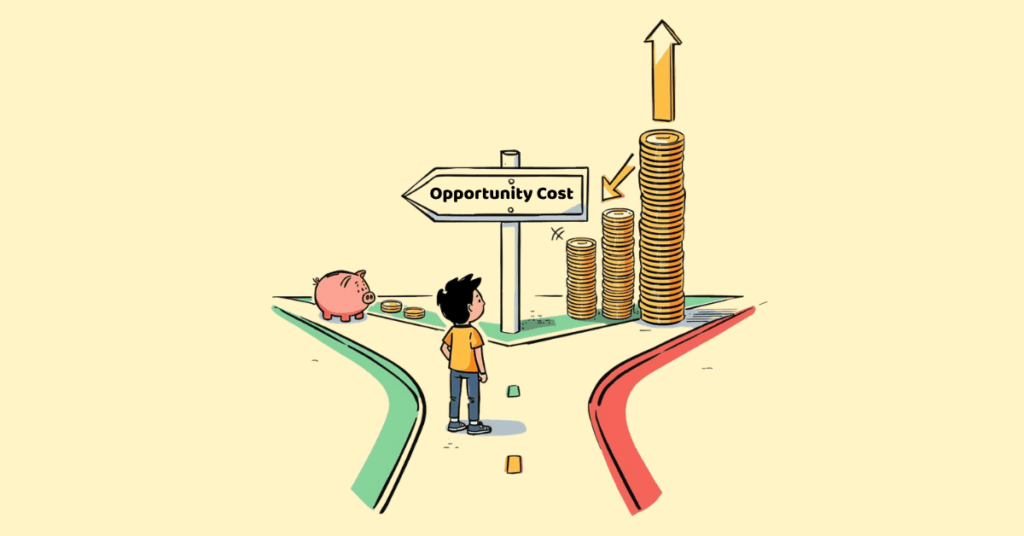
Have you ever turned down a job offer, skipped an investment, or decided to keep your money in a savings account and then quietly wondered if you made the right call? That quiet doubt has a name: opportunity cost.
Understanding the opportunity cost definition is one of those shifts in thinking that changes how you see money forever.
It applies whether you are a college student budgeting your first paycheck or a CEO deciding where to allocate millions. Once you understand what opportunity cost means and how to start calculating opportunity cost in real situations, you will never look at a financial choice the same way again.
Watch the Money Nudge YouTube Video about the definition of Finance:
Prefer to watch instead of read?
Subscribe to The Money Nudge on YouTube for plain-English videos on money, investing, and economic topics.
Table of Contents
Opportunity Cost Definition: What Does It Actually Mean?

Wait a minute… You will not believe what the real definition of Finance is…
Read Article →The opportunity cost definition is straightforward: it is the value of the next best alternative you give up when you make a choice. Every time you choose one thing, you are automatically not choosing something else, and opportunity cost is the value of that something else.
Here is a simple example. Imagine you have $5,000 sitting in a checking account earning basically nothing, and you are deciding what to do with it.
- Option A is to leave it in the checking account.
- Option B is to put it in a high-yield savings account earning 4% annually.
- Option C is to invest it in an index fund with an average historical return of 8% per year.
If you choose Option A, your opportunity cost is the return you could have earned from Option B or C. If you choose Option B, it is the potential higher return from Option C. The money you do not earn is just as real as the money you do earn, and that is the core of what opportunity cost means.
The meaning goes beyond money as well. Time is one of the biggest opportunity costs in personal finance. If you spend two hours watching TV, it might be two hours you could have spent learning a new skill, working a side gig, or researching investments.
In finance and economics, it is sometimes called the hidden cost because it does not show up on a receipt or invoice. But it is very real, and ignoring it leads to poor financial decisions. Every dollar and every hour you spend on one thing is a dollar and an hour you cannot spend on something else. Opportunity cost is simply the price tag of that trade-off, and it is always there whether you notice it or not.
Why Opportunity Cost Matters More Than Most People Think
Most people think about costs in terms of what they spend. Opportunity cost flips the lens by asking what you give up when making a particular choice. This matters because humans are naturally loss-averse. We hate losing money more than we love gaining it. Yet we are surprisingly bad at recognizing losses that do not appear directly in our bank accounts. Opportunity cost is exactly that kind of invisible loss.
Consider a few everyday examples to make this concrete. If your car loan charges 3% interest but the stock market historically averages 8% annually, paying extra on your car loan has a real opportunity cost. You are saving 3% but potentially giving up 8%. When you buy a home, your down payment is locked up in an asset that may or may not appreciate at the same rate as other investments, so the trade-off of homeownership includes the returns that capital could have generated elsewhere.
If you go back to school, tuition is one cost, but the trade-off of graduate school also includes the salary you are not earning while studying full-time. None of these situations has a single right answer, but understanding the opportunity cost of each one helps you make a far more informed decision.
It is also worth understanding what economists call the opportunity price of a decision, which refers to what you are paying to make a particular choice, not in cash, but in foregone value. The opportunity price of holding cash is the investment return you could have earned.
The opportunity price of taking a lower-paying job you love is the salary difference from a higher-paying role. The opportunity price of buying a luxury car in cash is the compound growth that money could have generated over 10 to 20 years. When you start framing decisions this way, it becomes clear that financial choices are not just about what something costs today but about what it costs you over time.
Calculating Opportunity Cost: The Formula and Real-World Examples
Calculating opportunity cost does not require an economics degree. The formula is simple: Opportunity Cost equals the return on the Best Foregone Option minus the return on the Chosen Option. In plain terms, it is what you could have earned minus what you actually earned.
To see how this works in practice, consider three common situations. First, suppose you have $10,000 to invest and choose a certificate of deposit that earns 3% per year, yielding $300 in annual interest. Your best alternative was an S&P 500 index fund averaging 8% per year, which would have generated $800 in annual income. The opportunity cost is $800 minus $300, which equals $500 per year. Over ten years, with compounding factored in, that gap becomes significantly larger than it appears in year one.
Second, you currently earn $70,000 per year at your job and are considering quitting to start a business that you project will earn $50,000 in its first year. The opportunity cost is $70,000 minus $50,000, which equals $20,000 in year one. That does not mean starting the business is wrong. It might earn $150,000 in year three. But calculating opportunity cost makes clear what you are sacrificing during the early stages and helps you plan accordingly.
Third, suppose you have $20,000 extra. You are choosing between paying down your mortgage at a 3.5% interest rate, which saves you $700 per year in interest, or investing it in a diversified portfolio with an expected 7% return, which would earn $1,400 per year. The opportunity cost is $1,400 minus $700, which equals $700 per year. Paying down debt offers guaranteed savings and peace of mind, but calculating opportunity cost shows you the full financial picture of that trade-off.
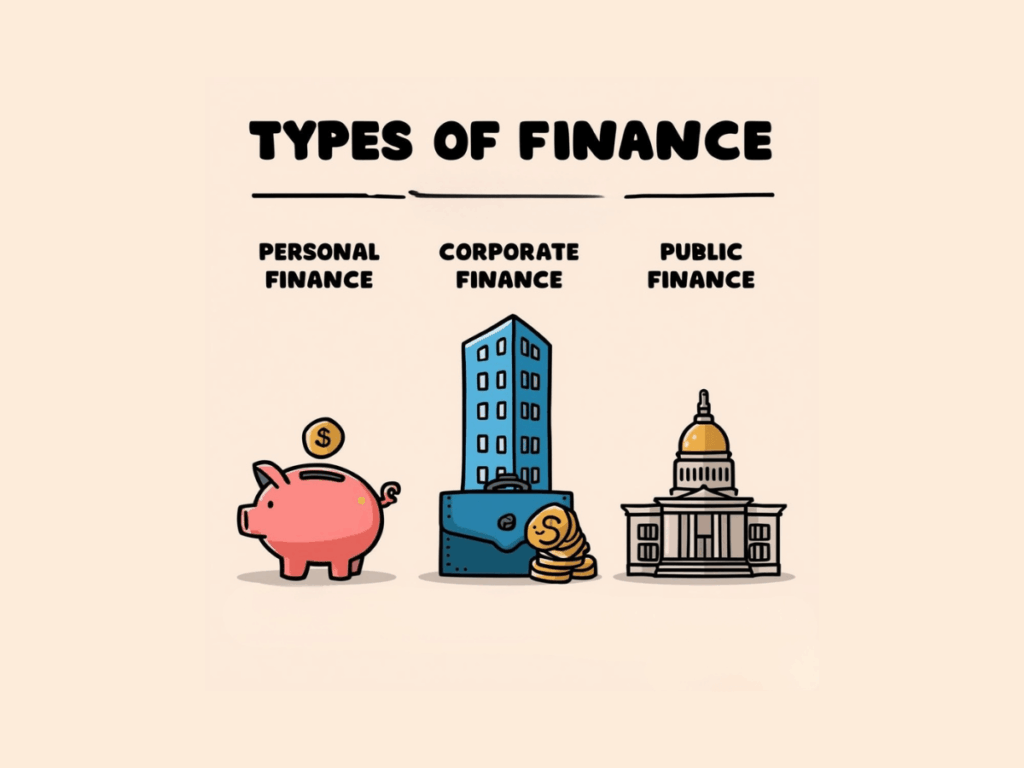
Do you know the 3 main fields of finance?
Read Article →Opportunity Cost in Personal Finance
In personal finance, opportunity cost shapes virtually every major money decision, often in ways people do not immediately recognize. One of the most common examples involves where you keep your savings. Keeping money in a traditional savings account earning 0.5% when a high-yield savings account offers 4.5% has a real and measurable opportunity cost. It is not that saving is wrong. It is where you save that matters. The opportunity cost of low-yield savings becomes more dramatic over time thanks to compound interest, and a difference of even a few percentage points in annual return can translate into tens of thousands of dollars over twenty years.
The rent-versus-buy debate is another area where opportunity cost plays a central role. When you buy a home, your down payment, which is often $30,000 to $100,000 or more, is tied up in an asset that may or may not appreciate at the same rate as other investments. Homeowners also pay maintenance costs, property taxes, and insurance that renters avoid, while renters can potentially invest the difference. Neither path is universally better, but understanding the cost of each choice helps you evaluate what is right for your situation rather than following a one-size-fits-all rule.
Education and lifestyle spending are two more areas where the hidden costs of decisions are easy to overlook. A four-year degree with $60,000 in tuition does not just cost $60,000. It also costs four years of full-time earnings you are not receiving. If you could have earned $35,000 per year working during that time, that adds another $140,000 in opportunity cost, making the real total cost of that education closer to $200,000.
Similarly, spending $600 per month on a car payment instead of driving a paid-off vehicle carries an opportunity cost in the form of the investment you are not making. If that $600 were invested monthly at a 7% annual return, after twenty years, you would have roughly $310,000. That is the true opportunity price of a car upgrade, and knowing it does not mean you should not buy the car. It simply means you are making a decision with all the information available.
Opportunity Cost in Corporate Finance
Opportunity cost is just as central to corporate finance as it is to personal money decisions. The principle remains the same. Every dollar deployed in one direction is a dollar unavailable for every other direction. One of the most important responsibilities of a CFO is deciding where to allocate the company’s capital. Should the company invest in new equipment, expand to a new market, buy back shares, or acquire a competitor?
Did you know that Corporate Finance is only one type of finance?
Read Article →Every dollar allocated to one project is a dollar that cannot go elsewhere, so corporate leaders rely on opportunity cost analysis to evaluate whether any given investment is truly the best use of available capital. This evaluation is often formalized through a concept called the hurdle rate, which is the minimum acceptable return on investment. If a project does not clear the hurdle rate, it signals that a better opportunity exists elsewhere, even if the project itself would turn a profit.
Companies also regularly face “make-versus-buy” decisions, in which they must decide whether to manufacture a component in-house or outsource it to a supplier. The opportunity cost calculation in these situations includes not only the direct production costs but also the resources, factory floor space, and management attention that would be freed up or consumed by each option. A manufacturer that produces its own components might be giving up the chance to use that same factory capacity for higher-margin products. That trade-off needs to be part of the analysis.
Research and development spending is another area where opportunity cost thinking is critical. Allocating budget to R&D means not spending that same money on marketing, additional headcount, or shareholder dividends. Companies that fail to weigh opportunity cost in their R&D decisions often end up over-investing in low-return projects or neglecting high-impact opportunities that would have generated far greater returns.
At the broadest level, opportunity cost in corporate finance relates to the cost of capital, which is the return a company must achieve to satisfy its investors. If a company’s investments do not outpace its cost of capital, shareholders are effectively losing money relative to what they could earn by investing elsewhere. Capital will eventually flow to where it is treated best, and that is opportunity cost working at the macro level.
Common Mistakes People Make When Thinking About Opportunity Cost
Understanding the concept is one thing. Applying it consistently is another. Four mistakes repeatedly occur when people try to factor opportunity cost into their decisions.
The first and most common mistake is simply ignoring opportunity cost altogether. When someone asks whether an investment is good, they usually mean whether it will make money. But the more useful question is whether it is the best use of that money. A 5% return on an investment sounds appealing until you realize you could have earned 9% with a different choice. The absolute return matters less than the relative one.
The second mistake is to compare only obvious options and forget about less visible alternatives. Most people evaluate two explicit choices, such as this investment versus that investment, but fail to include less obvious benchmarks in the comparison. For many investors, the opportunity cost of any active strategy also includes the option of simply investing in a low-cost index fund. That baseline is one of the most important comparisons to make, and it is often the one people skip.
The third mistake is ignoring time. Opportunity cost compounds the same way interest does. The longer money sits in a lower-return vehicle, the wider the gap grows between what you have and what you could have had. Calculating opportunity cost over ten or twenty years instead of just one year tells a much more complete and often more motivating story about why the decision matters.
The fourth mistake is confusing sunk costs with opportunity costs. A sunk cost is money already spent that cannot be recovered. Many people hold onto poor investments or unprofitable business lines because they do not want to accept the loss on what they have already put in. But the opportunity cost going forward does not care about past spending. It only cares about what your money or time could do from here on out. The right question is always: what is the best available option right now, not what you paid to get here.
What if I tell you that the Interest Rate is not the same as the APR?
Read Article →How to Apply Opportunity Cost in Your Own Financial Life
You do not need to run complex spreadsheets to start using opportunity cost as a decision-making tool. A simple five-step framework works for most personal financial decisions. Start by identifying your realistic options, not just the two most obvious ones. Then estimate the return or value of each option as best you can. A rough estimate is fine for most personal decisions.
Next, apply the formula by subtracting the return of your chosen option from the return of your best alternative. After that, consider the non-financial factors. Risk tolerance, peace of mind, personal values, and lifestyle preferences are legitimate inputs into any financial decision, and the mathematically optimal choice is not always the right one for your situation.
Finally, make a conscious and informed trade-off rather than a default one. The goal is not to eliminate opportunity cost, which is impossible, but to understand what you are giving up before you give it up.
Quick Reference: Opportunity Cost in 5 Common Scenarios
Illustrative Examples:
| Scenario | Chosen Option | Best Alternative | Opportunity Cost |
| $10,000 in a savings account at 1% | $100 per year | An index fund at 8% equals $800 per year | $700 per year |
| Paying off a 3% mortgage early | Save $300 per year in interest | Invest at 7%, and earn $700 per year | $400 per year |
| Four-year degree, while forgoing a $35,000 annual salary | Education | $140,000 in earnings over four years | $140,000 or more in lost income |
| Buying a home with a $50,000 down payment | Home equity | Invested at 7% equals $3,500 per year | $3,500 per year |
| Holding $100,000 in cash instead of a HYSA at 4.5% | Near-zero return | $4,500 per year in interest | $4,500 per year |
Final Thoughts: The True Cost of Every Choice
Every financial decision, no matter how small, carries an opportunity cost. The opportunity cost is simply the value of the path not taken, and it exists whether you account for it or not.
When you genuinely understand the meaning of opportunity cost, calculating it stops feeling like extra work and starts feeling like clarity. You begin to see that money is not just about what you spend. It is about what you choose to do with it and what you decide to pass on. Whether you are comparing two investments, weighing a career move, or figuring out where to keep your savings, the cost of each choice is always in the background. Understanding it puts you in a position to make better, more deliberate decisions rather than accidental ones.
The goal is not to maximize every dollar perfectly, because that is not realistic. The goal is to make conscious trade-offs with full information. That is what strong financial decision-making actually looks like, and now you have the tools to do exactly that.
Watch It Instead
The Money Nudge — YouTube Channel
Prefer watching over reading? Every topic on this blog also comes to life as an animated video on our YouTube channel — where we make money talk even more simply.
Visit Our Channel