The 1929 stock market crash did not arrive quietly. It arrived like a freight train — sudden, loud, and devastating. Within days, fortunes evaporated. Within weeks, confidence in the financial system began to buckle. But as catastrophic as the crash was, it was only the beginning. What followed was ten years of economic suffering on a scale that the modern world had never seen before and has not seen since. That decade is known as the Great Depression, and understanding it changes how you see economies, governments, and money itself.
If you have not yet read our companion piece on the 1929 Market Crash, that article tells the full story of how the market collapsed and why. This article picks up from that point — after the crash, after the initial panic — and follows the wreckage forward into the decade of ruin that followed, and eventually into the slow, painful process of recovery.
Watch the Money Nudge YouTube Video about the definition of a Recession:
Prefer to watch instead of read?
Subscribe to The Money Nudge on YouTube for plain-English videos on money, investing, and economic topics.
Table of Contents
Where the 1929 Crash Left Things
By the end of October 1929, the American stock market had shed roughly 25 percent of its value in just two trading days. Investors who had borrowed money to buy stocks — a common practice at the time — were wiped out completely. Brokerage firms scrambled to collect on margin calls. Banks that had extended credit to speculators began to feel the strain. Consumer spending slowed as people tightened their belts. Business investment dried up almost overnight.
The crash had a psychological effect that went far beyond the numbers. People who had believed in endless prosperity suddenly did not know what to believe. Businesses stopped hiring. Factories cut production. Workers were laid off. And because fewer people had wages to spend, businesses sold less, leading to more layoffs, which in turn meant even less spending. This self-reinforcing cycle of economic decline was just getting started.
What the Great Depression Actually Was
The Great Depression was not simply a bad recession. It was a prolonged, catastrophic collapse of economic activity that lasted from roughly 1929 to 1939, with the worst years falling between 1930 and 1933. In the United States, the unemployment rate reached 25% at its peak. One in four workers had no job. In some cities and industrial regions, the number was even higher.
Gross domestic product fell by roughly 30% between 1929 and 1933. Prices fell sharply, too, in a process called deflation. At first glance, falling prices might sound like good news. But deflation is deeply dangerous. When prices fall, businesses earn less revenue. When businesses earn less, they cut wages and jobs. When workers earn less or nothing, they buy even less. And when consumers buy less, prices fall further. The cycle feeds itself.
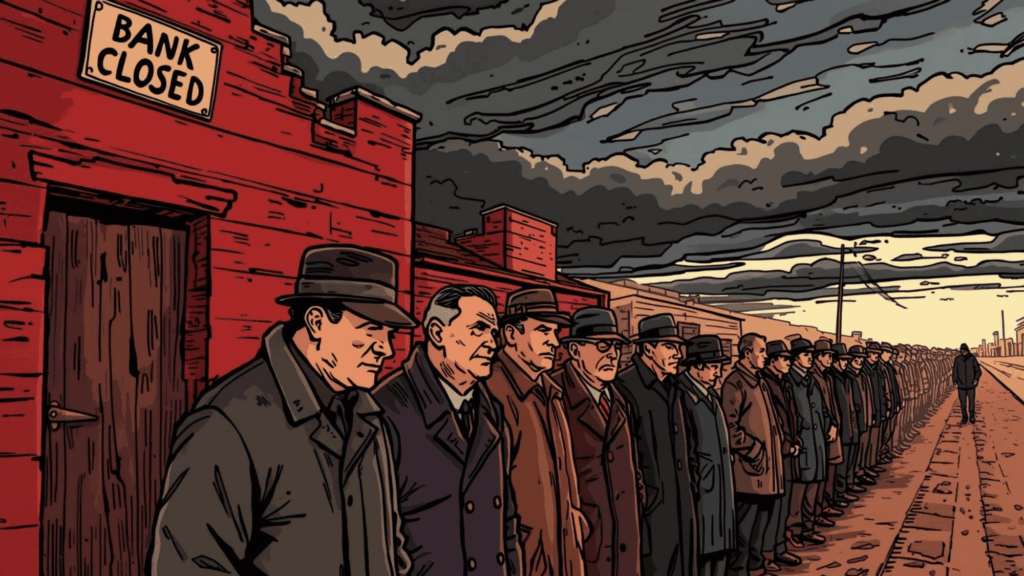
The human picture was stark. Families who had been comfortable working-class households in 1928 found themselves standing in bread lines by 1932. Men in suits — former office workers and managers — waited alongside factory workers for a bowl of soup. Tent cities, mockingly called Hoovervilles after President Herbert Hoover, appeared on the edges of major American cities. Children went to school hungry. Entire communities collapsed.
The Great Depression was not an abstraction. It was a lived experience, and millions of Americans carried its lessons about financial fragility and insecurity for the rest of their lives.
The Definition of Recession You Never Heard Before…
Read Article →How the Banking System Collapsed
One of the most destructive forces of the Great Depression was not unemployment itself, but the chain reaction that destroyed the banking system.
American banks in the 1920s had operated with very little federal oversight. Many had made risky loans to stock market speculators and extended credit far beyond what was prudent. When the crash came, and borrowers could not repay, banks began to absorb losses. Word spread quickly that certain banks were in trouble. Depositors, fearing they would lose their savings, rushed to withdraw their money.
Picture a bank run in practical terms. Hundreds of depositors flood the sidewalk outside a branch, each one determined to pull their savings out before the doors close for good. The problem is structural. Banks lend out the vast majority of the money people deposit, keeping only a fraction on hand at any given time. A simultaneous rush of withdrawals overwhelms that reserve instantly. The bank stops paying. It closes. News of that closure sends depositors at neighboring institutions into the same panic, and the cycle repeats across the city and then across the country.
Between 1930 and 1933, more than 9,000 American banks failed. Every failure wiped out the savings of everyone who had money deposited there. Working families who had spent years saving lost everything overnight, not because of bad investments, but simply because their bank collapsed. The history of the Great Depression is impossible to tell without understanding how completely this destroyed ordinary people’s financial lives.
Credit dried up. Businesses could not borrow to make payroll or expand operations. Farmers could not get loans to buy seed for the next season. The country’s economic engine seized up because the financial infrastructure that powered it had been destroyed from within.
The Dust Bowl: When Nature Made Everything Worse
While the financial system was collapsing, the American Great Plains were experiencing an environmental catastrophe that worsened the economic Depression for millions of farming families.
Throughout the 1920s, farmers aggressively expanded into the semiarid grasslands of Oklahoma, Texas, Kansas, Colorado, and the surrounding region. They plowed under the native grasses that had held the soil in place for centuries. When the rains stopped coming in the early 1930s, the exposed topsoil had nothing anchoring it. The wind did the rest.
Massive dust storms, sometimes called black blizzards, swept across the Great Plains. These were not ordinary sandstorms. Some storms stretched hundreds of miles wide and thousands of feet high, turning afternoon into complete darkness. The dust buried farm equipment, suffocated livestock, and filled houses through every crack and gap. Families stuffed wet rags under doors and taped newspaper over windows, but the dust got in anyway.
The Dust Bowl displaced hundreds of thousands of farm families. Many packed what they could into their cars and drove west to California, chasing the promise of agricultural work. What they found instead was more hardship — competition for scarce farm labor jobs, hostile reception from local communities, and wages so low that families could not afford basic necessities. John Steinbeck documented their experience in The Grapes of Wrath. Still, the reality behind the novel was even harder than the fiction.
The Dust Bowl compounded the Great Depression in practical terms. Farming communities that had been struggling financially were now economically and physically destroyed. Entire counties lost their populations. Agricultural output dropped sharply. Food prices, which had been falling with deflation, now faced supply pressures from ruined harvests.
How the Great Depression Spread Around the World
The history of the Great Depression does not belong only to the United States. The economic collapse spread rapidly across the globe, hitting some countries as hard or harder than America.
The international spread happened through several channels. American banks had loaned significant sums to European governments and businesses throughout the 1920s, particularly to Germany, which had been struggling to pay war reparations since the end of World War I in 1918. When American banks began failing and credit dried up, that flow of money to Europe stopped. German banks and businesses, heavily dependent on American credit, began to fail in turn.
Germany suffered some of the most devastating economic consequences of the Great Depression. Unemployment rose to above 30 percent. The political stability of the Weimar Republic, already fragile, buckled under the weight of mass unemployment and economic despair. The conditions created by the economic Depression opened the door to political extremism. By 1933, Adolf Hitler and the National Socialist Party had seized power, partly on the strength of populist economic promises. The causes of the Great Depression, therefore, connect in a direct and documented chain to the rise of fascism in Europe.
The United Kingdom experienced its own severe contraction. Industrial regions like South Wales, the northeast of England, and central Scotland, which depended on coal, steel, and shipbuilding, saw unemployment rise sharply. The British government initially pursued austerity, cutting government spending to balance the budget. This approach deepened the suffering rather than relieving it.
Canada, Australia, and Latin American nations that depended on exporting raw materials and agricultural goods to the United States also experienced severe economic contractions. Global trade collapsed. Between 1929 and 1932, world trade volumes fell by roughly 65 percent. Countries began raising tariffs to protect their domestic industries, further choking global commerce and worsening the economic Depression for everyone.
What Governments Tried First — and Why It Failed
Understanding what caused the Great Depression to last as long as it did requires examining the policy responses that made it worse. Governments on both sides of the Atlantic initially made the same fundamental mistakes.
In the United States, President Herbert Hoover’s administration believed that the economy would correct itself naturally if the government stayed out of the way. This was the dominant economic thinking of the era — that markets were self-regulating and government interference would only delay recovery. Hoover was not indifferent to suffering. He encouraged voluntary private relief efforts and tried to maintain business confidence through speeches. But he resisted large-scale federal spending programs, fearing they would unbalance the budget and undermine business confidence.
Meanwhile, the Federal Reserve, the United States’ central bank, made a catastrophic error. Rather than expanding the money supply to fight deflation and stimulate economic activity, the Fed raised interest rates in 1931, partly to defend the gold standard. Raising interest rates during a depression reduced the money available for lending and investment, worsening the contraction. Economists widely regard this as one of the most damaging policy mistakes in American economic history.
Trade policy delivered another blow in 1930. The Smoot-Hawley Tariff Act pushed duties on imported goods to some of the steepest levels in American history, a move designed to buffer domestic producers from foreign competition. Other nations responded by closing their own markets to American goods. Exports collapsed. Global commerce seized up further. A financial crisis that had started inside American borders spread outward with added force, accelerated by governments choosing protectionism at precisely the moment when open trade was most needed.
TThe Central Bank Has A Hidden Power…
Read Article →What the New Deal Was and What It Changed
Voters had seen enough by November 1932. Roosevelt swept into office on a mandate for change; his campaign was built around the argument that the federal government could not keep watching from the sidelines. He inherited a country in freefall — banks failing, breadlines growing, and no clear bottom in sight.
The New Deal, explained, is a series of federal programs, reforms, and regulatory changes implemented between 1933 and 1939 that used the power of the federal government to stabilize the financial system, put people back to work, and reform the rules of the economy to prevent future collapse.
Roosevelt moved on the banking crisis first. He declared a temporary bank holiday, shutting down every bank in the country to stop the bleeding from ongoing runs. The Emergency Banking Act followed quickly, giving federal examiners authority to assess each institution and permit only the financially sound ones to reopen. Roosevelt then went on national radio to explain what had happened and what the government had done about it, speaking in plain terms directly to American families. The response was immediate. Depositors began putting money back into banks within days. The panic, while not finished, had been interrupted.
The programs that followed were wide-ranging. The Civilian Conservation Corps put young unemployed men to work in national parks and forests. The Public Works Administration funded the construction of roads, bridges, hospitals, schools, and public buildings. The Works Progress Administration, later renamed the Works Progress Administration, employed millions of Americans in construction, arts, literacy programs, and other initiatives. These programs did not end the Great Depression. However, they provided income to millions of families and built infrastructure that the country still uses today.
Farm policy took a different approach. Federal programs paid farmers to scale back their output, pushing crop prices upward from the catastrophic lows that had been driving agricultural bankruptcies. Financial oversight followed on the securities side. A new federal body, the Securities and Exchange Commission, took authority over Wall Street in 1934, charged with policing the trading abuses and disclosure failures that had let speculation run unchecked through the 1920s.
The Debate About What Actually Ended the Great Depression
Here is where Great Depression history becomes contested, and where economists still disagree sharply. The question of what ended the Great Depression does not have one universally accepted answer.
The traditional view, associated with Keynesian economics, holds that government spending — particularly the enormous wartime expenditures that began when the United States entered World War II in 1941 — finally provided enough economic stimulus to pull the country out of the Depression. Defense spending rose from around $1.9 billion in 1940 to over $80 billion by 1945. Unemployment essentially disappeared as men were drafted into the military and women entered the workforce in large numbers to staff factories. This view argues that the New Deal moved in the right direction but was not large enough in scale to finish the job, and that only the full mobilization of wartime spending completed the recovery.
A second school of thought, associated with monetarist economists including Milton Friedman, argues that the Federal Reserve’s policy failures were the primary cause of the Great Depression’s severity, and that correcting monetary policy was the essential ingredient for recovery. In this view, the government spending debate is somewhat secondary to the question of whether the money supply was adequately managed.
A third perspective, often associated with more market-oriented economists, holds that the New Deal actually extended the Depression by creating uncertainty for businesses and distorting market signals. Proponents of this view argue that the recovery did not come until wartime clarity replaced the policy unpredictability of the New Deal years.
Most economic historians today hold a position somewhere between these views. The Great Depression was caused by multiple interacting factors, and the recovery required both fiscal stimulus and monetary stabilization working together. What virtually all economists agree on is that the Great Depression was not self-correcting on any reasonable timeline, and that government action — whatever its precise form and scale — was necessary to end it.
The Lasting Structural Changes That Came Out of the Depression
Even setting aside the debate over what ended the Great Depression, the structural reforms it produced reshaped the American economy in ways that endure to this day.
Deposit insurance was established in 1933 through the creation of the Federal Deposit Insurance Corporation, now universally known as the FDIC. The mechanism is straightforward: if a bank fails, the FDIC insures deposits up to a defined limit, so families do not lose their savings simply because their institution becomes insolvent. That guarantee removed the primary trigger for bank runs. Depositors no longer had reason to panic at the first sign of trouble, because federal backing now stood between them and the total loss that had devastated millions of households during the Depression years.
Social security was established in 1935. Before Social Security, elderly Americans who could not work had no federal safety net. Many depended entirely on family members or charitable institutions. Social Security created a system of retirement income funded through payroll contributions, providing a baseline of financial security for older Americans that did not previously exist.
The banking structure itself was overhauled by the Glass-Steagall Act of 1933. Deposit-taking institutions were legally prohibited from engaging in securities trading and underwriting — two activities whose combination had generated dangerous conflicts of interest and concentrated risk, thereby amplifying the pre-Depression collapse. Portions of Glass-Steagall were dismantled in the late 1990s. Still, its original enactment represented a deliberate effort to redesign how financial institutions operated at a foundational level.
The Securities and Exchange Commission brought federal oversight to stock markets for the first time. Disclosure requirements, rules against insider trading, and oversight of investment products changed how Wall Street operated and gave ordinary investors a degree of protection that had not existed before.
These structural changes collectively represent the most significant reform of the American financial system in its history. They were born directly from the suffering of the Great Depression, and they have shaped how Americans save, invest, and rely on financial institutions ever since.
What the Great Depression Still Teaches Us Today
The history of the Great Depression is not just a record of past suffering. It is a living lesson about economic fragility, the limits of unregulated markets, and the role of policy in shaping outcomes for ordinary people.
The first lesson concerns how financial systems actually fail. The Depression made visible something that prosperity had hidden: economic institutions are deeply interconnected in ways that only become apparent when things go wrong. October 1929 was the ignition point, but the damage radiated outward fast. Lending markets tightened, bank balance sheets buckled, international trade routes closed, and factory payrolls evaporated in a chain reaction that outpaced every attempt to contain it. Damage at one point in the system accelerated damage at every other point, and no single household or business could see the full picture or protect against it on its own.
The second lesson concerns the danger of deflation and the trap it creates. Once prices start falling broadly and people expect them to keep falling, spending slows, production contracts, and unemployment rises. Breaking out of this trap requires deliberate action. Waiting for the economy to self-correct while families go hungry is not a viable policy option. This lesson shaped how central banks around the world now respond to financial crises.
The third lesson is about the value of automatic stabilizers. Programs like unemployment insurance, deposit insurance, and Social Security do not just help individuals. They prevent sharp drops in consumer spending that would otherwise accelerate economic downturns. When the economy contracts, these programs automatically inject spending, without waiting for legislation. The Great Depression built the case for these mechanisms by demonstrating what happens in their absence.
For individuals, the Great Depression left a generational lesson about financial resilience. People who lived through the Depression often carried habits of frugality, self-reliance, and distrust of financial institutions for the rest of their lives. They kept cash hidden in mattresses. They grew their own food. They avoided debt. They did not trust that prosperity was permanent. These behaviors were sometimes excessive, but they reflected a genuine and rational response to the sudden disappearance of financial security.
The practical implication for anyone reading this today is not anxiety but awareness. Economic conditions shift, sometimes faster than anyone expects. Emergency savings provide options when income disappears. Spreading risk across multiple institutions or income sources reduces exposure to a single point of failure. The protections that exist now — insured deposits, retirement programs, regulated markets — were not always there. They were built after a catastrophe proved their necessity. Engaging with those systems actively and thoughtfully is simply what it looks like to take the lessons of that period seriously.
From Crisis to Reform: What the Great Depression Left Behind
Ten years of economic Depression reshaped a country. The Great Depression transformed the relationships among American citizens and their government, among workers and employers, and among savers and banks. It produced legislation, institutions, and social programs that have outlasted every administration that followed Roosevelt’s. It changed the way economists think about recessions, the way central banks respond to financial crises, and the way governments weigh the costs of inaction.
It also left a human imprint. The generation that survived the Great Depression — that stood in bread lines, packed their families into cars, lost savings to failed banks, and watched dust bury their farms — carried those memories forward. They taught their children that security was not guaranteed, that prosperity required maintenance, and that financial fragility was always closer than it looked during good times.
The world recovered. It took a decade, a war, and a wholesale reinvention of economic policy to get there. But the recovery produced something the pre-Depression world had not possessed: a financial system with guardrails, a government with tools, and a society that had learned, at enormous cost, what happens when those protections are absent.
The Great Depression did not end with a celebration. It ended with the world mobilizing for another catastrophe. But the economic architecture built in its wake — the deposit insurance, the retirement programs, the market regulations — remains standing. That architecture is part of what stands between ordinary households and the kind of ruin that millions of people experienced between 1929 and 1939.
Understanding the Great Depression is not an academic exercise. It is the origin story of the financial safety net that most people today rely on without ever thinking about its origins.
Watch It Instead
The Money Nudge — YouTube Channel
Prefer watching over reading? Every topic on this blog also comes to life as an animated video on our YouTube channel — where we make money talk even more simply.
Visit Our Channel