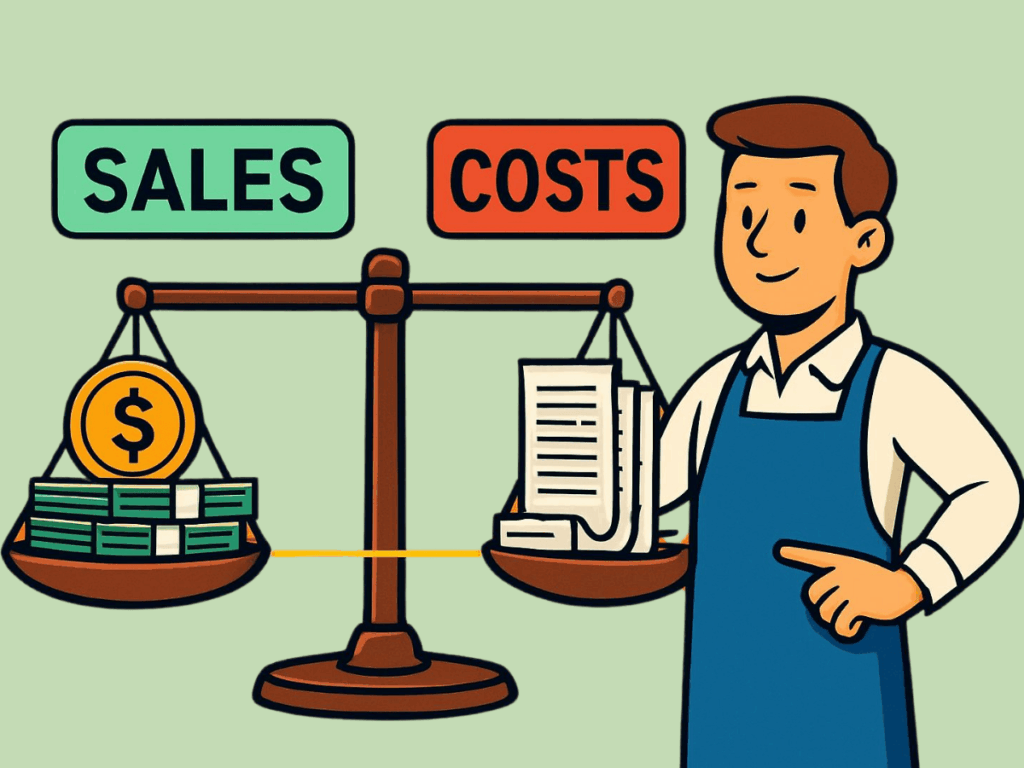
A small bakery has been open for six months. The owner arrives before sunrise, the display case fills with fresh croissants by seven, and customers walk in every single day. Sales happen. Receipts pile up. The register is busy. And yet, at the end of each month, the business bank account barely moves. The owner cannot figure out why. The shop appears successful on the surface, but something beneath the surface isn’t adding up.
That missing piece has a name. It is called the break-even point, and it is one of the most important numbers any business owner will ever calculate. Once you understand it, you will never look at your own business the same way again.
This article explains what the break-even point actually means, how to calculate it step by step, and why ignoring it is one of the fastest ways to run a business into the ground without realizing it.
Watch the Money Nudge YouTube Video about the definition of a Recession:
Prefer to watch instead of read?
Subscribe to The Money Nudge on YouTube for plain-English videos on money, investing, and economic topics.
Table of Contents
What the Break-Even Point Really Means
The break-even point is the exact moment when a business stops losing money and starts making a profit. It is the sales level at which total sales income equals total operating costs. Not a dollar of profit yet, but no loss either. Break-even is the financial finish line at which a business pays for itself in full.
Most new business owners assume that making sales automatically means making money. That assumption is what causes so many businesses to fail quietly. A shop can ring up hundreds of transactions a day and still operate below its break-even point. Every sale below that line leaves the business a little further behind, even when the register looks busy.
Think of the break-even point as the floor your business must stand on before it can start climbing. Below the floor, every day of work is absorbed by costs. Above the floor, every additional sale turns into real profit.
For the bakery example, imagine the owner learns that the shop needs to sell 1,200 pastries each month just to cover rent, utilities, ingredients, labor, and all other expenses. At 1,199 pastries sold, the bakery loses money. At 1,201, it finally earns a tiny profit. That single unit makes the difference between falling behind and moving forward.
There Is ONE Clear Difference Between Revenue and Profit…
Read Article →Why Knowing Your Break-Even Point Is Non-Negotiable
Break-even analysis is often the difference between a business that grows and a business that silently drains its owner’s savings. Running a company without knowing this number is like driving cross-country with no fuel gauge. You may make it a long way, but you will never know when the tank is about to run dry.
Here is why break-even matters so much, both before launching a business and after it has been running for months or years.
Before launch, the break-even calculation tells you whether your business idea is financially realistic. If your numbers show that the business must sell 8,000 units every month to survive, and your local market can only reasonably support 3,000, you have learned something crucial before spending a single dollar on inventory. That kind of early clarity saves entrepreneurs from disasters that look avoidable only in hindsight.
After launch, the break-even point becomes a constant compass. It tells you whether your prices are working, whether your costs are under control, and whether your sales volume is enough to sustain the business. Every month of operation should be measured against this line. If you consistently fall short, something has to change. If you consistently clear it, you have room to grow.
Many business owners run their companies on feel rather than numbers. They sense when things are good and worry when things feel slow. The break-even point replaces that guesswork with math. It shows exactly how close or far the business is from financial health on any given day.
A second reason break-even matters is that it forces a business owner to separate emotion from strategy. A product you love making might be lovely, but if the break-even math shows the price cannot realistically be reached, that insight is worth more than any gut feeling. Break-even analysis is the honest friend every business owner needs.
This is where You Will Find The Real Difference Between Finance and Accounting…
Read Article →The Two Types of Costs That Drive the Break-Even Point
Every break-even calculation starts with understanding two basic cost categories: fixed costs and variable costs. A separate Money Nudge article covers these in full detail, but here is the short version you need to follow this one.
Fixed costs remain the same regardless of how much the business sells. Rent, insurance, software subscriptions, base salaries, and equipment leases are all fixed costs. The bakery pays the same rent whether it sells zero pastries or 2,000 in a month. These costs exist simply because the business exists.
Variable costs rise and fall with sales volume. Ingredients, packaging, shipping, payment processing fees, and hourly wages tied to production all change with activity. The more pastries the bakery makes, the more flour, butter, and sugar it uses. Each sale carries its own slice of variable cost baked in.
Understanding the split between these two cost types is essential because the break-even formula treats them very differently. Fixed costs act like a mountain the business must climb. Variable costs act like a backpack the business carries on every single sale. The break-even point is the moment the business reaches the top of the mountain with the backpack still on its shoulders.

This Difference Between Variable Vs. Fixed Expenses Will Change How You Think…
Read Article →How to Calculate the Break-Even Point: The Formula Explained
Calculating break-even does not require accounting software or a finance background. The break-even formula is simple, and with one clear example, anyone can follow it.
Here is the classic break-even formula in units:
Break-Even Point (in units) = Fixed Costs ÷ (Price per Unit − Variable Cost per Unit)
The bottom part of the formula, price minus variable cost, has its own name. It is called the contribution margin. The contribution margin is the amount each sale contributes toward covering fixed costs after variable costs are paid. Once fixed costs are fully covered by contribution margins, every additional sale becomes profit.
Now, let us walk through this with the bakery example.
Step 1: Add Up the Fixed Costs
The bakery owner sits down and lists every monthly cost that stays the same regardless of sales volume:
- Rent: $2,500
- Utilities: $400
- Insurance: $150
- Equipment lease: $300
- Base salary for one part-time employee: $1,500
- Accounting software and bank fees: $150
Total fixed costs equal $5,000 per month.
Step 2: Identify the Price per Unit
The bakery sells each pastry for $5.00. That is the price per unit.
Step 3: Calculate the Variable Cost per Unit
For every pastry sold, the bakery spends money on ingredients, packaging, and a small share of payment processing:
- Ingredients: $1.50
- Packaging: $0.25
- Payment processing: $0.25
The variable cost per pastry is $2.00.
Step 4: Find the Contribution Margin
Contribution margin equals $5.00 minus $2.00, which equals $3.00 per pastry. Every pastry sold contributes $3.00 toward covering the $5,000 in fixed costs.
Step 5: Apply the Break-Even Formula
Break-Even Point (in units) equals $5,000 divided by $3.00, which equals approximately 1,667 pastries per month.
The bakery must sell 1,667 pastries every month to break even. At 1,666 pastries, the shop loses a few dollars. At 1,668 pastries, it finally breaks even. Every pastry above 1,667 generates $3.00 in pure profit for the business.
How to Calculate Break-Even in Revenue Dollars
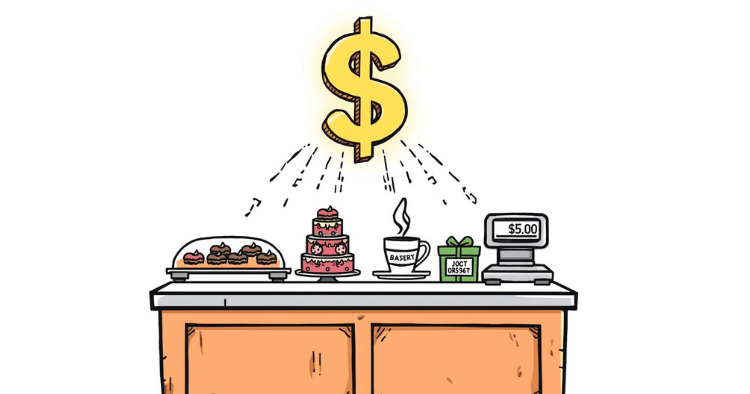
Sometimes a business needs to know the break-even point as a dollar amount rather than a unit count. This version of the break-even calculation is especially useful for businesses that sell many products at different prices, such as a full bakery offering pastries, cakes, coffee, and custom orders.
The break-even formula in revenue dollars looks like this:
Break-Even Point (in dollars) = Fixed Costs ÷ Contribution Margin Ratio
The contribution margin ratio is simply the contribution margin per unit divided by the price per unit. It expresses, as a percentage, how much of each dollar of sales goes toward covering fixed costs and, eventually, toward profit.
Using the bakery numbers:
- Contribution margin per pastry: $3.00
- Price per pastry: $5.00
- Contribution margin ratio: $3.00 ÷ $5.00 = 0.60, or 60%
Now apply the formula: $5,000 divided by 0.60 equals approximately $8,333.
The bakery must generate $8,333 in monthly revenue to break even. Any dollar above $8,333 contributes to profit at a 60% rate, meaning 60 cents of every additional dollar in sales becomes profit once fixed costs are covered.
Both methods give the same answer in different forms. Selling 1,667 pastries at $5.00 each equals $8,335, which is essentially the same number. Unit break-even is easier for single-product businesses. Revenue break-even works better for businesses selling a mix of items at different prices.
What the Break-Even Point Reveals About Your Pricing
One of the most powerful uses of break-even analysis is the moment of truth it creates around pricing. Many small business owners set prices based on what competitors charge, what feels reasonable, or what they think customers will accept. Then they run the break-even calculation and realize the numbers do not work.
Imagine the bakery owner had priced each pastry at only $3.50 instead of $5.00. The variable cost per pastry is still $2.00, so the contribution margin drops to $1.50 per unit. Dividing $5,000 in fixed costs by $1.50 gives a break-even point of 3,334 pastries per month.
That is double the previous target. The bakery now needs to sell twice as much product every single day to keep the lights on. For many small operations, doubling the sales volume is not realistic. The shop cannot physically produce that many pastries, the neighborhood cannot support that demand, or the owner cannot work the extra hours needed.
This is the pricing trap that catches so many businesses. They undercut their own prices to attract customers, then discover the volume required to survive those prices is unattainable. The break-even point clearly and early exposes this flaw, before months or years of losses accumulate.
The insight cuts both ways. Sometimes a business finds that a small price increase, even 10% or 15%, dramatically lowers the break-even point and makes the entire operation more realistic. A $5.50 pastry instead of a $5.00 pastry shifts the contribution margin from $3.00 to $3.50. The break-even point drops from 1,667 units to about 1,429 units. That difference of 238 pastries per month can decide whether a business thrives or closes.
How the Break-Even Point Changes When Numbers Shift
Business conditions never stay still. Costs rise, prices change, and sales volume rises and falls with seasons and trends. The break-even point shifts whenever any of these variables changes. Running the break-even calculation regularly keeps a business grounded in reality.
Rising costs raise the break-even point. Suppose the bakery’s flour supplier raises prices, pushing variable cost per pastry from $2.00 to $2.50. The contribution margin drops from $3.00 to $2.50. The new break-even point becomes $5,000 divided by $2.50, which equals 2,000 pastries per month. The owner now needs to sell 333 more pastries to stand still. Without noticing this change, a business can start losing money while appearing to perform the same as before.
Raising prices lowers the break-even point. If the bakery raises its price from $5.00 to $5.75 while variable costs stay at $2.00, the contribution margin jumps to $3.75. The break-even point drops to about 1,334 pastries per month. Fewer sales are needed to cover costs, and every sale above that line produces more profit than before.
Higher sales volume creates a profit cushion. A bakery that normally breaks even at 1,667 pastries and sells 2,200 pastries has 533 units of pure profit built in. If the contribution margin is $3.00, that means $1,599 in monthly profit. A drop in sales to 1,700 pastries would still keep the shop barely profitable, while a drop to 1,500 pastries would push it into loss territory.
Running the break-even calculation every quarter, and especially after any major cost or price change, prevents a business from drifting into financial trouble without realizing it.
This is One of The Big Reasons Prices Shift…
Read Article →Setting Realistic Sales Targets With Break-Even Analysis
Break-even analysis is not just a survival tool. It is also a growth tool. Once a business knows its break-even point, the owner can set sales targets that are based on math rather than hope.
Here is how the bakery owner uses break-even to plan.
Start with the monthly break-even point of 1,667 pastries. Say the owner wants to pocket $3,000 on top of covering every fixed cost. Each pastry already adds $3.00 to the profit bucket once variable costs are covered. That means 1,000 extra pastries beyond break-even will cover the $3,000 goal. Stacking those numbers together gives a monthly sales target of 2,667 pastries.
That number translates into daily goals. Open 26 days a month, the bakery needs to sell about 103 pastries per day to hit the profit target. The owner now knows exactly how many customers, how much production, and how many working hours are required to reach the profit goal. That clarity turns a vague wish for a profitable month into a concrete plan.
Break-even analysis also guides bigger decisions. Should the bakery hire another employee? Only if the added fixed cost still allows the business to hit an achievable sales volume. Should the owner invest in a second oven? Only if the added capacity creates enough additional sales to justify the expense. Every major business decision can be filtered through the break-even lens before any money is spent.
This is how business break-even moves from a defensive calculation into an offensive strategy. It protects the business from losses and guides it toward smarter, steadier growth.
How Break-Even Looks Different Across Industries
The bakery is a helpful example because the numbers are simple and the product is easy to picture. But break-even looks very different depending on the type of business.
Consider a personal trainer who works independently. Fixed costs include only gym rental ($500 per month), insurance ($100), and a scheduling app ($50). Total fixed costs equal $650. The trainer charges $75 per session and has almost no variable costs per session, aside from perhaps $5 in supplies. The contribution margin per session is $70. The break-even point is $650 divided by $70, which equals about 10 sessions per month.
That is a dramatically lower break-even point than the bakery. Service-based businesses often have lower fixed costs and very high contribution margins, enabling them to break even with far fewer transactions. On the other hand, they typically cannot scale as quickly because each transaction requires personal time. A trainer cannot train fifty clients at once, the way a bakery can serve fifty customers in an hour.
Product, service, and subscription businesses all use the same break-even formula. Still, the shape of the math looks different in each case. Understanding your specific industry’s cost structure and pricing reality is what turns break-even analysis from a textbook exercise into a real-world tool.
Common Mistakes Business Owners Make With Break-Even
Even business owners who know about break-even analysis often make the same errors. Watching for these mistakes keeps the calculation honest and useful.
Mistake 1: Leaving out real fixed costs. Some owners forget to include small recurring expenses, such as software subscriptions, bank fees, or their own modest salary. Every missed cost lowers the break-even point on paper and creates a false sense of security. A thorough list of fixed costs is the foundation of any accurate break-even calculation.
Mistake 2: Underestimating variable costs. Packaging, payment processing, shipping, and small supplies add up quickly. Owners who count only raw materials as variable costs often end up with a contribution margin that appears healthier than it really is. Every cost that rises with sales volume belongs in the variable column.
Mistake 3: Treating the break-even point as a one-time calculation. Costs change. Prices change—sales change. A break-even point calculated at launch may be completely outdated six months later. The calculation needs to be refreshed whenever conditions shift, and at a minimum once per quarter.
Mistake 4: Ignoring the break-even point entirely. The most common and most damaging mistake is never running the calculation at all. A business without a break-even target has no way to measure whether it is succeeding or quietly failing. Sales alone do not tell the full story.
Mistake 5: Confusing break-even with profitability goals. Break-even only covers the cost of existing. It does not include the owner’s desired profit, the taxes set aside, or the money reinvested in growth. Reaching the break-even point marks the start of financial stability, not the end. Profit goals belong above the break-even line, not inside it.
Final Thoughts: The Line Every Business Must Cross
The break-even point is the single number that separates a busy business from a healthy one. Sales activity alone does not reveal whether a company is winning or losing. Only the break-even calculation draws the line that makes the difference visible.
For the bakery owner who started this article, the math eventually became clear. The shop was selling 1,400 pastries a month. The break-even point sat at 1,667. Every day felt productive, every sale felt meaningful, and yet the business was running at a loss of roughly $800 per month. Nothing was wrong with the product, the customers, or the effort. The numbers had not been run until it was almost too late.
Once the owner understood the break-even point, the path forward became obvious. A small price increase, a slight reduction in packaging cost, and a push for 15% more daily sales moved the bakery from monthly losses into steady monthly profit. The transformation did not come from working harder. It came from finally seeing the finish line clearly.
Break-even analysis gives every business owner that same clarity. It turns guesswork into math, hope into strategy, and busy days into measurable progress. The number itself is not the goal. Crossing it, understanding it, and using it to plan the next step is what good business management actually looks like.
And now, you have the tools to calculate exactly where your own break-even line sits.
Watch It Instead
The Money Nudge — YouTube Channel
Prefer watching over reading? Every topic on this blog also comes to life as an animated video on our YouTube channel — where we make money talk even more simply.
Visit Our Channel