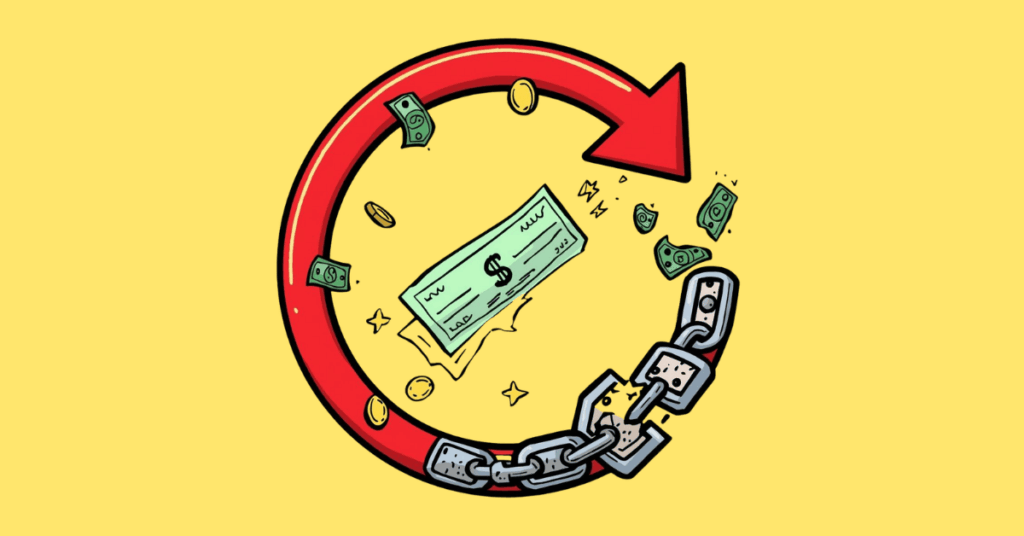
More than half of working adults in the United States run out of money before their next paycheck arrives. That number includes people earning six figures. Living paycheck to paycheck is not just a low-income problem. It is a structural trap that catches people across every income level, and the mechanics behind it are far more complex than most personal finance content acknowledges.
The paycheck to paycheck cycle does not start because someone bought too many lattes. It starts because modern financial life is designed around spending rather than saving. Understanding why this cycle begins and why it persists is the first step toward breaking it. This article walks through the mechanics, the psychology, and the practical moves that actually help.
Watch the Money Nudge YouTube Video about the definition of Finance:
Prefer to watch instead of read?
Subscribe to The Money Nudge on YouTube for plain-English videos on money, investing, and economic topics.
Table of Contents
What Living Paycheck to Paycheck Really Looks Like
The phrase “living paycheck to paycheck” gets tossed around a lot, but it is worth defining clearly. It means that most or all of each paycheck goes toward expenses, leaving little to no reserve. If a paycheck were delayed by even a week, bills would start going unpaid.
For some people, this looks like barely covering rent and groceries. For others, it looks like earning $90,000 a year, but still feeling a knot in the stomach every time an unexpected car repair shows up. The numbers on the paycheck are different, but the experience is strikingly similar. There is no financial buffer. There is no breathing room. Every dollar is already spoken for before it even hits the bank account. This is not a moral failing. It is a pattern, and patterns have causes.
Why the Paycheck to Paycheck Cycle Starts
Most explanations for the paycheck-to-paycheck cycle focus on personal choices. Spend less. Budget better. Stop eating out. Those suggestions are not wrong, but they skip the part that matters most: understanding why the cycle starts in the first place. Without that understanding, even well-meaning changes tend to fall apart within a few months.
Income That Barely Covers the Basics
For millions of workers, the math does not work. Housing costs have climbed faster than wages in most major cities over the past two decades. Health insurance premiums, childcare expenses, and transportation costs eat into take-home pay before discretionary spending even comes into play. When fixed costs consume 70 or 80 percent of income, the remaining margin is razor-thin. One price increase at the grocery store or one co-pay at the doctor can wipe out whatever was left over.
Living paycheck to paycheck in this scenario is not a budgeting problem. It is an arithmetic problem. The income side of the equation is too small relative to the cost side.
Why Every Personal Budget You Have Tried Has Failed (And What to Do Instead)
Read Article →The Spending Default
Even when income is adequate, the paycheck to paycheck cycle often starts because of how spending works by default. Most people do not sit down each month and deliberately allocate every dollar. Instead, money flows out through automatic subscriptions, habitual purchases, and social obligations. The spending happens on autopilot, and whatever is left at the end of the month becomes the “savings,” which is usually close to zero.
This default pattern is powerful because it requires no conscious decision. Nobody decides to live paycheck to paycheck. It just happens when spending is unmanaged, and income arrives at predictable intervals, creating a false sense of security.
Why the Cycle Persists Even When Income Rises
Here is where the conversation gets more interesting. Plenty of people escape entry-level wages, earn promotions, and take higher-paying jobs. Logically, their financial cushion should grow. But for many of them, the paycheck-to-paycheck cycle scales up. The reason comes down to two forces that operate quietly in the background.
Lifestyle Creep
Lifestyle creep is what happens when spending increases in lockstep with income. A $10,000 raise should create $10,000 in new breathing room. But in practice, that raise often triggers a series of small upgrades. A nicer apartment. A newer car. Better restaurants. A gym membership. Each upgrade feels reasonable on its own. Together, they consume the entire raise and sometimes more.
Lifestyle creep is not about greed or irresponsibility. Deeply human tendencies drive it. People compare themselves to peers in their new income bracket. They feel they have “earned” certain comforts. They respond to marketing that targets their exact demographic. The result is that a person earning $100,000 can feel just as financially squeezed as they did at $50,000, because their expenses expanded to fill the new income.
This is one of the most common reasons the paycheck to paycheck cycle persists at higher income levels. The gap between income and expenses never widens, because expenses always chase income upward.
The Absence of a Financial Buffer
The second force is the lack of a financial buffer. A financial buffer is money set aside specifically to absorb unexpected costs without disrupting regular cash flow. It is the difference between paying for a $1,200 car repair out of savings and putting it on a credit card at 22% interest rate.
Everything You Should Know About The Opportunity Cost
Read Article →Without a financial buffer, every surprise expense becomes a crisis. And those crises are not rare. They are routine. Cars break down. Medical bills arrive. Appliances fail. Pets get sick. The average household faces multiple unplanned expenses every year, and each one resets the clock on financial progress.
This creates a frustrating loop. Someone starts building a small cushion, but an unexpected cost drains it. They start over, rebuild, and another expense arises. After a few rounds of this, it begins to feel pointless. Many people stop trying to save altogether, which firmly locks the paycheck-to-paycheck cycle into place.
The Psychology That Keeps People Stuck
The paycheck to paycheck cycle is not purely a math problem. Psychology plays an enormous role in keeping people trapped, even when the numbers suggest they could break free.
Present Bias
Humans are wired to prioritize immediate rewards over future benefits. A purchase that feels good today consistently wins against a savings goal that pays off in five years. This tendency, called present bias, makes it genuinely difficult to redirect money toward goals that feel abstract or distant. Telling someone to “just save more” ignores the fact that their brain is actively working against that decision in the moment.
Decision Fatigue
Managing money on a tight margin is exhausting. Every purchase requires mental calculation. Every bill requires juggling. Every week involves micro-decisions about what to pay now versus what to delay. This constant mental load creates decision fatigue, which, over time, degrades the quality of financial decisions. By the end of a long week, the willpower needed to make optimal money decisions is depleted. That is when impulse purchases happen, and careful plans unravel.
Shame and Avoidance
Many people who are living paycheck to paycheck feel a deep sense of shame about their financial situation. That shame often leads to avoidance. They stop checking bank balances. They ignore bills. They avoid conversations about money with partners or family. This avoidance makes the problem worse because small issues grow into larger ones when left unaddressed. A $50 overdraft becomes a $200 fee spiral. A missed payment can damage your credit score.
The shame is misplaced, but it is real, and it has measurable financial consequences.
How Unexpected Expenses Keep Resetting Progress
One of the most discouraging aspects of the paycheck-to-paycheck cycle is how unexpected expenses function as a reset button. Understanding this dynamic is essential because it explains why so many attempts to break the cycle fail.
Consider someone who manages to save $500 over two months of careful budgeting. Then their car needs new brakes. The repair costs $480. They are right back where they started. The next month, a medical co-pay takes another chunk. The month after that, their child needs school supplies and new shoes.
None of these expenses is extravagant. None of them represents poor decisions. They are simply the normal cost of living. But without a large enough financial buffer to absorb them, each one feels like a punch to the gut. The emotional toll is significant, and it contributes directly to the sense that saving is futile.
This reset effect is the core mechanism that keeps the paycheck-to-paycheck cycle running. Breaking it requires not just saving a little bit of money, but building a buffer large enough to survive several unexpected expenses in a row without collapsing back to zero.
How to Stop Living Paycheck to Paycheck
Now that the mechanics and psychology are clear, the practical steps become much more effective. These are not generic tips. They are targeted responses to the specific forces that sustain the cycle.
Step 1: See Where the Money Actually Goes
Before anything changes, there needs to be a clear picture of current spending. Not a guess. Not an estimate. An actual accounting of where every dollar went over the last 30 to 60 days.
Most people are surprised by what they find. Subscriptions they forgot about. Spending categories are twice what they assumed. Small daily purchases that add up to hundreds per month. This exercise is not about judgment. It is about information. Nobody can redirect money they cannot see.
Bank and credit card statements provide the raw data. Sorting expenses into categories such as housing, food, transportation, subscriptions, and discretionary spending reveals the true picture.
Step 2: Build a Starter Financial Buffer
The single most important step in breaking the paycheck-to-paycheck cycle is building a financial buffer. This does not need to start big. Even $500 set aside in a separate account changes the dynamic. It means the next unexpected expense does not go on a credit card. It means one car repair does not unravel the entire month.
The key is treating the financial buffer like a non-negotiable expense. It is not what is left over after everything else. It is a line item that gets funded first, even if the amount is small. Twenty dollars per paycheck is a starting point. The habit matters more than the amount in the early stages.
A high-yield savings account is a practical place to park a financial buffer because it earns some return while remaining easily accessible. The goal is separation from everyday spending, not maximum investment returns.
Step 3: Freeze Lifestyle Creep
For people whose income is adequate but whose expenses have expanded to match it, freezing lifestyle creep is critical. This means making a deliberate decision: the next raise, bonus, or income increase does not trigger a spending increase. It goes directly into the financial buffer or toward debt reduction.
This single rule can transform a financial trajectory over two or three years. A person who redirects two annual raises entirely into savings can build a meaningful cushion without changing their current standard of living. They were already living on the previous income. They can continue doing so.
Step 4: Automate the Gap
Relying on discipline alone rarely produces lasting results. Motivation fades, busy weeks stack up, and the money that was supposed to move into savings stays in checking and gets spent. A better approach is to remove the decision entirely. Schedule an automatic transfer into a separate savings account on each payday, so the money moves before you have a chance to spend it on something else.
Automation removes the decision from the equation. The money moves before the temptation to spend it arrives. Over time, this creates a growing buffer without requiring constant mental effort. People who automate their savings consistently outperform those who rely on manual transfers, because the system works even when motivation does not.
Step 5: Address High-Interest Debt
Credit card debt and other high-interest obligations act as an anchor on the paycheck-to-paycheck cycle. When a significant portion of each paycheck goes toward interest payments, less money is available for everything else. Reducing high-interest debt frees up cash flow, accelerating the build-up of a financial buffer.
Two common approaches to paying down debt exist. One focuses on the smallest balance first to build momentum through quick wins. The other targets the highest interest rate first to minimize total interest paid over time—both work. The best approach is the one that keeps someone engaged and consistent.
Step 6: Create a Spending Plan That Reflects Reality
Traditional budgets often fail because they are built on ideal scenarios rather than real life. A more effective approach is a spending plan that accounts for irregular expenses. Car maintenance, medical costs, holiday gifts, and annual subscriptions are not surprises. They happen every year. They do not happen every month.
Adding a monthly allocation for irregular expenses smooths out the financial landscape. If car maintenance averages $1,200 per year, setting aside $100 per month means the next repair bill does not create a crisis. This approach directly addresses the reset effect that keeps the paycheck-to-paycheck cycle in motion.
Breaking the Paycheck Cycle Is a Process, Not a Single Decision
One of the most important things to understand about breaking the paycheck cycle is that it does not happen overnight. There is no single action that instantly transforms the situation. It is a gradual process of building systems, shifting habits, and growing a financial buffer large enough to absorb the inevitable unexpected costs.
The first few months are the hardest. The financial buffer is small, and progress feels slow. Unexpected expenses still show up. The temptation to abandon the plan is real. But each month that the system stays in place, the position gets a little stronger. The buffer grows. The stress decreases. The cycle loosens its grip.
People who successfully break the paycheck-to-paycheck cycle almost always describe the same turning point. It is the moment when an unexpected expense arrives and, for the first time, it does not cause a financial emergency. The buffer absorbs it. Life continues. That moment is worth the effort it takes to get there.
What This Looks Like Over Time
The difference between staying in the paycheck-to-paycheck cycle and breaking out of it compounds over the years. Someone who builds a $1,000 financial buffer in Year 1 and gradually adds to it reaches a point where three months of expenses are covered. At that point, a job loss or major expense is stressful but not catastrophic.
Beyond the financial buffer, the habits that break the cycle also create new possibilities. Money that used to go toward credit card interest becomes available for investing. Income increases that used to disappear into lifestyle creep start generating real wealth. The same person who once panicked over a $400 car repair now contributes to a retirement account and watches it grow.
This is not a story about deprivation. It is a story about redirecting money from places where it disappears to places where it works. The total income amount does not need to change. The direction does.
Final Thoughts
The paycheck-to-paycheck cycle is not a character flaw. It is a predictable result of specific financial forces: income that barely covers fixed costs, spending that expands with every raise, the absence of a financial buffer, and unexpected expenses that reset progress. Layer in the psychological tendencies toward present bias, decision fatigue, and shame-driven avoidance, and the trap becomes clear.
Understanding those forces is what makes breaking the paycheck cycle possible. The steps themselves are not complicated. Track spending. Build a small buffer. Freeze lifestyle creep. Automate savings. Address high-interest debt. Plan for irregular expenses. None of these requires advanced financial knowledge. They require awareness of the forces working against progress and a system designed to counteract them.
Every person starts from a different place. Every timeline is different. But the mechanics of the trap are the same, and so are the mechanics of escape. The first step is recognizing what is actually happening. The rest follows from there.
Watch It Instead
The Money Nudge — YouTube Channel
Prefer watching over reading? Every topic on this blog also comes to life as an animated video on our YouTube channel — where we make money talk even more simply.
Visit Our Channel