APR appears on nearly every financial product a person encounters, including credit card offers, loan agreements, mortgage disclosures, and bank advertisements. The number sits in bold type, prominently placed, designed to be seen. Yet most people glance past it without fully understanding what it measures or why it matters. That gap is expensive. APR is not just another way of expressing an interest rate. It captures the true annual cost of borrowing, including fees that the interest rate alone never reveals. Understanding it changes how financial products get compared and how borrowing decisions get made.
If you already understand what an interest rate is, APR is the natural next step.
Prefer to watch instead of read?
Subscribe to The Money Nudge on YouTube for plain-English videos on money, investing, and economic topics.
Table of Contents
APR What Is It? A Simple Explanation
APR stands for Annual Percentage Rate. The simplest way to describe it is this: APR shows the total cost of borrowing money across one full year, expressed as a percentage. When a loan advertisement lists “APR 7.5%” or a credit card offer shows “22%,” those numbers tell the borrower what the debt will cost on an annual basis.
A simple interest rate differs from APR in one important way. The annual rate often includes costs beyond the interest charged on the loan itself. Lenders may bundle origination fees, closing costs, broker fees, underwriting fees, and various administrative charges into the calculation, depending on the loan type. The result paints a more honest and complete picture of what the borrower actually pays. The interest rate names the price of the money. APR names the price of the money plus the fine print.
A short example brings the difference to life. Suppose someone borrows $10,000 at a 6% interest rate. The deal sounds clean on the surface. Then the lender adds a $500 origination fee, and the true cost of that loan rises above 6%. The annual figure absorbs the fee and spreads it across the life of the loan. The published APR might settle at 6.8% or even 7%, despite a stated interest rate of 6%. That extra fraction of a percent represents the fee, expressed as an annual rate.
A Simple And Clear Explanation About Interest Rate
Read Article →Credit cards offer a second example that works just as cleanly. A card might advertise a 20% interest rate. The annual figure often matches at 20%, since most cards skip upfront loan fees. The picture changes the moment a balance survives past the due date. That 20% then becomes the running yearly price of the unpaid debt. Carry $5,000 on that card with only minimum payments, and the interest charges stack up fast. APR is what makes the size of that ongoing cost visible before it ever becomes painful.
Comparison is where APR earns its keep. Picture two lenders pitching competing mortgages. One offers a 5.5% interest rate but loads the deal with heavy closing costs. The other offers 5.75% with very light fees. The lower interest rate grabs attention first. Line up the two annual figures side by side, though, and the second loan often turns out cheaper overall, because the smaller fee load drags its true price down below the flashier rate.
The number did not appear by chance. Before disclosure rules existed, lenders could advertise a tempting interest rate and then quietly recover their margin through fees buried elsewhere in the paperwork. The loan looked cheap on the page. The borrower discovered the real price only after signing. Regulators stepped in to fix that imbalance.
The Truth in Lending Act in the United States forced lenders to disclose borrowing costs in a single, uniform way. The reasoning was direct. Two lenders could quote the same interest rate while charging wildly different real prices for an identical loan, and borrowers had no reliable way to tell them apart. APR closed that gap by requiring every lender to use the same method and to publish the result as a single comparable number. Many other countries enforce similar disclosure rules under different names, which is why the measure shows up on financial products around the world.
APR Versus Interest Rate and APY: Three Terms People Mix Up
The confusion between an interest rate and an APR trips up a remarkable number of otherwise careful people, so this distinction deserves a slow walk through. An interest rate measures the percentage a lender charges on the amount borrowed. Take out a loan at 6%, and that rate governs how interest accumulates on the outstanding balance over time.
APR reaches past interest alone. It blends the interest rate with certain required fees, then spreads the total across the life of the loan and presents it as an annual cost. Two loans can both advertise a 6% interest rate, yet end up priced very differently. The first carries no fees—the second tacks on an upfront origination charge. The interest rates match, the real costs do not, and the annual figure is the tool that drags that hidden gap into the open.
The relationship between the two builds layer by layer. An interest rate describes the cost of borrowing in clean theory. APR describes how borrowing behaves once fees and other real costs are factored in. That progression is exactly why the topic follows naturally after learning about interest rates. One concept is the foundation. The other shows the foundation standing out in the weather.
How To Break Out Of The Paycheck-To-Paycheck Trap.
Read Article →A small example seals the idea. Borrow $1,000 for one year at a 10% interest rate with no fees attached. Twelve months later, the interest comes to $100, and the total repayment lands at $1,100. The interest rate and APR are nearly the same here because nothing extra was added to the deal.
Now change one thing. Keep the 10% interest rate, but let the lender add a $50 fee at signing. The interest still totals $100, yet the real cost of borrowing that $1,000 climbs to $150 for the year. The annual figure captures the extra charge and rises above 10% as a result. The loan amount held steady. The interest rate held steady. The yearly cost moved. That movement is the whole point.
Lenders love to lead with the interest rate because the smaller, simpler number looks friendlier in an advertisement. Leaning solely on that number can mislead the borrower. APR delivers the honest comparison that the advertisement leaves out. Set two products side by side, and the annual figure shows which one actually costs less over time. It also shields the borrower from quiet fees and clever marketing built to make an expensive loan look like a bargain. Between two similar loans, the one with the lower APR usually wins.
One more term belongs in this conversation, because people constantly swap it for APR. APY, or Annual Percentage Yield, runs in the opposite direction. APR measures what debt costs the consumer. APY measures what savings or investments earn for the consumer. One drains the wallet. The other fills it. That contrast is precisely why loans advertise APR and savings accounts advertise APY. Spotting which term applies tells a reader instantly whether a number is working for them or against them.
How APR Works on Credit Cards
Most people meet APR for the first time on a credit card statement, and credit cards are where the number turns most expensive. A card showing a 22% APR means that carrying a balance for a full year costs 22% of that balance in interest. The mechanics underneath that figure work a little differently from the mechanics on a fixed loan, and the difference matters more than it first appears.
Credit card interest accrues daily rather than annually. The card issuer divides the annual rate by 365 to find the daily rate, then adds interest to the balance every day the debt remains unpaid. That daily compounding is the engine behind how quickly card debt swells, even on a balance that does not look alarming at first glance.
The arithmetic makes the engine visible. Divide a 22% rate by 365, and the daily periodic rate lands near 0.0603%, on a $3,000 balance, which comes to roughly $1.81 of interest on the very first day. The next day, that interest is added to the balance, and the same calculation is run again on the slightly larger total. Repeat the cycle for 30 days, and the month closes with nearly $54 in interest charges. Scale the balance up, add fresh purchases before the old balance clears, and the figure grows faster still.
The 1987 Black Monday Was Marked in The Stock Market History
Find Out Why…
Read Article →Clear the full statement balance before the due date, and APR barely matters. No interest lands on a card that never carries debt from one billing cycle into the next. Let the balance roll over, though, and the picture flips hard. The rate suddenly governs how fast the debt grows and how much it will eventually cost to escape.
A closer look at the numbers drives the point home. Picture a $5,000 balance on a card charging a 24% APR. That rate generates roughly $100 in interest during the first month alone. A typical minimum payment on that balance might land near $125. Strip out the interest, and only about $25 actually chips away at the debt. The next month opens at $4,975, and interest runs again on that nearly unchanged figure. At that crawl, the balance can take decades to clear, and the total interest paid can quietly surpass the original $5,000. That math explains why consumer advocates and personal finance educators treat high-rate card debt as the most urgent form of debt to confront.
Context helps put these numbers in perspective. Credit card rates tend to run far higher than rates on most other borrowing. A mortgage might sit in the single digits. A car loan often lands somewhere in the middle. A credit card, by contrast, frequently climbs past 20% and sometimes higher still.
The reason traces back to risk. The house backs a house loan, and a car loan is backed by the vehicle, so the lender can recover something if payments stop. A credit card is backed by nothing but a promise to repay. The lender carries more risk on that promise, and the price of borrowing rises to reflect it. That single fact explains why financial educators rank credit card balances at the top of the list of debts to clear first, ahead of slower, cheaper debts like a mortgage or a federal student loan.
How APR Shapes Loans for Cars, Homes, and Education
Credit cards are far from the only place where APR appears. Car financing, home mortgages, personal lending, and student debt all rely on the same annual figure to tell borrowers how much their money will cost them.
Personal loans usually build the rate around an origination fee charged at the start. The fee may not feel like interest, yet it still raises the true cost of borrowing and lands inside the published APR all the same. Auto loans carry a lower rate than credit cards, which makes the number feel almost trivial. Stretch the loan across five or six years, though, and a tiny gap stops looking tiny. The extra cost on a long car loan can climb into the hundreds or even the low thousands by the time the final payment clears.
Student debt adds its own wrinkle. Federal student loans in the United States carry a fixed rate set by Congress each year, and the rate holds steady for the full life of the loan. Private student loans behave less predictably. A private lender may attach a fixed or a variable rate, and the figure often runs higher, since the borrower is frequently a young person with a thin credit history and no track record to reassure the lender.
Simple Steps To Raise Your Credit Score
Read Article →Mortgages push the comparison to its highest stakes. A homeowner financing $300,000 over thirty years feels even small APR gaps as enormous dollar swings by the end of the term. Stretch a tiny rate gap across thirty years, and a six-figure balance, and the dollar damage stops being theoretical. The final tally on a high-rate mortgage can outrun a low-rate version by a sum large enough to buy a second car, fund a child’s first year of college, or seed a retirement account from scratch. That weight is exactly why seasoned mortgage shoppers study the annual figure far more closely than the headline interest rate that dominates the billboard.
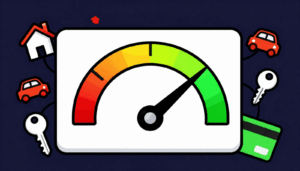
One factor shapes the rate a borrower receives more than almost any other. A credit score signals to lenders how reliably a person has repaid debt in the past. Higher scores tend to unlock a lower rate, since the lender sees less risk in lending. Lower scores tend to lead to a higher rate, because the lender prices in a greater chance of missed payments. Two people can walk into the same bank, ask for the same loan, and walk out with very different APRs based on nothing more than their borrowing histories. The number on the offer is personal, not universal.
Consider how that plays out for two coworkers buying the same $30,000 car. The first has spent years paying bills on time and qualifies for a 5% rate over five years. The second has a few late payments on record and gets offered 11% over the same term: same car, same dealership, same loan length.
By the time of the final payment, the second buyer has paid thousands more in interest than the first, purely because the lender read their histories differently. The car never changed. The cost of the money did. Stories like that one explain why a borrower with the time to improve a credit score before a major purchase often saves far more than any coupon or sticker discount could ever deliver.
The same logic rewards borrowers who shop around. A single lender produces a single offer, and that offer reflects one company’s appetite for risk on one particular day. Two or three lenders looking at the same borrower can return noticeably different numbers, since each one weighs credit history, income, and loan type through its own formula.
Many lenders allow a borrower to check an estimated rate without a hard credit pull, a process often labeled pre-qualification, which lets someone compare offers before committing to anything. Gathering a few of those estimates and lining them up side by side costs little more than an afternoon, and the gap between the best and worst offer can easily run into real money over the life of a loan. The borrower who treats a loan like any other major purchase, by comparing before buying, tends to walk away with the better deal.
Fixed APR, Variable APR, and Introductory Offers
Another layer of the story turns on whether the rate stays put or moves over time. A fixed APR stays the same for the life of the loan. The interest cost remains predictable, keeping budgeting simple and avoiding nasty surprises down the road. Personal loans and auto loans commonly have fixed rates, giving borrowers a payment they can count on month after month.
A variable APR behaves very differently. It shifts over time in response to a benchmark, which means the cost of the same balance can drift upward without any change in the borrower’s behavior. Credit cards lean heavily on this structure. A cardholder can watch the price of an unchanged balance creep higher, even after a month with no new purchases.
The benchmark behind most variable rates rewards a closer look. In the United States, a credit card variable rate usually tracks the prime rate, which moves alongside the Federal Reserve target for the federal funds rate. When the Federal Reserve lifts that target, the prime rate climbs, and the variable rate follows within a billing cycle or two. A cardholder who once carried a comfortable balance at 16% can suddenly face 19% or 20% after a string of central bank increases.
A fixed rate shields a borrower from that kind of move, yet it usually starts a little higher to compensate the lender for absorbing the risk. The trade between certainty and potential savings sits at the heart of every fixed-versus-variable decision. A borrower who values a steady, predictable payment tends to favor the fixed option. In contrast, a borrower who expects rates to fall or plans to pay off the debt quickly may prefer the variable rate.
Credit cards also dangle introductory offers, often advertised as 0% APR for the first 12 or 18 months. These deals can help with a planned large purchase or a balance transfer. They also hide conditions worth reading slowly. The rate usually leaps to a far higher level the instant the introductory window closes. Any balance still sitting on the card starts gathering interest immediately under the new terms. The promotion is not free money. It is a short window of opportunity that rewards discipline and punishes drift.
Balance transfers show the trap in sharp relief. Someone might move $6,000 of high-rate debt onto a card promising 0% for fifteen months. That move saves real money if the cardholder clears the debt before the window shuts. The math sours fast when the deadline arrives with a balance still in place. The APR may snap to 21% or higher, and some cards may go back and apply that rate to the entire transferred amount from day one, provided the original terms allowed it. Reading the fine print and mapping out a payoff plan that finishes ahead of the deadline are the two moves that turn an introductory offer into actual savings rather than a delayed bill.
What APR Cannot Tell You, and the One Rule Worth Keeping
For all its usefulness, APR does not tell the whole story, and a smart borrower keeps its blind spots in mind. The annual figure compares the yearly cost of loans cleanly enough. It does not reveal the total dollar amount a borrower will pay over the life of the loan. Two loans can share the same APR yet yield very different total interest costs, depending on how long repayment drags on. The number works best beside loan length and total repayment figures, never entirely on its own.
A second blind spot deserves attention. The calculation assumes the borrower keeps the loan for its entire scheduled term, but many borrowers do not. A homeowner might refinance, sell, or pay the mortgage off years early. When that happens, the fees the calculation spreads thinly across 30 years are actually paid in 5 or 10, which quietly pushes the real cost of that borrowing above the published APR. The standard formula also excludes certain credit card charges, including cash advance rates, foreign transaction fees, and penalty rates triggered by a late payment. Those costs live outside the headline number and surface only in the card agreement itself.
Knowing where to look on a disclosure turns this knowledge into something useful. Lenders in the United States must hand over a standardized box of figures before a borrower signs. The interest rate sits in one spot. APR sits beside it, usually slightly higher once fees are factored in. A finance charge total, the loan amount, and the full repayment total round out the page.
Reading those numbers in order tells a clear story. The gap between the interest rate and the annual figure reveals how much the fees actually add. The repayment total reveals the true size of the commitment in plain dollars. A borrower who reads that box slowly, rather than skimming straight to the monthly payment, walks into the deal with both eyes open and far fewer surprises waiting down the road.
Strip everything down to a single takeaway, and one line survives. APR shows how expensive a loan really is over one year. A lower number means cheaper borrowing. A higher number means more expensive debt. Carry that one sentence into any lending decision, and the fog around financial offers starts to lift on its own.
APR ranks among the most important figures in personal finance, yet it remains widely misunderstood or skipped. It exists for a reason worth respecting: to protect consumers and force transparency in lending. Grasping what APR measures, how it differs from a plain interest rate, and why it carries so much weight gives the borrower real control. The person who understands the number stops falling for surface-level offers and starts reading the true cost printed underneath. Once it becomes a familiar tool rather than a mysterious figure, guessing ends and informed choices begin.
Watch It Instead
The Money Nudge — YouTube Channel
Prefer watching over reading? Every topic on this blog also comes to life as an animated video on our YouTube channel — where we make money talk even more simply.
Visit Our Channel