Illustrative Disclaimer: Any names, characters, or personal scenarios mentioned in this article are entirely fictional and created solely for educational purposes. They do not represent real individuals, events, or situations. Any resemblance to actual persons, living or deceased, is purely coincidental.
Maya found the perfect apartment in her third week of searching. The rent fit her budget, the neighborhood felt right, and the leasing agent seemed friendly during the tour. Two days after submitting her application, she received a short email. Her application had been declined. The reason listed was a single line referencing her credit score. Maya was twenty-three years old. She had a steady paycheck, no debt, and a clean banking history. She did not even know she had a credit score, let alone one that could cost her an apartment.
That moment is more common than most people realize. A number sits quietly in the background of your financial life, waiting to introduce itself at the worst possible time. It shows up when you apply for a car loan. It shows up when you try to rent your first place. It can even appear when you apply for certain jobs. Many people learn about their credit score the same way Maya did, through an unexpected rejection.
This article explains what a credit score actually is, where it comes from, what it measures, and why it carries so much weight in modern financial life.
Prefer to watch instead of read?
Subscribe to The Money Nudge on YouTube for plain-English videos on money, investing, and economic topics.
Table of Contents
What Is a Credit Score, Explained in Plain Language
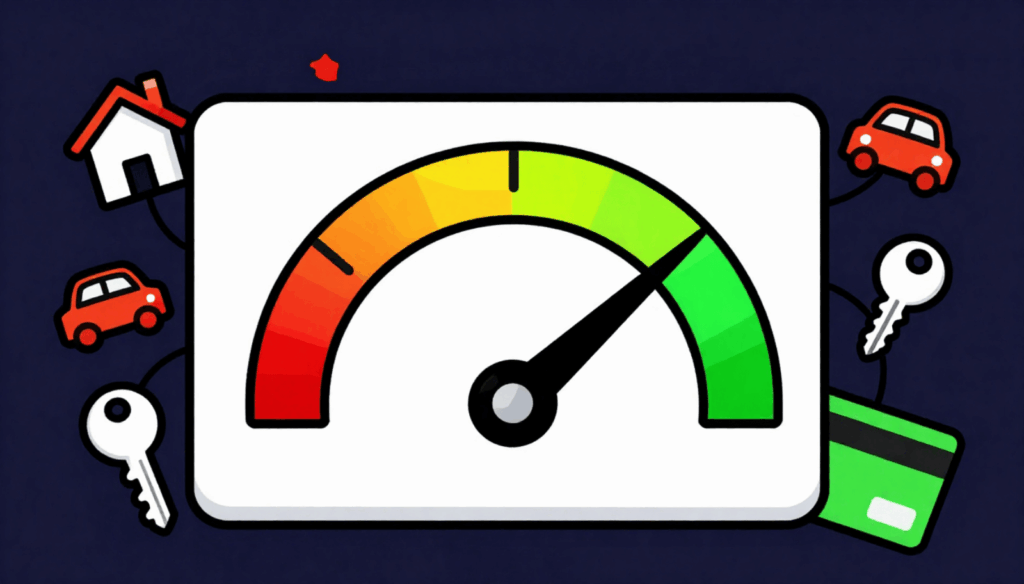
A credit score is a three-digit number that summarizes how someone has handled borrowed money in the past. Lenders, landlords, and certain employers use it as a quick snapshot of financial behavior. The number itself usually falls somewhere between 300 and 850. A higher number indicates a lower perceived risk for lenders or credit extenders.
The score does not measure income. It does not measure how much money sits in a savings account. It does not look at job title or net worth. Instead, the credit score focuses on borrowing patterns. It tracks whether bills are paid on time, how much available credit a person uses, and how long the borrowing track record stretches back.
Think of it as a financial reputation score. A grocery store does not need to know a customer’s personal details to judge them. A lender works the same way. The credit score provides a quick, standardized snapshot of whether someone has historically repaid debts as agreed. That single number can open doors or quietly close them.
Do you Know What Is The Paycheck-To-Paycheck Trap?
Read Article →Where Credit Scores Come From and Who Creates Them
Credit scores do not appear out of thin air. They are calculated using information collected by three large companies known as credit bureaus. Three names dominate the bureau landscape across the United States: Equifax, Experian, and TransUnion. Each one gathers data on borrowing activity from banks, credit card companies, auto lenders, and other institutions.
These bureaus do not lend money themselves. They function as record keepers. Every time someone opens a credit card, takes out a loan, or misses a payment, that activity is reported to one or more of the bureaus. The bureaus then compile this information into a credit report. The credit report is the raw material that scoring models use to generate the actual three-digit score.
One scoring model sits at the center of the industry. The FICO score, developed and maintained by Fair Isaac Corporation, is used in the majority of lending decisions. Another common model is VantageScore, developed jointly by the three credit bureaus. Both models use similar information but weigh certain factors slightly differently. As a result, the same person can have a slightly different score depending on which model and bureau are used. The general ranking, however, is consistent across all of them.

Find out How The Compound Interest Can Work On Your Favor…
Read Article →The Five Main Factors That Shape How Credit Scores Work
Understanding how credit scores work means looking at the ingredients that go into the calculation. Most scoring models rely on five core factors. Each one carries a different weight, and each one tells the lender something specific about borrowing behavior.
1. Payment History
Payment history is the largest single factor in most credit score calculations. It accounts for roughly 35 percent of a FICO score. The model looks at whether bills have been paid on time across credit cards, loans, and other reported accounts. A pattern of on-time payments steadily builds the score. A single late payment can knock points off, and a missed payment that becomes 30, 60, or 90 days overdue causes more serious damage.
Picture two roommates. One pays the electric bill the day it arrives every month. The other pays a week after the due date. Over a year, the difference seems small. To a lender reviewing payment history, the difference is enormous. The reliable payer signals dependability. The late payer signals risk, even if both eventually pay every cent owed.
2. Credit Utilization
Credit utilization measures how much of the available credit a person is actually using. Roughly 30% of the overall score stems from this single factor. The math is simple. Carrying a $3,000 balance on a card that allows up to $10,000 produces a utilization rate of 30 percent. Lower utilization generally helps the score. Higher utilization tends to drag it down.
A relatable example helps here. Imagine a buffet plate stacked nearly to the edge. It looks chaotic, even if nothing has spilled. A lender views a near-maxed-out credit card the same way. The borrower may still be paying on time, yet the heavy use suggests financial pressure. Keeping balances well below the limit tells a calmer story.
3. Length of Credit History
Older accounts pull weight in the calculation. About 15% of the score reflects the length of a person’s credit history. The model studies how long each account has been open and averages the age across the full set of accounts. Established accounts contribute more positively because they provide a longer track record for the scoring model to evaluate.
This is part of why people fresh out of school often struggle with their first credit score. They have no long history to point to. Even responsible behavior takes time to translate into score points. Closing an old credit card can also hurt this factor by shortening the average age of accounts.
4. Credit Mix
Credit mix makes up roughly 10 percent of the score. It refers to the variety of credit types a person manages. A healthy mix might include a credit card, an auto loan, and a student loan. Handling different kinds of credit responsibly shows the lender that the borrower can manage more than one type of obligation.
No one needs to chase a perfect mix. Opening loans to diversify is rarely a smart move. The factor rewards people who naturally have a balanced credit profile over time.
5. New Credit
Recent borrowing activity carries weight, too. Around ten percent of the score reflects how much new credit a person has pursued. Submitting an application for a fresh card, loan, or financing arrangement triggers the lender to pull the credit report. That request is recorded as a hard inquiry. A burst of hard inquiries in a short window can lower the score, because it suggests the borrower may be scrambling for funds.
A single inquiry usually has a minor impact. Several inquiries within a few months send a different signal. Many people are surprised to learn that even applying for a store card at checkout results in a hard inquiry on their credit report.
Credit Score Ranges and What They Mean in Practice
Once the scoring model crunches the numbers, the result lands somewhere on a scale from 300 to 850. Credit scores are typically grouped into broad tiers. These tiers help lenders and landlords quickly categorize an applicant.
- 300 to 579: Poor. Borrowers in this range face significant challenges. Loan approvals are difficult, and approved loans often carry high interest rates and strict terms.
- 580 to 669: Fair. Approval is possible, but rarely on the best terms. Interest rates are still elevated, and security deposits may be larger.
- 670 to 739: Good. This range is considered solid. Most lenders approve standard applications, and interest rates start to feel reasonable.
- 740 to 799: Very Good. Borrowers in this range generally receive favorable terms, lower rates, and broader approval options.
- 800 to 850: Excellent. This tier unlocks the best available rates and the smoothest approvals. Lenders compete for these borrowers.
The practical difference between tiers is real. Two people applying for the same car loan can walk away with very different monthly payments based solely on their scores. One person might pay several thousand extra dollars in interest over the life of a loan simply because their credit score landed in a lower bracket. This is also the point where the score connects directly to <a href=”https://theemoneynudge.com/apr/”>APR</a>. This rate determines how expensive borrowed money actually becomes.
How a Credit Score Shapes Real-World Decisions
A credit score does far more than sit on a screen at a bank branch. It quietly influences moments that most people would not associate with credit at all. The reach of this number is one reason it deserves attention.
Loan Approvals
Mortgages, car loans, personal loans, and student loan refinances all begin with a credit check. Lenders use the credit score as a first filter. Below a certain threshold, the application may not move forward at all. Above that threshold, the score determines how much can be borrowed and on what terms.
Interest Rates
Two borrowers can apply for the same loan and receive completely different interest rates. The credit score is usually the largest reason for that gap. A higher score signals lower risk, and lower risk earns a lower rate. Over the life of a thirty-year mortgage, even a one-point rate difference can mean tens of thousands of dollars.
Rental Applications
A lease application sits on a desk, awaiting a credit check before moving forward. Most landlords and property management firms run that check routinely. A weak score may result in a denied application, a larger security deposit, or a request for a co-signer. Maya’s story at the top of this article is a textbook example of how this shows up in daily life.
Employment Screening
Certain employers, especially in finance, government, and roles that involve handling money, may review a version of the credit report during the hiring process. They generally do not see the full score, but they can see patterns like missed payments or accounts in collections. A struggling credit report can quietly affect career opportunities.
Insurance Premiums and Utilities
Auto and home insurance rates can swing based on credit data, too. In many states, insurers rely on a credit-based insurance score when pricing policies. Utility companies may also use the score to decide whether a deposit is required before activating service. These uses surprise many people, because they do not feel like borrowing decisions.
No Credit History Versus Bad Credit: Two Different Problems
People often lump these two situations together, but they are not the same. Someone with no credit history is invisible to the scoring system. Someone with bad credit is visible for the wrong reasons. Both create challenges, yet each requires a different path forward.
A person with no credit history has never opened a credit card, taken a loan, or had any accounts reported to the credit bureaus. The scoring model has nothing to evaluate. Lenders cannot assess risk, so they often decline applications or require a co-signer. This is sometimes called being credit invisible. Recent immigrants, young adults, and people who have only used cash or debit cards often find themselves in this position.
A person with bad credit has a track record, but it’s negative. Missed payments, accounts in collections, charge-offs, or bankruptcy have pulled the score down. Lenders can see exactly what went wrong. Rebuilding from this position is possible, but it is slow because negative marks remain on the credit report for years.
The fix for each situation is different. Credit invisibility is solved by carefully opening a first account and building a history from scratch. Bad credit is repaired by consistent on-time payments, lowering balances, and waiting for old negative marks to fade. Both paths require patience.
Behaviors That Build a Strong Credit Score Over Time
Understanding the factors is one thing. Translating them into daily habits is another. A few simple behaviors drive lasting improvement in a credit score.
Paying every bill on time is the foundation. Even one missed payment can set the score back, and consistent on-time payments slowly compound in the borrower’s favor. Setting up automatic minimum payments is a common way people protect themselves from forgetting due dates.
Keeping credit card balances low is the second pillar. Many experts suggest staying under 30 percent of the available limit, and under 10 percent is even better for the score. A card with a $5,000 limit looks healthiest when the balance stays under $1,500.
Letting accounts age also matters. Closing a long-held credit card lowers the average age of credit. It reduces total available credit, which pushes the utilization ratio higher. Leaving older accounts open and active, even with light use, generally helps the score.
Limiting new applications is another quiet but important habit. Each application creates a hard inquiry, and a string of inquiries can suggest financial strain. Applying only when there is a clear need keeps the score stable.
Regularly checking credit reports is one of the most overlooked habits. Errors happen. Accounts get mixed up between people with similar names. A wrong late payment on a report can drag the score down for years if no one catches it. Each of the three main credit bureaus is required to provide a free report on request.
Behaviors That Damage a Credit Score and How Long the Damage Lasts
Just as certain habits build the score, others pull it down. Understanding the damage helps explain why recovery takes so long.
Late payments are among the most harmful events. A payment that lands 30 days past due begins to hurt the score. A payment that reaches 60 or 90 days late causes deeper drops. These marks generally remain on the credit report for up to seven years.
Maxing out credit cards drives utilization to sky-high levels and signals financial stress. Even if the balance is later paid down, the period of high utilization can affect the score in the meantime.
Accounts sent to collections create a long-lasting black mark. Collection accounts typically remain on credit reports for about 7 years, even after they are paid. The damage softens over time, but the entry remains visible.
Charge-offs occur when a lender writes off the debt as a loss after extended nonpayment. Charge-offs are serious negative events that remain on the report for about 7 years.
Bankruptcy creates the deepest impact. A Chapter 7 filing tends to linger on the credit report for as long as ten years. Chapter 13 bankruptcy typically stays for seven years. The score usually drops sharply at the time of filing, and rebuilding takes years of careful behavior afterward.
Hard inquiries from new credit applications stay on the report for two years. However, their direct impact on the score usually fades after a few months. Repeated applications in a short period can suggest desperation to lenders.
A pattern emerges. Most negative marks remain for 7 years. The good news is that their impact lessens over time, especially as newer positive behaviors get reported. The bad news is that there is no shortcut. Credit repair scams that promise to erase legitimate negative marks rarely deliver on their promises.
How a Credit Score Connects Directly to Borrowing Costs
A strong credit score does more than signal good standing. It functions as a tool that reduces the actual cost of borrowing. The connection runs through the interest rate, which is expressed as an annual percentage rate. The relationship between credit score and APR is one of the most concrete reasons the number matters.
Lenders price loans based on risk. Borrowers with high scores pose less risk, so they receive lower rates. Borrowers with low scores pose more risk, so they pay higher rates to compensate the lender. On a small purchase, the difference may feel minor. Apply the same rate gap to a mortgage or auto loan, and the additional interest can quietly add up to a five-figure total before the balance is paid off.
This pricing logic also appears in newer forms of borrowing, such as <a href=”https://theemoneynudge.com/buy-now-pay-later/”>Buy Now Pay Later</a> plans, where credit data can influence approval and terms. A weak credit score does not just close doors. It makes every door that does open more expensive to walk through. That is why building and protecting the score has a direct dollar value.
Common Myths About Credit Scores
Misinformation about credit scores is everywhere. A few persistent myths cause people to make worse financial decisions than necessary. Clearing them up is part of understanding the system.
Myth: Checking your own credit score hurts it. Checking your own report or score is called a soft inquiry. Soft inquiries do not affect the score. Only hard inquiries from lenders reviewing a new application have any impact.
Myth: Carrying a balance on a credit card builds credit faster. This is one of the costliest myths in personal finance. Carrying a balance from month to month creates interest charges without improving the score. Paying the full balance each month is generally better for both your score and your wallet.
Myth: Closing old credit cards improves the score. Closing an old card usually hurts the score. It shortens the average age of credit history and reduces total available credit, which raises the utilization ratio.
Myth: All debts affect the credit score equally. Not every bill reaches the credit bureaus. Rent, utility, and phone payments are often not reported in the same way as credit card and loan payments are. Some services now offer to report rent payments, but this is not automatic.
Myth: Income is part of the credit score. Salary, wages, and other earnings are completely excluded from the scoring formula. A high earner with poor borrowing habits can have a worse score than a modest earner with disciplined habits.
Myth: Marriage merges credit scores. Spouses keep separate credit scores. Joint accounts opened together are reported to both, but the underlying scores remain individual.
Myth: A perfect 850 is necessary for the best rates. Once the score reaches the high 700s or low 800s, most lenders treat the borrower as top-tier. The difference between 800 and 850 rarely changes the offered rate.
Final Thought: A Number Worth Understanding
A credit score is more than a financial statistic. It is a quiet companion that travels with a person through nearly every major money decision. Renting an apartment, buying a car, financing a home, applying for certain jobs, and even setting up utilities can all turn on this single number. Most people meet it for the first time, as Maya did, in a moment of unexpected consequence.
The good news is that the system is learnable. The five factors, the score ranges, and the behaviors that move the number up or down are not secret. They are not taught widely enough. A person who understands what is being measured can make intentional choices that build the score over time rather than accidentally damage it.
No single article can guarantee a perfect score, and no credit score is a substitute for thoughtful financial habits. Yet a clear understanding of the system removes much of the fear and confusion that surrounds it. The number stops feeling like a mystery and becomes a record, one that responds to consistent, patient effort.
Watch It Instead
The Money Nudge — YouTube Channel
Prefer watching over reading? Every topic on this blog also comes to life as an animated video on our YouTube channel — where we make money talk even more simply.
Visit Our Channel