Two friends save for retirement. One contributes $24,000 over ten years and stops. The other contributes $72,000 over thirty years and never stops. They both retire at the same age. The one who puts in less money finishes with more. That is not a typo or a trick. It is compound interest doing exactly what it always does, quietly, in the background, to everyone.
Most people have heard of compound interest. Few realize just how strange and powerful it actually is. By the end of this article, the math will be clear, the mechanics will be obvious, and a few money decisions may never look the same again.
Do you know how inflation can affect interest rates? Watch the Money Nudge Video Below:
Prefer to watch instead of read?
Subscribe to The Money Nudge on YouTube for plain-English videos on money, investing, and economic topics.
Table of Contents
What Compound Interest Actually Is
Compound interest is the process of earning interest not only on the original amount of money invested or saved, but also on the interest that money has already earned. It is interesting how it stacks on itself year after year, like layers in a cake.
To understand compound interest, it helps first to understand its quieter cousin: simple interest. Simple interest is calculated only on the original amount, also called the principal. If a person puts $1,000 into an account that pays 5% simple interest per year, the account earns $50 each year. Year one earns $50. Year two earns $50. Year ten earns $50. The interest never changes because it is always calculated on the same starting balance.
Compound interest behaves differently. With compound interest, the $50 earned in year one gets added to the principal. So in year two, the 5% is calculated on $1,050, not on the original $1,000. That earns $52.50 in year two. In year three, the 5% is calculated on $1,102.50. The interest earns interest, and that interest also earns interest. The growth curve bends upward over time, slowly at first, and then much more sharply.
The difference between simple and compound interest may look small in any single year. Over a decade or two, however, the gap becomes massive. Simple interest grows in a straight line. Compound interest grows like a snowball rolling down a hill, picking up more snow with every turn.
What is interest rate? A Simple and Clear Explanation
Now that you understand how interest compounds, find out who actually sets the benchmark rate — and why every Fed decision ripples through your savings, loans, and investments.
Read Article →How Compound Interest Works Through a Real Example
Numbers usually explain compound interest better than words can. Consider a starting balance of $10,000 placed into an account that earns 7 percent annually, compounded once a year. Nothing else gets added. The money sits and grows.
Year one ends with $10,700. The account earned $700 in interest. Year two starts with that $10,700, and 7 percent of that is $749. So year two ends at $11,449. Year three earns 7 percent on $11,449, which is roughly $801. The account ends year three at $12,250.
Notice what happened there—the first year earned $700, the second year earned $749, and the third year earned $801. The interest amount keeps growing, even though the rate stayed the same and no new money was added. That is compound interest explained in its simplest form: each year, the base that earns interest grows a little, so the interest itself grows a little too.
Now stretch that same example over thirty years. The original $10,000 does not double, triple, or quadruple. It grows to roughly $76,000. The account earned about $66,000 in pure interest, on a single $10,000 deposit, with no additional contributions. That is the quiet compounding cycle in motion.
If a person were to add monthly contributions on top of that, the numbers grow far more dramatically. This is why retirement calculators sometimes feel almost unbelievable. They are not lying. They are simply showing what compounding does over time and with consistency.
Compounding Frequency: Why How Often Matters
Compound interest does not always compound once a year. Many financial products compound more frequently. Some compound monthly. Some compounds daily. A few even compound continuously, which is a more advanced concept used mostly in academic finance.
The general Rule is this: the more often interest compounds, the more total interest is earned, assuming everything else stays equal. The reason is simple. More frequent compounding means interest is added back to the principal sooner, so the next round of interest is calculated on a slightly higher balance.
Consider $10,000 earning 5 percent for one year under three different compounding schedules. With annual compounding, the account earns $500 flat. With monthly compounding, the account earns about $511.62. With daily compounding, the account earns about $512.67. The differences look small at first glance, yet they widen substantially over decades.
For savings accounts, certificates of deposit, and many investment products, daily or monthly compounding is common. For credit cards, daily compounding is the norm, which is part of what makes credit card debt so dangerous. The compounding is fast, and it works against the borrower instead of for them.
When comparing financial products, it helps to look not just at the advertised interest rate, but also at how often it compounds. Two accounts can offer the same headline rate and still produce different results based on their compounding schedule.
The Paycheck to Paycheck Trap: How to Break Out of It
Now that you understand how interest compounds, find out how to break out of the paycheck to paycheck cycle.
Read Article →The Rule of 72: A Mental Shortcut Anyone Can Use
The Rule of 72 is one of the most useful pieces of financial math a person can learn. It is fast, surprisingly accurate, and requires no calculator. The Rule of 72 estimates how long it takes for an investment to double at a given annual rate of return.
The formula is short. Divide the number 72 by the annual interest rate. The result is roughly how many years it will take for the money to double.
A few examples make this clear. At a 6% annual return, money doubles in about 72/6, or 12 years. At a 9% annual return, money doubles in about 72/9, or 8 years. At a 3% return, doubling takes about 24 years. At a 12% return, doubling takes only about 6 years.
This shortcut is incredibly useful for everyday financial thinking. It transforms abstract percentages into concrete time frames. A 7% return is not just a number on a screen. It means money roughly doubles every ten years. Someone who invests $20,000 at age 30 and earns 7% on average could see that money grow to about $40,000 by age 40, $80,000 by age 50, $160,000 by age 60, and $320,000 by age 70, even with no additional contributions.
The Rule of 72 also reveals how dangerous high-interest debt can be. A credit card charging 24% interest doubles the debt every three years if no payments are made. That is the same engine of compound interest, simply running in reverse.
When Compound Interest Works Against You
Compound interest does not care which direction it runs. It will multiply savings and debt with equal enthusiasm. For anyone carrying a credit card balance or paying off a loan, this is the side of compounding that matters most.
Credit cards are one of the clearest examples. The average credit card APR in the United States hovers in the high teens to mid-twenties, depending on the card and the borrower. That interest typically compounds daily. Each day, interest is calculated on the unpaid balance, which is then added to the balance. The next day, interest is calculated on the new, slightly larger balance.
Imagine someone carries a $5,000 credit card balance at 22% APR and only makes the minimum payment each month. Without doing the full calculation, the result is simple: it can take well over a decade to pay off, and the total interest paid can exceed the original $5,000 balance. The compounding cycle keeps the balance growing in the background while the borrower struggles to catch up.
The same pattern shows up in other forms of borrowing. Auto loans, personal loans, and several types of student loans all run on the same compounding machinery, just usually at gentler rates than credit cards. The principle remains the same. When debt compounds, every day of delay costs more than the day before.
This is why financial conversations often emphasize paying off high-interest debt as quickly as possible. It is not about being frugal for its own sake. It is about turning off a compounding machine that is actively working against the borrower’s future balance.

APR: What Is It and Why It Matters More Than You Think
What if I tell You that Interest Rates are not everything?
Read Article →When Compound Interest Works For You
The flip side of all of this is the version most people want to hear about. When compound interest is on the saver’s side, time becomes the saver’s most valuable ally. Every dollar invested early gets more compounding cycles than a dollar invested later.
Return to the two friends from the opening of this article. Let’s call them Maya and Jordan. Maya invested $200 a month from age 25 to 35, then stopped. Jordan invested $200 a month from age 35 to 65. At an average annual return of 8 percent, Maya’s $24,000 contributions grow to roughly $342,000 by retirement. Jordan’s contributions of $72,000 grow to roughly $300,000 by retirement.
Maya put in less money. Maya stopped contributing decades earlier. And yet Maya retires with more. The only reason is time. Her money had more decades to compound, so each early dollar did far more work than any of Jordan’s later dollars could.
This is the part of compound interest that feels almost magical. It rewards patience more than effort. It rewards consistency more than intensity. A modest amount, invested early and left alone, can outperform a much larger amount invested later. The numbers are not exaggerations. They are simply what happens when the compounding cycle gets enough runway to operate.
For long-term goals like retirement, education funds, or generational wealth, compound interest is the central engine that makes the whole plan possible. Without it, saving would be a slow, linear process. With it, saving becomes exponential.
Why Starting Early Matters So Much
The most important ingredient in the compound interest formula is not the rate of return. It is not the amount contributed. It is time. Time is what allows compounding to do its real work.
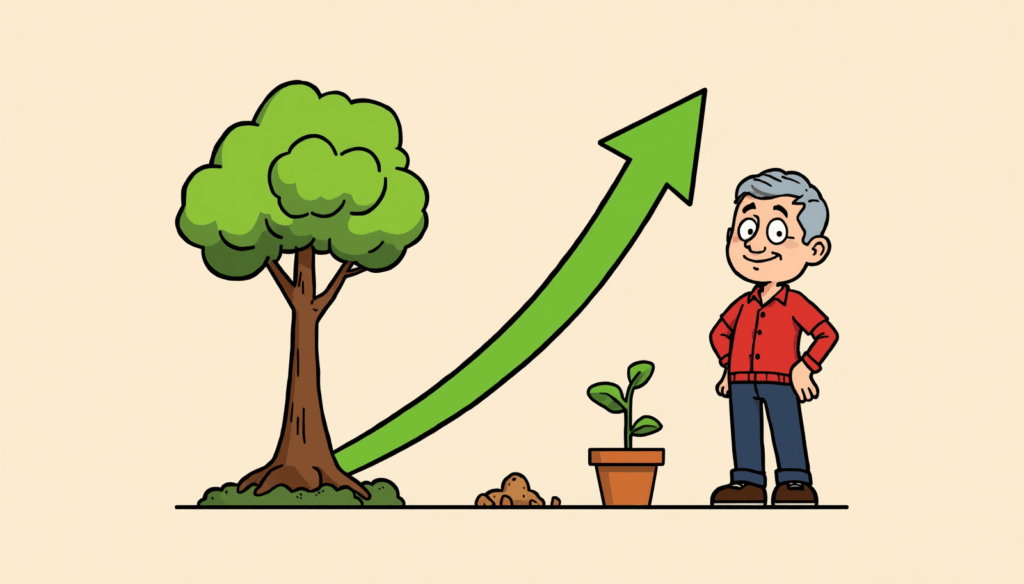
A useful way to think about this is to picture compound growth as a hockey stick. The line starts nearly flat. For the first few years, the difference between simple and compound growth is barely visible. Then the curve begins to bend. After a couple of decades, the line shoots upward at a pace that feels almost unfair compared to the early years.
This is why the saying “the best time to start was twenty years ago, and the second best time is today” appears so often in personal finance writing. Every year of delay removes one of the most powerful compounding years from the timeline, the one all the way at the end, where the balance grows the fastest.
Someone who starts saving $300 a month at age 25 will, at an 8 percent average annual return, accumulate roughly $1 million by age 65. Someone who starts the same $300 a month at age 35 will accumulate roughly $440,000 by age 65. Same monthly amount. Same return. A ten-year head start more than doubles the outcome.
The lesson is not that late starters are doomed. Plenty of people start later and still build meaningful wealth. The lesson is that early starters get a steep discount on their financial goals. Less money has to be contributed because compound interest carries more of the load.
How Inflation Interacts With Compound Interest
There is one factor that can quietly shrink the power of compound interest, and it deserves honest attention. The culprit, in most cases, is inflation.
Most people notice inflation long before they name it. Groceries cost a few dollars more than they used to. A car repair quote feels higher than it did a year ago. Across years and decades, prices on almost everything drift upward, and that drift has a name—each upward tick in prices chips away at what a single dollar can actually buy. A $20 bill in a wallet today does not stretch as far as it did fifteen years ago.
Compound interest grows the number of dollars in an account. Inflation reduces what each of those dollars can buy. The two forces run in opposite directions. To get a true sense of how much wealth has actually been built, the rate of inflation has to be subtracted from the rate of return. The result is called the real return.
If a savings account earns 4 percent and inflation runs at 3 percent, the real return is roughly 1 percent. The account is technically growing, yet the buying power of that money is barely keeping up. If inflation outpaces the return, savers are actually losing ground in real terms, even though the balance on the screen keeps rising.
This is one of the reasons why simply parking money in low-yield accounts can be risky over the long term. The compounding is slow. Inflation eats into the gains. Over decades, the saver may have more dollars but less actual purchasing power. The real return is what truly matters when planning for far-off goals.
None of this means inflation cancels out compound interest. It simply means the math has to be looked at honestly. A 7 percent return in a 3 percent inflation environment is functionally a 4 percent real return. That is still a powerful number over time, yet it is not the same as 7 percent in terms of pure spending power.
What Is Inflation and Why Does Everything Keep Getting More Expensive
Inflation is not as bad as you think for the economy. Find out why.
Read Article →What Compound Interest Means for Everyday Decisions
Understanding compound interest changes how a person looks at routine financial choices. Three of the most common situations show this clearly.
The first is whether to pay off debt or save and invest. When the interest rate on a debt is high, especially in the credit card range, paying it off aggressively almost always wins. The compounding working against the borrower is faster and more punishing than most savings vehicles can keep pace with. Eliminating that debt is earning a guaranteed return equal to the interest rate that no longer has to be paid.
The second situation involves low-interest debt, such as a mortgage at a modest fixed rate. Here, the math is less obvious. A person paying down a 4 percent mortgage early effectively earns a 4 percent return on those extra payments. Investing that same money in a long-term, diversified portfolio might earn more on average, although nothing is guaranteed. This is where personal preference, comfort with risk, and long-term goals all come into play. Compound interest does not give a single right answer here. It simply makes the trade-off visible.
The third situation is about saving habits. Compound interest rewards consistency above almost everything else. Setting up automatic monthly contributions, even small ones, takes advantage of the long runway compounding needs. A person who contributes $100 a month every month for forty years will likely outperform someone who contributes much larger lump sums sporadically and inconsistently. The timeline matters more than the size of any single contribution.
These situations show why compound interest is more than a textbook idea. It is a practical lens for everyday financial choices, from credit card payoff strategies to retirement planning to deciding where to keep savings.
Common Misconceptions About Compound Interest
A few myths about compound interest circulate, and they are worth clearing up.
The first myth is that a person needs a large amount of money to benefit from compounding. That is not true. The original sum matters less than the time horizon. Small, consistent contributions over decades often outperform large, late contributions. Compound interest is built for patience, not size.
The second myth is that compound interest only matters for investing. Compound interest also affects high-yield savings accounts, retirement accounts, certificates of deposit, and even some bond products. Anywhere interest is paid on a balance and added back to that balance, compounding is at work.
The third myth is that compounding only works in long, smooth lines. In reality, investment returns fluctuate. Some years are strong. Some years are negative. The averages quoted in articles like this one are long-term averages, not promises about any single year. Compound interest still works in volatile markets, yet the line is bumpy, not smooth. Looking at the long-term average is what reveals the underlying power of compounding.
The fourth myth is that compounding is something only finance professionals understand or use. Compounding is happening to everyone all the time, whether they pay attention to it or not. Every credit card balance, every savings account, every retirement account, every loan is subject to compounding in some form. The only question is whether a person uses it deliberately or lets it happen accidentally.
Compound Interest as a Mindset, Not Just a Formula
The compound interest formula is useful, yet the deeper takeaway is not mathematical. It is psychological. Compound interest teaches a way of thinking that pays off in nearly every part of personal finance.
It rewards patience, because the biggest gains come at the end of long timelines. It rewards consistency, because steady contributions outperform sporadic bursts. It rewards starting early, even with very little, because time amplifies every dollar. It punishes ignored debt because compounding continues while a balance is ignored. It quietly favors people who automate their savings and let their money sit, because emotional decisions often interrupt compounding before it has time to do its real work.
Once a person internalizes this mindset, ordinary money decisions start to feel different. A small monthly contribution stops looking trivial and becomes a long-term investment in the future self. A lingering credit card balance stops feeling like a minor annoyance and starts looking like a slow leak in the financial foundation. A choice to wait one more year before starting to save seems meaningfully more expensive than waiting a single year.
That shift in perspective is more valuable than any specific calculation. Compound interest is not just a formula that makes money grow. It is a model for how patience, time, and consistent action quietly create outsized results.
Final Thoughts: The Quiet Force That Shapes Financial Lives
Compound interest does not announce itself. It does not arrive in a single dramatic moment. It works in the background for every account, every loan, every investment, slowly bending outcomes by a small percentage point at a time. The people who understand it stop seeing money as a series of isolated transactions and start seeing it as a long, connected story.
Maya and Jordan both saved real money. Both made reasonable choices. The difference between their outcomes was not effort or income. It was time, and how much of it each gave to compound interest.
Anyone reading this still has time. Maybe more, maybe less, yet always some. The earliest possible day to start using compound interest deliberately is today. The next best day is the one after that. What compounding does with that time depends on the choices made between now and then.
Understanding what compound interest is, how it works, and why it sits at the center of nearly every long-term financial outcome is one of those rare moments in personal finance when a single concept genuinely changes how a person thinks about money. The math is simple. The implications are enormous. And the sooner that idea takes root, the more time it has to do its work quietly.
Watch It Instead
The Money Nudge — YouTube Channel
Prefer watching over reading? Every topic on this blog also comes to life as an animated video on our YouTube channel — where we make money talk even more simply.
Visit Our Channel