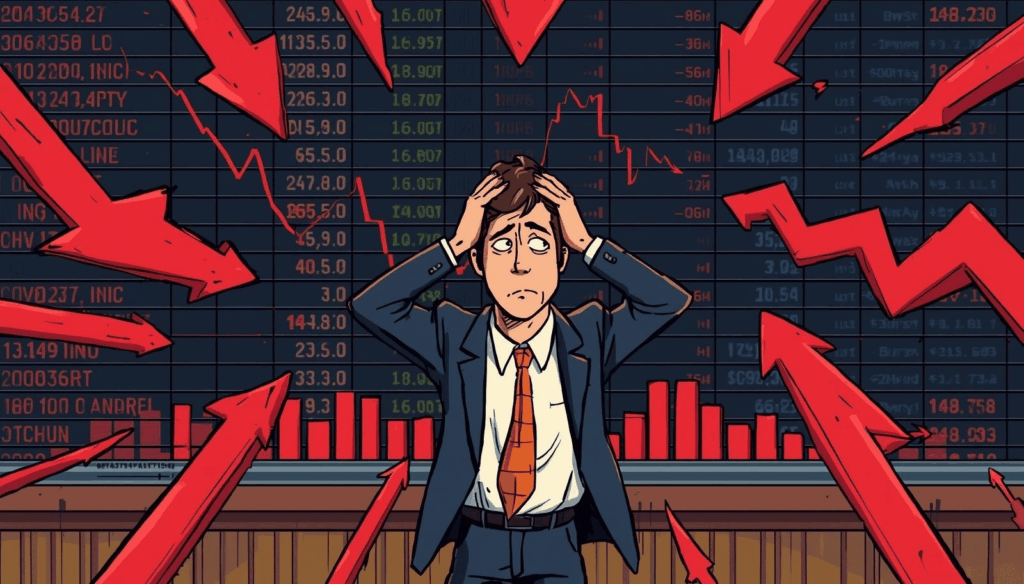
On the morning of October 19, 1987, something impossible began to unfold. Inside the Big Board in lower Manhattan, men in jackets crowded the pit with no clear sense of what to do next. The numbers on the screens did not tick down as they usually do. They fell. They kept falling. Phones rang and went unanswered because there was nothing useful to say into them. Order slips piled up faster than anyone could process them. By the afternoon, portfolios had lost nearly a quarter of their value, entire retirement accounts had been rewritten in a matter of hours, and nobody on Wall Street had a clear explanation for what was actually happening.
That day became known as Black Monday 1987. No American trading session before or after has matched it for sheer percentage loss. The record still belongs to that single autumn Monday on Wall Street. Nothing before it and nothing since has matched the sheer speed of the collapse. Understanding Black Monday 1987 is not only about understanding what went wrong on a single autumn afternoon. It is about understanding how modern markets work, how panic moves through financial systems, and why the rules that govern trading today were shaped by the lessons of that day.
Watch the Money Nudge YouTube Video about the definition of a Recession:
Prefer to watch instead of read?
Subscribe to The Money Nudge on YouTube for plain-English videos on money, investing, and economic topics.
Table of Contents
The Calm Before the Storm: What Markets Looked Like Before Black Monday 1987
To understand the shock of Black Monday 1987, you have to understand how confident the market had become in the years leading up to it.
The early and mid-1980s were a boom period for American stocks. The economy had pulled out of the painful recession of the early 1980s, inflation had been tamed, and interest rates were falling. President Ronald Reagan had pushed through major tax cuts and a broader deregulation agenda that Wall Street welcomed. Corporate profits were rising. Mergers and acquisitions were reshaping entire industries. A new class of financial professionals, often young and aggressive, was making fortunes in ways that captured the public imagination.
Between August 1982 and August 1987, the Dow Jones Industrial Average nearly tripled. That kind of run-up creates a particular psychology. People stop asking whether the market can go down and start assuming it will keep going up. Small dips get treated as opportunities to buy more. New investors enter the market because free money is being handed out to anyone willing to participate.
By the summer of 1987, stock valuations were stretched. Many analysts warned that prices had outrun the companies’ underlying earnings. The market had also become increasingly dependent on large institutional investors who were using new computer-driven strategies that most individual investors did not even know existed. Beneath the surface confidence, the market’s structure had quietly changed in ways that would matter enormously when the mood shifted.
In early October 1987, the mood shifted. A series of smaller declines rattled investors. The Dow dropped more than 4 percent on October 14 and again on October 16. That Friday, markets closed with a nervousness that traders carried home over the weekend. Nobody slept well. Few realized just how bad the coming Monday would be.
Have You Ever Heard About Hyperinflation?
Read Article →Program Trading Explained: The Hidden Engine of the Crash
One of the most important aspects of the Black Monday 1987 story is the concept of program trading. The phrase sounds technical, but the idea behind it is simple.
Program trading is the use of computers to automatically buy or sell large amounts of stock based on preset rules. Instead of a human broker picking up a phone and deciding to sell, a computer follows instructions like this. If the market drops by a certain amount, sell a specific list of stocks immediately. The goal was speed and efficiency. Big institutions like pension funds and insurance companies managed enormous sums of money. They wanted tools that could react faster than any human trader could.
Alongside program trading, portfolio insurance had become popular among large institutional investors. Portfolio insurance promised to protect big portfolios from losses by automatically selling stocks whenever prices started to fall. The logic seemed reasonable on paper. If the market dropped, the computers would sell, locking in values before things got worse.
The problem was what happened when too many funds used the same strategy at the same time. When prices started falling on October 19, the computers did exactly what they had been programmed to do. They sold. That selling pushed prices lower. Lower prices led to more computers being sold. More selling pushed prices lower still. Within hours, the market was caught in a feedback loop that human decision-making could not slow down.
This was the program trading crash in action. It was not that the computers broke. It was that the computers worked exactly as designed, and nobody had fully understood what would happen when their collective behavior hit a market already on edge. Speed and automation, marketed as tools to manage risk, turned out to amplify risk instead.
October 19, 1987: How the Day Unfolded Hour by Hour
The morning of October 19 opened with heavy selling pressure already building. Over the weekend, financial news carried reports of trouble in the Persian Gulf, weakness in the dollar, and continuing concerns about stock valuations. Investors in Asia and Europe had started selling before New York even opened.
The opening bell rang without an orderly market. Selling pressure had already reached a level nobody on the floor had ever seen. The New York Stock Exchange struggled to match buyers with sellers. Some major stocks could not even open for trading right away because there were no buyers at any reasonable price. Specialists on the exchange floor, whose job was to keep trading orderly, were overwhelmed within minutes.
Losses deepened through the late morning hours. The Dow Jones Industrial Average kept sinking in ways that veteran floor traders had never witnessed on a single chart. The ticker tape, which normally reported prices with only a slight delay, fell more than an hour behind. Traders had no reliable way to know what stocks were actually selling for in real time. That uncertainty made people want to sell even more aggressively. If you could not see the price, you assumed the worst.
By midday, the selling had become a full stampede. Mutual fund redemptions poured in from panicked retail investors. Portfolio insurance programs kept firing off sell orders. The futures market in Chicago, which was connected to the cash market in New York, dropped even faster than the stocks themselves, sending further panic signals back to New York.
The afternoon brought no relief. Some traders stopped answering their phones because they could not fill the orders coming in. Others watched their screens with a numb disbelief. The closing bell at 4:00 PM brought the day to an end, but the damage was already historic.
The final tally was historic. Losses on the Dow reached 22.6 percent by the close, with the index shedding 508 points across a single session. Nothing had ever happened before.
The Scale of the Stock Market Crash 1987: Putting the Numbers in Human Terms
Percentages can feel abstract until you translate them into real life. A drop of 22.6 percent in one day means that someone who started the morning with 100,000 dollars invested in a broad portfolio ended the afternoon with roughly 77,400 dollars. More than $ 22,000 in value had evaporated between breakfast and dinner.
For comparison, the famous October 28, 1929, crash that helped trigger the Great Depression saw the Dow fall 12.8 percent in a day. Black Monday 1987 nearly doubled that. If you want more context on the 1929 event and how it compared, we cover it in depth in our 1929 Market Crash article.
The total value wiped out across American markets on October 19, 1987, has been estimated at roughly $ 500 billion. Adjusted for inflation, that number would be well over one trillion dollars in today’s money. Every pension fund, every mutual fund, every individual retirement account holding stocks was affected.
The psychological scale was even harder to measure. Millions of ordinary Americans who had been told throughout the 1980s that the stock market was a path to long-term wealth watched their savings drop by nearly a quarter in a single afternoon. Retirement plans were thrown into doubt. College savings accounts were rewritten overnight. Families who had no direct exposure to Wall Street still felt the ripple effects through their employer pensions and insurance policies.
The Black Monday of 1987 did not just move numbers on a screen. It shook the confidence of a generation of investors who had come to believe that the market only went up.
Here Is Everything You Need To Know About How The Great Depression Started…
Read Article →How the Crash Went Global: Panic Crosses Time Zones
One of the most striking features of Black Monday 1987 was how quickly it spread worldwide. Modern financial markets were already deeply connected by 1987, even though the internet as we know it did not exist. Telephone lines, satellite links, and early computer networks connected major exchanges. When New York collapsed, the shock wave traveled at the speed of those connections.
As the American market closed on Monday evening, Asian markets were already opening. Tokyo, Hong Kong, Singapore, and Sydney all faced their own waves of selling on Tuesday morning local time. Hong Kong took the most dramatic step of any major market. Authorities there shut down the Hong Kong Stock Exchange for four full days to try to stop the panic. When it reopened, it fell by more than 33 percent in a single day.
Europe was next. London, Paris, Frankfurt, and other major markets opened on Tuesday to heavy losses. The London FTSE index fell by more than 10 percent on October 19 and continued to fall over the following days. By the end of October, most major international markets had lost somewhere between 20 and 45 percent of their value.
The Black Monday 1987 was the first truly global stock market collapse of the computerized era. It demonstrated something that policymakers had suspected but never clearly seen. Financial markets were no longer national. A panic that started in one country could cross oceans in hours. That realization would shape international financial cooperation for decades afterward.
The Federal Reserve Response: Stopping the Bleeding
What happened in the days after Black Monday 1987 proved just as important as what happened on the day itself.
Alan Greenspan had been Chairman of the Federal Reserve for only two months when the crash hit. He faced a problem with no recent precedent. If banks and brokerage firms ran out of cash to meet their obligations, the crash could spiral into a full banking crisis. That is exactly what happened after 1929, and the result was the Great Depression.
Greenspan and the Federal Reserve acted quickly. On the morning of Tuesday, October 20, the Fed issued a short but powerful statement. It promised to provide whatever money the banking system needed to keep functioning. In plain language, the Fed told banks to keep lending to brokerage firms and other market participants, and it guaranteed the cash to back that lending.
Major commercial banks followed the signal. They extended credit to securities firms that needed it. Some large corporations stepped in to buy back their own shares, signaling confidence in their own value. Within days, the immediate liquidity crisis eased. The market stabilized, although prices remained well below their pre-crash peaks for months.
The Federal Reserve response became a model for how central banks handle financial panics. The lesson was clear. When panic threatens to freeze the financial system, the central bank must act decisively and publicly to reassure everyone that cash will be available. That lesson would be applied again during later crises, including the dot-com crash and the 2008 financial crisis.
The 2008 Financial Crisis Explained as You Never Heard Before…
Read Article →Why There Was No Depression After Black Monday 1987
One of the most surprising facts about Black Monday 1987 is what did not happen afterward. The market had fallen further in one day than it had in 1929. Yet, the American economy did not slip into a depression. Within two years, the Dow had fully recovered its losses. By contrast, the market after 1929 took roughly 25 years to regain its previous peak.
The difference tells us a great deal about how crisis response has evolved in the half-century between the two events.
In 1929, the Federal Reserve largely failed to act. Money supply actually contracted in the years after the crash. Thousands of banks collapsed. Savings were wiped out. Consumer confidence crumbled. The financial shock turned into an economic catastrophe because the institutions responsible for stabilizing the system did not step in quickly or forcefully enough.
During Black Monday 1987, the institutions acted. The Federal Reserve flooded the system with liquidity within 24 hours. Deposit insurance, which did not exist in 1929, protected ordinary savers from bank failures. Modern unemployment insurance and social safety nets cushioned the worst individual outcomes. The underlying economy in 1987 was also stronger than the economy of late 1929, which had already been showing signs of weakness for months before the crash.
The lesson is not that crashes do not matter. The lesson is that the damage a crash does to the broader economy depends heavily on how authorities respond. A financial panic, caught early and met with decisive action, can be contained. A financial panic ignored or mishandled can become a decade-long economic disaster. The speed of the 1987 response is the reason most Americans remember Black Monday as a bad day on Wall Street rather than the start of a lost decade.
The Birth of Circuit Breakers: How Black Monday 1987 Changed Market Rules
One of the most important legacies of Black Monday 1987 is something most investors interact with today without ever noticing. Circuit breakers.
After the crash, a presidential task force led by Nicholas Brady investigated what had gone wrong. The Brady Commission report identified the feedback loops between program trading, portfolio insurance, and panicked human selling as a central factor in the collapse. It recommended mechanisms to automatically slow trading when markets moved too quickly.
Those recommendations eventually became circuit breakers. Circuit breakers are rules that pause trading across the entire stock market when prices fall by a certain percentage within a given timeframe. The idea is simple. When everyone is selling at once, and prices are moving faster than anyone can think clearly, a brief pause lets emotions settle, lets information catch up, and lets buyers and sellers reassess before the panic compounds.
Today, the New York Stock Exchange uses a three-level circuit breaker system. Trading pauses for 15 minutes once the S&P 500 falls 7 percent from the prior day. Another 15-minute halt kicks in at a 13 percent decline. A drop of 20 percent closes the market for the rest of the day. These thresholds have been tested during other major market events, including the early days of the COVID-19 pandemic in March 2020, when circuit breakers were triggered four times in a single month.
Circuit breakers do not prevent crashes. They slow them down. That small pause, born directly from the lessons of Black Monday 1987, has become one of the most important safety features in modern finance.
Technology, Speed, and Financial Risk: What the Crash Taught Us
Black Monday 1987 exposed something that had been quietly building underneath the surface of modern markets. As technology made trading faster and more automated, it also made panics faster and more automated. The same tools that helped markets function efficiently on normal days turned into amplifiers of chaos on abnormal days.
This is not a problem unique to Black Monday 1987. The core lesson has shown up repeatedly since. The 2010 Flash Crash saw the Dow drop nearly 1,000 points in minutes before recovering. High-frequency trading algorithms have occasionally caused sudden price swings in individual stocks with no connection to real news. The dot-com bubble and its 2000 collapse involved different dynamics but, once again, showed how technology can pull prices away from fundamentals.
The broader takeaway is this. Speed is not neutral. Every time a market becomes faster, more connected, and more automated, it also becomes more vulnerable to rapid, system-wide moves that no individual human can fully anticipate. Every generation of financial technology solves old problems and creates new ones. The challenge for regulators and market designers is to stay one step ahead of the unintended consequences of their own innovations.
Black Monday was the first time this lesson arrived with such force. It was not the last.
What Black Monday 1987 Still Teaches Us Today
The history of stock market crashes offers plenty of lessons. Still, the specific lessons of Black Monday 1987 remain among the most relevant to today’s markets.
The first lesson is about the psychology of panic. Markets do not crash because every investor suddenly reassesses the value of every company. Markets crash because fear moves faster than analysis. When prices start falling rapidly, the instinct to sell before losing more money becomes overwhelming. That instinct is understandable, but it is also the force that turns a bad day into a catastrophe. Understanding this helps modern investors recognize panic for what it is when they see it unfolding.
The second lesson is about interconnection. No market stands alone. A shock in one corner of the financial system can travel across the world in hours. Protecting any single market means thinking about how it connects to every other market.
The third lesson is about preparation. The reason black monday 1987 did not become 1929 is that policymakers had learned from the earlier crisis and built systems designed to respond quickly. Deposit insurance, an active central bank, circuit breakers, regulatory oversight, and international cooperation among central banks all exist because previous crises revealed the need for them. Every crisis leaves behind new infrastructure, and that accumulated infrastructure is why modern crashes, however painful, rarely become economic depressions.
The fourth lesson is about humility. Nobody on Wall Street saw Black Monday coming. The models that were supposed to prevent large losses were the same models that accelerated them. The confidence that had built up over five years of rising prices turned out to be built on assumptions that did not hold when the market truly tested them. Markets always contain risks that nobody has quite identified yet. Accepting uncertainty rather than pretending it does not exist is part of financial maturity.
Final Thoughts: A Day That Rewrote the Rules
Black Monday 1987 was a day that exposed the hidden machinery of modern markets. It revealed how deeply technology had woven itself into trading, how fragile confidence could be once it started to break, and how connected the financial world had become without most people realizing it.
The day also showed how far financial crisis response had come since 1929. A market that fell further than the Great Depression crash did not produce a depression, because the tools to prevent that outcome had been built in the decades between. That progress is easy to take for granted. Still, it is the direct reason ordinary savers today have more protection against a worst-case outcome than their grandparents did.
Understanding Black Monday 1987 is not about memorizing a date or a percentage. It is about seeing how markets actually work under stress, how institutions respond when the stakes are highest, and how past failures shaped the rules we live with today. The 1987 stock market crash changed finance permanently. Its fingerprints are still on every trading screen, every regulatory filing, and every circuit breaker that pauses a market when things move too fast.
The markets of tomorrow will look different from the markets of black monday 1987, just as the markets of 1987 looked different from the markets of 1929. But the underlying story will rhyme. Confidence builds. Technology accelerates. Risks hide in places nobody is looking. And when the pressure finally arrives, the systems built from past lessons will be tested once again.
That is the real teaching of Black Monday. Not a warning about the market, but a reminder of how much the past has already taught us, and how much we still have to learn.
Watch It Instead
The Money Nudge — YouTube Channel
Prefer watching over reading? Every topic on this blog also comes to life as an animated video on our YouTube channel — where we make money talk even more simply.
Visit Our Channel