The 1929 Market Crash stands as one of the most significant financial events in world history. Nearly a century later, it remains a foundational case study for understanding how financial markets behave under extreme optimism—and how quickly that optimism can turn into fear.
More importantly, the 1929 Market Crash provides critical insight into how a stock market collapse can trigger a broader economic breakdown. Many people casually use the terms “market crash” and “recession” interchangeably, but they are not the same thing. The 1929 Market Crash was not, in itself, a recession. Instead, it was the event that exposed deep structural weaknesses in the U.S. economy and set off a wave reaction that eventually led to the worst economic downturn in American history.
Understanding the 1929 Market Crash is essential for anyone trying to grasp how recessions begin, how financial systems fail, and why economic definitions matter. This is why the crash naturally connects to a deeper explanation of what a recession actually is.
Watch the Money Nudge YouTube video about definition of Recession:
Prefer to watch instead of read?
Subscribe to The Money Nudge on YouTube for plain-English videos on money, investing, and economic topics.
Table of Contents
The Economic Climate Before the 1929 Market Crash
To understand the 1929 Market Crash, we must first understand the environment that made it possible. The decade leading up to the crash—the 1920s—was a time of rapid economic expansion in the United States. Often called the Roaring Twenties, this period was marked by technological innovation, rising consumer confidence, and dramatic changes in how Americans lived and worked.
Automobiles became widely accessible, electricity spread to homes and factories, and mass production reduced the cost of consumer goods. Credit was easy to obtain, allowing families to buy cars, appliances, and radios even if they didn’t have the cash up front. Businesses expanded aggressively, and profits appeared strong.
The stock market reflected this optimism. Throughout the 1920s, stock prices rose steadily, reinforcing the belief that investing in stocks was a reliable way to build wealth. This belief played a central role in setting the stage for the 1929 Market Crash.
Before You Go, Make Sure You Understand The Real Definition Of Recession
Read the article below and find out.
Read Article →Stock Market Speculation and Herd Behavior
One of the primary drivers of the 1929 Market Crash was speculation. Investors were not buying stocks because companies were producing long-term value; they were buying because prices kept rising. The logic was simple and dangerously flawed: if stock prices always go up, there is no reason not to invest.
This mindset spread rapidly. Middle-class Americans, clerks, factory workers, and small business owners all began participating in the stock market. Investing became a cultural phenomenon rather than a calculated financial decision.
This herd behavior magnified risk. When confidence is universal, warning signs are often ignored. That is exactly what happened in the years leading up to the 1929 Market Crash.
Margin Investing and Excessive Leverage
Before understanding why excessive leverage became so dangerous in 1929, it’s important to clearly understand what margin investing actually is.
Margin investing means buying stocks using a combination of your own money and borrowed funds from a broker. Instead of paying the full price of an investment upfront, you only put down a portion—called the margin—and borrow the rest. This allows you to control a larger investment with less cash.
For example, imagine you have $1,000. Without margin, you can buy $1,000 worth of stock. But if your broker allows you to invest with 10% margin (which was common in the 1920s), you could control up to $10,000 worth of stock. The remaining $9,000 is a loan. This creates a powerful effect. If the stock rises by 10%, your $10,000 investment becomes $11,000. After repaying the $9,000 loan, you are left with $2,000—doubling your original $1,000 investment. This is why margin investing was so attractive during the booming 1920s.
However, the risk works just as fast in the opposite direction. If the stock falls by 10%, your investment drops to $9,000—the exact amount you owe. Your entire $1,000 is wiped out. If prices fall further, you actually lose more than your initial investment and still owe money.
This is where excessive leverage becomes dangerous. Leverage happens when one uses borrowed money to increase the size of an investment. In moderation, it can enhance returns. But when too many investors rely heavily on borrowed funds, the system becomes fragile. During the years leading up to the 1929 Stock Market Crash, margin investing became extremely common. Many investors were heavily leveraged, meaning even small declines in stock prices triggered margin calls—demands from brokers to deposit more money or sell assets.
As prices began to fall, investors were forced to sell quickly to cover their loans. This wave of forced selling pushed prices down even further, triggering more margin calls in a vicious cycle. What started as a normal market correction quickly turned into panic, accelerating the collapse and deepening the crisis.
Early Warning Signs Before the 1929 Market Crash
Despite widespread optimism, there were warning signs that the economy was becoming unstable. These signals were not obvious to everyone at the time. Still, in hindsight, they clearly showed that the foundation of growth was weakening.
One of the first cracks appeared in industrial production, which began to slow in 1928. During the earlier part of the decade, factories had expanded rapidly, fueled by new technologies and strong consumer demand. However, by the late 1920s, many industries were producing more goods than consumers could realistically buy. This is known as overproduction. Businesses had invested heavily in machinery and capacity, expecting demand to keep rising—but demand started to level off. As inventories piled up, factories reduced output, cut back on new investments, and in some cases began laying off workers. This slowdown was an early signal that economic growth was losing momentum.
At the same time, agricultural prices were weak, creating serious problems in rural America. Farmers had increased production during and after World War I to meet global demand. But once the war ended, international demand dropped sharply, while supply remained high. This imbalance pushed crop prices down significantly. As a result, farmers earned less income even when they produced more. Many struggled to repay loans they had taken out for land and equipment. This weakened rural banks and reduced spending in agricultural communities, creating a ripple effect across the broader economy.
Meanwhile, consumer debt was rising faster than wages, which made the situation even more fragile. The 1920s saw a boom in consumer goods like automobiles, radios, and household appliances. For the first time, many Americans could buy these products using installment plans—essentially early forms of credit. While this made goods more accessible, it also meant that people were committing future income to current spending. The problem was that wages were not increasing at the same pace. Over time, households became financially stretched, with a growing share of their income going toward debt payments rather than new spending.
At the same time, stock prices continued to climb far beyond what corporate earnings justified. Valuations became disconnected from economic reality. These imbalances made the financial system extremely vulnerable. When confidence finally cracked, the market had no cushion to absorb the shock. This imbalance is a defining feature of the 1929 Stock Market Crash.
Black Thursday: The Panic Begins
The first major shock of the 1929 Stock Market Crash occurred on October 24, 1929—a day that became known as Black Thursday. It marked the moment when growing concerns finally turned into visible panic.
On that morning, selling pressure hit the market almost immediately after the opening bell. Investors who had been uneasy about high stock prices and weakening economic conditions suddenly rushed to sell. The volume of sell orders surged so quickly that the system was overwhelmed. Prices began to fall sharply, and in many cases, there were not enough buyers willing to step in.
The situation was made worse by the way trading worked at the time. Orders were recorded on paper and transmitted through ticker tape machines, which quickly became delayed due to the sheer volume of activity. As a result, many investors were making decisions based on outdated prices, increasing confusion and fear. By the time some traders realized how far prices had already dropped, losses were much larger than expected.
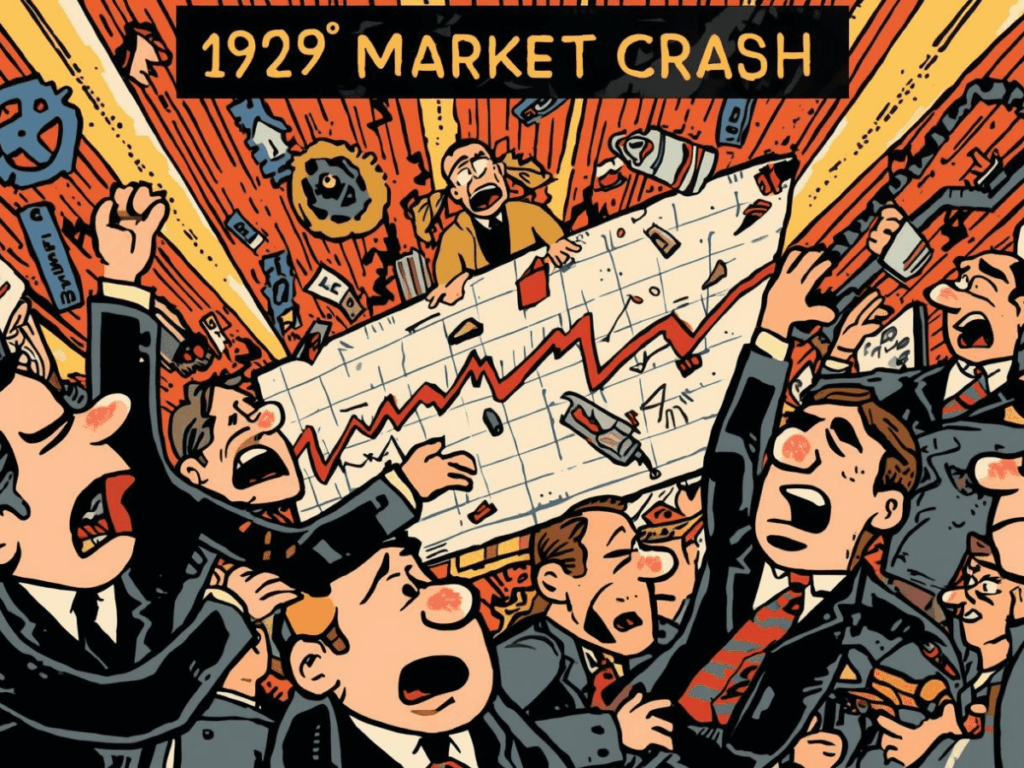
Inside the New York Stock Exchange, the atmosphere turned chaotic. Traders shouted orders, phones rang nonstop, and uncertainty spread across the trading floor. Outside, crowds gathered, desperate for news, reflecting how deeply the stock market had become tied to public confidence.
In an effort to restore stability, a group of powerful bankers and financial institutions stepped in. Led by figures associated with major banks, they began buying large blocks of blue-chip stocks. This intervention was meant to signal strength and reassure investors that the market still had support. For a brief moment, it worked—prices stabilized and even recovered slightly toward the end of the day.
However, the damage had already been done. The sudden drop shattered the belief that stock prices would continue rising indefinitely. Fear replaced optimism, and many investors began to question whether they should remain in the market at all.
Black Thursday did not mark the end of the crash—but it was the turning point. It exposed the fragility of the financial system. It set the stage for even more severe declines in the days that followed.
Black Tuesday: The Collapse Accelerates
Five days later, on October 29, 1929—known as Black Tuesday—panic returned with full force. Investors rushed to sell stocks at any price. Over 16 million shares were traded in a single day, an unprecedented volume at the time.
There were a few buyers. Prices collapsed rapidly. Fortunes that had taken years to build vanished within hours. Margin calls flooded investors with demands for cash they did not have. Black Tuesday became the most infamous day of the 1929 Market Crash, symbolizing the moment when the illusion of endless growth finally collapsed.
The Scale of the Market Decline
The immediate damage from the 1929 Market Crash was staggering, but the full extent of the collapse unfolded over several years. From the market’s peak in September 1929 to its bottom in 1932, stock prices fell nearly 90 percent. Many investors were wiped out completely. Those who had borrowed heavily to invest lost not only their portfolios but also their personal savings. Banks that had loaned money against stock collateral faced massive losses. The crash destroyed wealth on a scale never seen before—and rarely since.
Banking Failures and Financial Contagion
The 1929 Market Crash did not remain confined to Wall Street. It quickly spread throughout the banking system. Banks had invested directly in the stock market and loaned extensively to investors buying on margin.
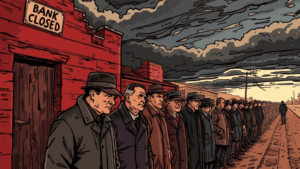
As stock prices collapsed, banks faced insolvency. Thousands of banks failed during the early 1930s. Because there was no federal deposit insurance at the time, depositors lost their savings entirely when a bank collapsed. Fear spread rapidly. Bank runs became common as people rushed to withdraw cash. This loss of trust crippled the financial system and deepened the economic downturn triggered by the 1929 Market Crash.
From Market Crash to Economic Depression
It is crucial to understand that the 1929 Market Crash alone did not cause the economic collapse that followed. Instead, it exposed weaknesses that were already present in the economy. As banks failed and credit dried up, businesses could no longer finance operations. Investment declined sharply. Companies laid off workers. Consumer spending fell, leading to further declines in production. These feedback loops transformed the initial market crash into the Great Depression, the longest and most severe economic downturn in modern history.
Unemployment and Social Consequences
By 1933, unemployment in the United States reached nearly 25 percent. Millions of Americans lost their jobs, homes, and life savings. Breadlines stretched through city streets. Farmers lost land to foreclosure.
The psychological toll of the 1929 Market Crash and its aftermath was profound. Confidence in financial institutions collapsed. Trust in government policy eroded. The crash reshaped public attitudes toward capitalism, regulation, and economic risk.
The human cost of the 1929 Market Crash is one of the most important reasons it remains relevant today.
Global Impact of the 1929 Market Crash
The effects of the 1929 Market Crash were not limited to the United States. International trade declined sharply as demand collapsed. Countries dependent on exports suffered severe economic contractions.
Financial instability spread globally. Currency crises emerged. Governments raised tariffs to protect domestic industries, further reducing global trade and deepening the worldwide downturn.
The global consequences of the 1929 Market Crash demonstrate how interconnected economies can amplify financial shocks.
Government Response and Structural Reforms
In the years following the 1929 Market Crash, governments gradually introduced reforms aimed at stabilizing the financial system. Banking regulations were strengthened. Market oversight increased. Social safety nets were created to protect workers and retirees.
These reforms fundamentally changed how modern financial systems operate. Many of today’s protections—such as deposit insurance and securities regulation—exist because of lessons learned from the 1929 Market Crash.
Why the 1929 Market Crash Still Matters Today
The 1929 Market Crash remains a powerful reminder of how quickly financial optimism can turn into disaster. It highlights the dangers of excessive leverage, unchecked speculation, and blind faith in rising markets.
Most importantly, it shows that a market crash and a recession are not the same thing. A crash is a financial event. A recession is an economic condition defined by sustained declines in economic activity.
Understanding this distinction is essential for anyone trying to interpret modern economic cycles.
Final Takeaway
The 1929 Market Crash was a turning point in economic history. It did not simply erase wealth—it exposed systemic weaknesses that transformed a market collapse into a prolonged economic catastrophe.
Watch It Instead
The Money Nudge — YouTube Channel
Prefer watching over reading? Every topic on this blog also comes to life as an animated video on our YouTube channel — where we make money talk even more simply.
Visit Our Channel