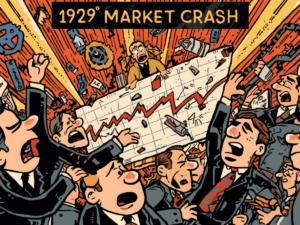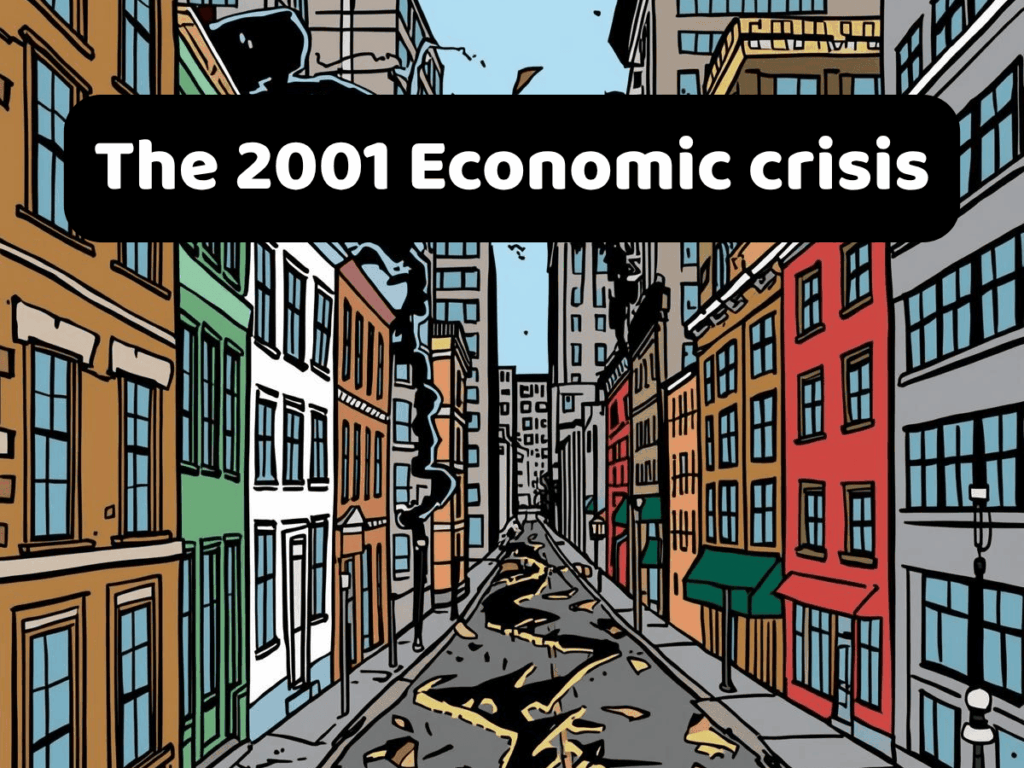
For many Americans, money felt easy to come by in the late 1990s. Retirement accounts kept climbing. Technology stocks doubled year after year. The internet was rewriting the rules of business, and nearly everyone wanted a piece of it. Then, somewhere around 2000, the math stopped working. Job listings disappeared. Portfolios that had swelled throughout the late 1990s shrank at a pace that left people stunned. Companies that had been featured in magazine cover stories were suddenly filing for bankruptcy. And before the country had time to find its footing, the September 11 attacks arrived, followed by a series of corporate fraud scandals that called into question whether any of the financial information people had been given was even true.
The 2001 economic crisis was not a single event. It was a sequence of compounding crises that stretched the pain across several years, each one hitting just as people began to believe the worst had passed. This article traces the full arc of what happened: where the 2001 economic crisis came from, how it spread, who it hurt the most, and what it permanently changed about the way economies and markets are governed.
If you want the full story of the speculative investment frenzy that set the stage, our article on the dot-com bubble covers that period in detail. Here, the focus is on the crisis itself.
Watch the Money Nudge YouTube Video about the definition of Recession:
Prefer to watch instead of read?
Subscribe to The Money Nudge on YouTube for plain-English videos on money, investing, and economic topics.
Wait a minute… Do you know the real definition of an economic recession?
Read Article →Table of Contents
What Set the Stage: The Collapse of Technology Stocks
No explanation of the 2001 economic crisis makes sense without starting in the years before it officially began. Throughout the second half of the 1990s, investor enthusiasm for internet-based companies drove technology stock prices to levels that had almost no relationship to the actual revenues those companies were generating.
To put that in numbers: the NASDAQ Composite Index, which tracks a broad range of technology and growth companies, climbed from around 751 points at the start of 1995 to 5,048 points by early March 2000. That represents a gain of more than 570 percent in five years. Almost none of that growth was anchored in the earnings and profitability that would normally support valuations at that level.
Then the selling began. By October 2002, the index had given back nearly four-fifths of its value from the peak, wiping out an estimated five trillion dollars in wealth across the market. Hundreds of companies that had raised enormous sums through initial public offerings ceased to exist. But the stock market crash was only the first layer. What followed over the next two to three years is what most people never fully processed: a recession, mass layoffs, sweeping corporate fraud, and an agonizingly slow road back to stability.

Do you know what triggered the DOT-COM Bubble?
Read Article →How the 2001 Economic Crisis Unfolded: Layer by Layer
One of the most important things to understand about this 2001 economic crisis is that the damage did not arrive all at once. It built gradually, each new layer arriving just as many people were beginning to believe the worst was behind them. That pattern of compounding bad news over an extended period is part of what made the 2001 economic crisis so disorienting to live through.
The first layer was the stock market collapse itself. By April 14, 2000, the NASDAQ had already fallen 35 percent from its March peak. That kind of decline, happening that fast, wiped out the savings and retirement balances of millions of Americans who had poured money into technology-heavy funds during the boom years. A person who had invested $100,000 in NASDAQ-linked funds at the March 2000 peak and held on through October 2002 would have been left with approximately $22,000. That is not a theoretical scenario. For a significant number of Americans, that number represented the difference between a retirement they had planned for and one they had to rebuild from scratch.
The second layer was the collapse of individual companies, which accelerated throughout 2000 and into 2001. Some of these failures were quiet. Others became symbols of how badly investment judgment had broken down. Pets.com, a company that spent tens of millions of dollars on advertising and brand recognition only to run out of operating cash, shut its doors just nine months after its initial public offering. In the year 2000 alone, 220 dot-com companies closed. By mid-2001, another 330 had followed.
From Stock Market Crash to Full Economic Recession
A falling stock market does not automatically produce a full economic recession. The two can move together, but not always. In 2001, however, the connection between the two was direct enough that the collapse of technology stock valuations eventually pulled the broader economy into contraction, and understanding why that happened clarifies an important aspect of how financial markets and the real economy interact.
When stock prices fall sharply and remain depressed, household wealth declines. People who felt financially secure in 1999 because their portfolio had tripled suddenly felt exposed in 2001 because those gains had largely reversed. That shift in how people feel about their financial situation tends to change behavior. Consumers cut back on spending. Businesses, responding to falling demand, cut back on investment and hiring. The cycle compounds, and what started as a market problem becomes an employment problem, a consumer confidence problem, and eventually a broader economic problem.
According to the National Bureau of Economic Research, the body that officially tracks the American business cycle, the contraction started in March 2001 and ran through November of that year. At eight months, it ranked among the briefer downturns of the post-World War II era in terms of official length. That window, however, is misleading as a measure of the actual pain. Unemployment kept rising after the recession technically ended, peaking at 6.3 percent in 2003. Economists coined the phrase “jobless recovery” to describe a period in which output was growing again, but employers were not yet hiring. After previous postwar recessions, lost jobs had returned in an average of twenty-one months. After 2001, the wait was considerably longer.
The Human Cost: Jobs, Careers, and a Generation of Displaced Workers
Figures like “78 percent decline” and “five trillion dollars in lost market value” are abstractions that are hard to feel personally. The job losses are more immediate.
By the time the technology sector reached its employment floor in 2004, its workforce had contracted by 17.8 percent from peak levels. In Silicon Valley alone, an estimated 200,000 jobs disappeared between 2001 and early 2004. Across the country, roughly two million people were laid off in 2001. These were not primarily entry-level roles. A significant portion of those who lost their jobs were engineers, developers, project managers, and marketing professionals who had built careers on the assumption that the technology industry would continue to expand indefinitely. For many of them, finding equivalent employment required retraining, relocation, or accepting positions at substantially lower salaries. That adjustment took years for some, not months.
The ripple effect of the 2001 economic crisis extended well beyond the companies that shut down. Advertising agencies that had built client rosters around dot-com firms lost the bulk of their revenue almost immediately. Commercial real estate in technology-concentrated markets like San Francisco and Seattle experienced sharp spikes in vacancy rates as startups abandoned their offices. Law firms that had specialized in initial public offering filings, staffing agencies, and countless other businesses that had grown up alongside the boom economy found themselves scrambling to replace revenue that had vanished almost overnight.
Four out of five dot-com companies in the San Francisco Bay Area went out of business in 2000 and 2001, and every business that had served them as customers, tenants, or employers felt the consequences.
Beyond the direct financial losses, there was a psychological dimension that shaped behavior for years. For much of the previous decade, the prevailing financial advice had pointed average households squarely toward the stock market, and technology funds in particular, as the most reliable way to grow long-term savings and prepare for retirement. Millions of people followed that guidance in good faith. When those investments collapsed, the experience planted deep skepticism about whether the financial markets were genuinely fair or systematically rewarded insiders while leaving average investors holding losses. That skepticism would deepen significantly when the housing market collapsed less than a decade later.
September 11 and the Economy: Compounding a Crisis Already Underway
On September 11, 2001, coordinated terrorist attacks killed nearly 3,000 people across New York, Virginia, and Pennsylvania, sending the country into a period of grief and national uncertainty. These attacks did not arrive in a vacuum. They hit an economy that had already been contracting for months. The sequence matters: the recession had officially begun in March 2001, six months before September 11, and its primary driver was the collapse of technology stock prices and the subsequent investment contraction. The attacks did not cause the recession. They intensified it.
In the days after September 11, U.S. stock markets closed and then fell sharply when they reopened. Consumer confidence, already declining as layoffs mounted throughout 2001, dropped further. Airlines, hotels, and tourism-related businesses absorbed some of the sharpest blows, as passenger volumes dropped sharply and took months to recover. Government spending on defense and homeland security increased substantially, providing some economic stimulus. Still, the uncertainty the attacks created reinforced the caution that businesses and consumers were already exercising. For families already managing job losses or diminished retirement accounts from the technology collapse, September 11 made an already difficult year feel genuinely precarious in a way that had nothing to do with markets.
Corporate Fraud: The Crisis That Nobody Saw Coming
Just as many investors and workers were beginning to believe the worst of the stock market collapse was behind them, a series of accounting scandals at major corporations sent markets into a second significant decline and shattered whatever public trust remained in large public companies.
The most consequential of these was the collapse of Enron Corporation. Throughout the late 1990s, Enron had been among the most praised companies in the United States, a regular presence on lists of the most innovative and admired corporations in the country. In October 2001, the company disclosed a $638 million loss and announced it would restate its earnings for the previous 4 years. Those restatements reflected years of fraudulent financial reporting aimed at concealing billions of dollars in debt from investors and the public.
Enron filed for bankruptcy on December 2, 2001, becoming at that moment the largest corporate bankruptcy in United States history. More than $60 billion in assets were rendered essentially worthless. Four thousand Enron employees lost their jobs immediately, and approximately 15,000 others discovered that their retirement savings, invested primarily in Enron stock, were now worth almost nothing.
Enron’s collapse would have been devastating as an isolated event. What followed made clear that the problem was not confined to one company. WorldCom, one of the country’s largest telecommunications companies, disclosed in June 2002 that it had fraudulently inflated its reported earnings by approximately $3.8 billion over multiple years. WorldCom filed for bankruptcy in July 2002, surpassing Enron as the largest corporate bankruptcy in American history at that point. Significant accounting scandals followed at Tyco International, Adelphia Communications, and Xerox.
Each new disclosure added to the pressure on a market that was already falling. The Dow Jones Industrial Average had declined roughly 25 percent from its March 2002 level by the time the WorldCom fraud became public. Investors who had already endured two years of declining markets now faced an additional problem: the financial statements they used to evaluate companies could no longer be relied on. Between January 2001 and mid-2002, the total value of all publicly traded U.S. stocks declined by roughly 40 percent, from approximately $17 trillion to $10 trillion.
The Federal Reserve’s Response: Cutting Rates to Stimulate Recovery
When an economy contracts, as it happened in the 2001 economic crisis, the Federal Reserve, the United States’ central bank, has a primary lever to encourage recovery: cutting interest rates. Lower rates make borrowing cheaper, which is intended to encourage businesses to invest, consumers to spend, and the broader economy to generate the activity it needs to grow again.
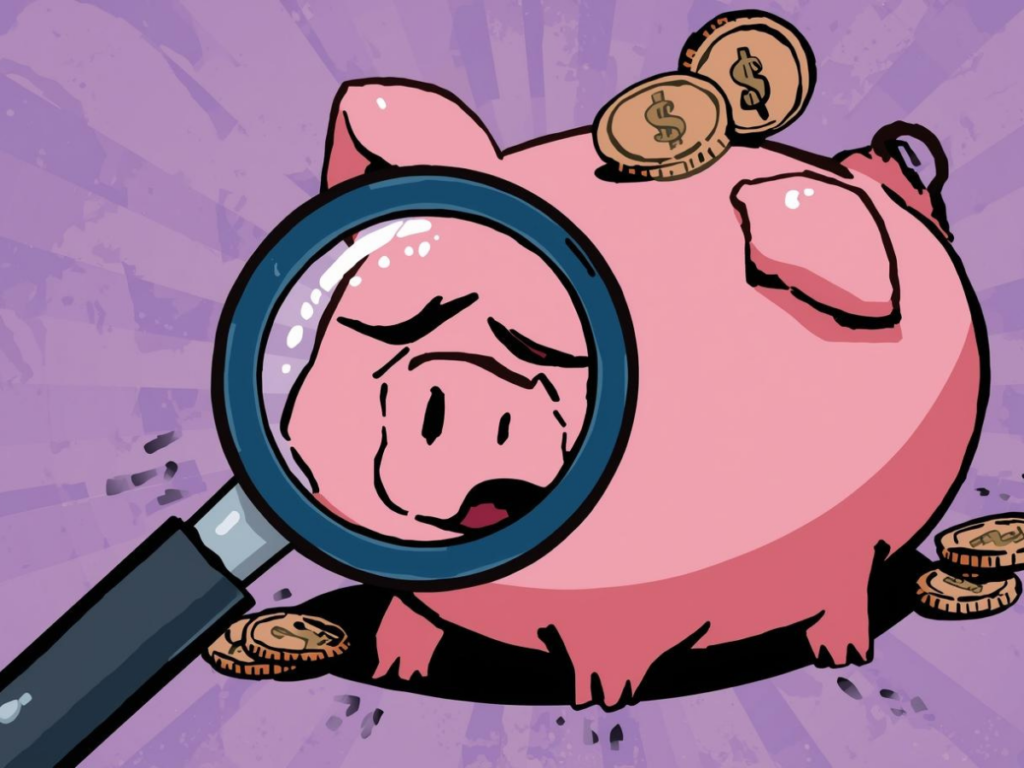
The interest rate is more important than you think…
Read Article →To help the economy during the 2001 economic crisis, the Federal Reserve used this tool with unusual intensity. It cut the federal funds rate eleven times during the year, reducing it from 6.5 percent at the start of 2001 to 1.75 percent by December. This was one of the most rapid, sustained sequences of rate cuts in the institution’s history up to that point. The goal was to make credit accessible and affordable enough that businesses would begin borrowing and hiring, and that consumers would regain enough confidence to spend.
The rate cuts did contribute to stabilizing the financial system and supported the eventual recovery. They also produced an unintended consequence that would not become fully visible for several years. With interest rates held at very low levels through the early 2000s, capital that had previously been directed toward technology stocks began flowing into real estate, an asset class that seemed more stable and tangible. That redirection of capital helped fuel the housing price increases that would eventually inflate into the 2008 financial crisis.
If you want to better understand how recessions like the 2001 economic crisis work, mechanically, and how policymakers typically respond to them, our article on the meaning of recession explains those dynamics in plain terms.
Do You Want To Understand How a Recession Works?
The Sarbanes-Oxley Act: Government Steps In
The string of corporate fraud revelations made clear that the existing oversight system for public companies was failing. Boards of directors were not catching the manipulation. Auditing firms, whose purpose is to provide independent verification of financial statements, had either missed or allowed years of fabricated accounting. Investors had no reliable mechanism for determining whether the earnings reports they were reading accurately reflected the companies producing them.
Congress responded with legislation in July 2002. The resulting law, the Sarbanes-Oxley Act, represented a level of regulatory intervention in corporate governance the country had not seen since new financial rules were enacted in the 1930s. Under the new framework, chief executives and chief financial officers were required to personally sign off on the accuracy of financial reports, making false certification a criminal offense. The legislation introduced harsh penalties for altering or destroying financial records and created a new independent body, the Public Company Accounting Oversight Board, to set auditing standards. The law also drew a firm line between auditing and consulting, closing one of the loopholes that had allowed the Enron situation to develop unchecked.
The law drew criticism from those who argued its compliance requirements were costly, particularly for smaller public companies, and from those who believed it did not go far enough. But its passage acknowledged something important: the crisis was not simply the result of individual bad actors. It was also a failure of the institutional mechanisms that were supposed to protect investors from exactly that kind of bad behavior. The law remains in force today and governs the compliance obligations of every company listed on a U.S. stock exchange.
What the Jobless Recovery Felt Like: 2002 Through 2004
When the National Bureau of Economic Research announced that the recession (2001 economic crisis) had technically concluded in November 2001, the finding carried a precise and limited meaning: output had stopped shrinking and turned upward again. For most people still out of work or watching their savings dwindle, that announcement changed little about daily life.
The unemployment rate, which had sat at 4 percent during the late 1990s expansion, kept climbing after the recession technically ended, reaching 6.3 percent in 2003. The phrase “jobless recovery” captured something real about that period. Output was growing. Corporate profits were improving. But employers were not hiring. Workers who had lost jobs in the technology sector, many of whom had developed specialized skills in demand during the boom, often found that finding equivalent work required retraining, relocation, or accepting positions at meaningfully lower wages. That adjustment stretched across years for a significant number of people, not months.
The recovery in stock prices was even slower. The NASDAQ would not return to its March 2000 peak of 5,048.62 until April 2015, fifteen years after the crash. For investors who had concentrated their savings in technology stocks and held on in the hope of a recovery, that wait carried an enormous cost beyond the paper losses themselves. Money that had not been growing for 15 years was not compounding. The practical cost of that lost time, measured against what those funds might have earned in alternative investments over the same period, was substantial.
What Survived and What Was Built on the Ruins
Not everything that emerged from the 2001 economic crisis was negative. The years between the recession and the mid-2000s also produced something unexpected: some of the most enduring companies of the next generation of the internet economy were built or solidified during and immediately after the collapse.
Google, founded in 1998, went public in 2004 and built its core business during the downturn. Amazon survived a period when its stock fell from approximately $100 per share near the market peak to around $7 per share. It used those difficult years to develop the infrastructure and operational systems that would eventually make it one of the dominant companies of the following two decades. The physical infrastructure funded during the boom, including fiber optic cables, data centers, and network hardware, remained in place even after the companies that paid for it went bankrupt. The next generation of internet businesses could build on that foundation at a fraction of what the original builders had spent.
The 2001 economic crisis also permanently changed how investors and entrepreneurs evaluated technology companies. The willingness to fund startups almost exclusively based on user growth projections and brand visibility, with minimal scrutiny of revenue or a realistic path to profitability, did not disappear entirely. But it became far less common. Investors who had absorbed heavy losses demanded more rigorous justification for high valuations. Terms like “unit economics,” “cash flow,” and “sustainable business model” became central to conversations about startup funding in ways they had not during the boom. Those lessons would be partially forgotten and then painfully relearned in later cycles. Still, the 2001 economic crisis established benchmarks that the investment community could not entirely set aside.
The Long Shadow: How the 2001 Economic Crisis Shaped the Next Decade
The 2001 economic crisis did not end cleanly in 2003 or 2004. It cast a long shadow across the decade that followed in two significant directions.
The first was the lasting effect on ordinary investors. The experience of watching years of accumulated savings erode between 2000 and 2002 made many Americans deeply cautious about equity investing for years after the recovery. Some of that caution was rational. But some of it pushed people toward assets they perceived as safer, including real estate, at precisely the time when real estate was beginning to attract speculative investment of its own. Capital burned by technology stocks found its way into mortgage-backed securities and related instruments that turned out to carry substantial hidden risks. The search for safety after the technology crash contributed, in ways not recognized at the time, to the dynamics that produced the housing bubble.
The second was the policy environment the Federal Reserve created in response to the recession. The extended period of very low interest rates maintained through the early 2000s helped the economy recover. Still, it also made borrowing extraordinarily cheap for a prolonged period. That cheap credit found its way into the housing market, where prices began rising sharply from 2002 onward. By 2006 and 2007, when housing prices peaked and began their own collapse, the consequences would prove far more severe than anything the 2001 crisis had produced.
Our article on the meaning of recession covers how these cycles tend to repeat and why understanding them matters for your own financial planning.
Are you curious to know how these cycles tend to repeat?
Read Article →What the 2001 Economic Crisis Teaches About Money and Risk
The 2001 economic crisis contains several lessons that apply directly to anyone thinking about their personal finances today.
The first is that markets can remain disconnected from economic reality for surprisingly long periods, but they eventually correct. Stock prices can climb far above what actual earnings justify, sustained by enthusiasm and momentum. But eventually the underlying math reasserts itself. When the correction arrives, it tends to happen faster and with more force than the buildup did.
The second is that diversification matters in practice, not just as a concept. The investors who suffered most during the 2001 economic crisis were those who had concentrated their savings in technology stocks, often because those investments had been performing so well in the years before the crash. The investors who came through in relatively better shape were those who held portfolios spread across multiple sectors and asset classes that did not all move in the same direction at the same time.
The third is that corporate financial statements, even from large and widely praised companies, can be misleading or fraudulent. Enron and WorldCom were not obscure firms that investors had reason to be skeptical of. They were among the most celebrated and widely held companies of their era. Their collapse is a reminder that selecting individual stocks carries risks beyond general market movement, including the risk that the information on which those stocks are being evaluated is simply inaccurate. This is part of why many financial educators point toward low-cost, broadly diversified index funds as the appropriate foundation for ordinary investors. Broad diversification limits the damage that any single company’s failure can do to a portfolio.
The fourth, and perhaps most importantly, is that economic crises do not announce themselves in advance. Most of the people who lost jobs, retirement savings, or businesses between 2000 and 2003 were not reckless decision-makers. Many had followed the conventional advice of the time: invest in the stock market, favor high-growth sectors, and trust the financial statements of major corporations.
A recession, like the 2001 economic crisis, is a reminder that financial resilience, which means maintaining an emergency fund, avoiding excessive debt, and avoiding concentration of savings in a single asset class, is not merely conservative caution. It is the foundation that makes it possible to survive economic downturns that you did not cause and that no one had publicly predicted.
Conclusion: The 2001 Economic Crisis, a Recession That Reshaped an Era
The 2001 economic crisis was not simply a chapter in financial history. It was a period that reshaped the investment industry, triggered the most sweeping corporate governance reforms in decades, displaced a generation of workers from careers they had spent years building, and created the policy conditions that would contribute to the next major financial crisis less than a decade later.
Tracing the full arc, from the market crash through the official recession, then the fraud wave, then the long crawl of the jobless recovery, produces a far richer and more honest account of how economic crises actually work in practice. They rarely begin and end with a single dramatic moment. They build, compound, and linger long after the headline event has faded.
The real measure of any financial crisis is not found in index charts or GDP figures. It is found in the daily experience of the people who lived through it: the workers who spent years finding their footing again, the retirees who had to revise plans they had spent decades building, and the investors who learned, at real personal cost, that no investment is so obvious or so widely endorsed that it does not require clear-eyed scrutiny.
Money Nudge is dedicated to making money talk simple. Whether you are just beginning your financial journey or looking to deepen your understanding of how economic events shape everyday life, we break down complex topics into clear, practical explanations.
Watch It Instead
The Money Nudge — YouTube Channel
Prefer watching over reading? Every topic on this blog also comes to life as an animated video on our YouTube channel — where we make money talk even more simply.
Visit Our Channel