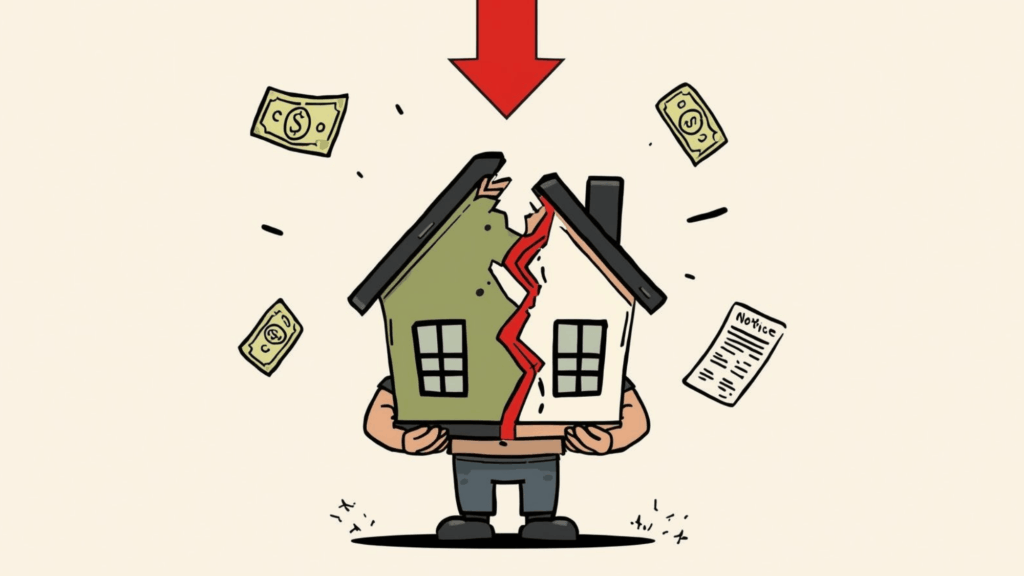
In the summer of 2006, a young couple in Phoenix signed the papers on a four-bedroom house they never imagined they could afford. The mortgage broker called it a “stretch loan”, but he assured them the payment would stay low for the first two years. Their income barely covered groceries and gas, yet the bank approved them in under a week. Two years later, that same couple stood on the lawn with boxes stacked beside them, watching a sheriff tape a foreclosure notice to the front door. Their story became one of millions swept up in the 2008 financial crisis.
Nearly a decade of quiet buildup led to the 2008 financial crisis, not a single dramatic afternoon or a single reckless boardroom decision. The pressure grew out of sight for most people, hidden inside mortgage paperwork, bank balance sheets, and products almost nobody outside Wall Street could name. Recognition came too late. Damage had already traveled through every corner of the global economy by the time the headlines caught up. This article walks through what really happened, why it happened, and what the event still teaches us today.
Watch the Money Nudge YouTube Video about the Dot-Com Bubble:
Prefer to watch instead of read?
Subscribe to The Money Nudge on YouTube for plain-English videos on money, investing, and economic topics.
Table of Contents
Setting the Stage: What the Economy Looked Like Before the 2008 Financial Crisis
Optimism defined the early 2000s across the United States. Growth looked steady, jobs felt secure, and the national mood leaned upward. The dot-com bubble had left its wreckage behind in 2000, prompting the Federal Reserve to slash interest rates as part of the recovery effort. Rates kept falling. By 2003, the federal funds rate had reached 1 percent, a level the country had not seen in decades.
Cheap borrowing costs changed the national mood. Credit became easy to access for nearly everyone, from large corporations to first-time homebuyers. Banks had more reason than ever to lend, and consumers had more reason than ever to borrow. Housing prices began climbing across almost every major market, and Americans began treating their homes as investments that could only appreciate.
Wall Street grew hungrier at the same time. Investment banks sought new products that could deliver strong returns in a low-interest-rate environment. Pension funds, foreign investors, and insurance companies sought safer options with higher yields than those offered by government bonds. All of these forces pushed money toward one place: the United States housing market.
Television shows celebrated house flipping. Magazines ran cover stories on ordinary people turning modest homes into six-figure paydays. Banks advertised mortgages with almost no paperwork required. The global financial crisis that would soon follow had its roots in this exact moment, when every incentive pointed toward borrowing more, lending more, and believing that home prices would keep climbing forever.
The Definition of Recession You Never Heard Before…
Read Article →What the Housing Bubble Was and How It Formed
A housing bubble happens when home prices rise far above what the actual value of those homes can justify. Buyers stop caring about fundamentals such as income, location, and long-term affordability. Instead, they buy because they expect prices to keep rising. That expectation fuels more buying, which pushes prices even higher, which confirms the expectation again.
During the housing bubble, home prices across the United States climbed at a pace almost no one had ever seen before. Values nearly doubled on average between 2000 and 2006. In cities such as Las Vegas, Miami, and Phoenix, entire neighborhoods posted 50 percent valuation jumps in a single year. Appraisers could barely keep pace with the market. Sellers received multiple offers within hours of listing, often above the asking price.
The housing bubble grew because everyone involved had reasons to keep it going. Buyers wanted the property before prices climbed again. Real estate agents earned higher commissions on higher sales. Banks collected more fees on larger loans. Mortgage brokers received bonuses for closing deals, regardless of whether the borrowers could repay. Rating agencies earned money grading mortgage products as safe investments. Each link in this chain later became part of the collapse story.
Economists who tried to warn about the bubble were largely ignored. The prevailing view held that housing, unlike stocks, had never crashed nationwide in modern American history. That belief turned into a dangerous assumption. Home prices, the thinking went, might stall in some regions, but they would never fall everywhere at once. The housing bubble grew on that faith, and the entire financial system came to depend on it.
Have You Ever Heard About The DOT-COM Bubble?
Read Article →Subprime Mortgages: The Engine That Fed the Bubble
Standard lending rules exist to protect banks from borrowers unlikely to repay. A subprime mortgage pushes past those rules, extending a home loan to someone who would normally be turned away. Borrowers in this category tend to share a few traits. Credit scores are usually low, income is often inconsistent, and savings accounts typically hold very little cushion. Traditional mortgages require steady income, documented employment, and a meaningful down payment. Subprime loans relaxed or eliminated most of those requirements.
During the bubble years, lenders created increasingly unusual mortgage products to stretch buyers further. Adjustable-rate mortgages started with very low “teaser” rates that reset to much higher payments after two or three years. Interest-only loans let borrowers pay nothing toward the principal for years. Stated-income loans, nicknamed “liar loans,” required no proof of actual earnings.
Many borrowers had no real understanding of what they were signing. Mortgage brokers walked them through dense paperwork and promised that rising home values would let them refinance before the higher payments kicked in. For a few years, that promise held. Homes appreciated quickly enough that owners could borrow against the new equity or sell at a profit.
Looking back, these practices laid the foundation for what came next, long before most Americans heard the phrase “subprime loan.” The subprime mortgage crisis grew out of a simple truth that most people ignored. Lenders kept approving these loans because they did not plan to keep them. Once a mortgage was closed, banks packaged it up with thousands of others and sold the bundle to Wall Street. The risk moved down the chain, and no single institution felt responsible for whether the borrower could actually pay.
Mortgage-Backed Securities and Collateralized Debt Obligations Explained Simply
Wall Street took those millions of home loans and turned them into something called a mortgage-backed security. Picture a giant pool of home loans combined into one big bucket. Investors could buy a slice of that bucket and receive monthly income from all the mortgage payments. It worked like buying a share of a rental property, except the rental was thousands of homes scattered across the country.
Mortgage-backed securities seemed attractive because they offered higher returns than government bonds and were backed by something real: houses. Credit rating agencies gave many of these products the highest possible ratings, marking them as safe as U.S. Treasury debt. That rating allowed pension funds, foreign banks, and city governments to buy them.
Collateralized debt obligations, usually shortened to CDOs, took the idea further. A CDO grouped many mortgage-backed securities and divided them into risk tiers. The top tier got paid first and received the highest rating. The middle tier paid next. The bottom tier absorbed losses first, but it also offered the highest returns.
Here is where the system went wrong. Wall Street packaged low-quality subprime loans into CDOs, mixed them with slightly better loans, and sold the resulting product as high-grade investment material. Most buyers had no way to see what was actually inside. Banks even created CDOs composed entirely of other CDOs, layering complexity until no one truly understood the underlying risk. The 2008 economic crisis would eventually expose the fragility of this entire structure.
The Collapse Begins: Rising Defaults and the Fall of Lehman Brothers
The first cracks of the 2008 financial Crisis appeared in 2006 as home prices stalled. Borrowers with adjustable-rate mortgages hit their reset date, and monthly payments jumped by hundreds or even thousands of dollars. Many could not refinance because home values had stopped climbing. Defaults started spreading across subprime loans.
Bankruptcy filings began targeting subprime-focused mortgage companies in early 2007. New Century Financial fell first among the giants, collapsing in April after years of ranking among the largest subprime lenders in America. HSBC took billions in losses on its American mortgage division. Bear Stearns delivered another shock, revealing that two of its hedge funds had been wiped out almost entirely by failed mortgage bets. Each failure looked isolated at first, but the pattern became harder to ignore.
Throughout 2007 and into 2008, losses multiplied across the financial system. Banks that had packaged and sold mortgage products still held huge piles of them on their own books. Nobody could accurately say how much these assets were worth, because nobody wanted to buy them anymore. Financial institutions began doubting one another, and short-term lending between banks began to freeze.
Lehman Brothers, a 158-year-old investment bank, became the breaking point. On September 15, 2008, Lehman filed the largest bankruptcy in American history. The federal government chose not to rescue it, hoping the move would signal discipline. Instead, it triggered panic. Stock markets crashed worldwide within hours. Credit markets froze entirely. Major financial institutions that had survived for more than a century suddenly faced collapse. The financial crisis explained in real time, on every screen, in every country.
How the 2008 Financial Crisis Spread Around the World
The United States did not suffer alone. European banks had eagerly bought American mortgage-backed securities, convinced by their AAA ratings that the investments were safe. German regional banks, British lenders, French insurers, and Swiss giants all held billions in American housing debt. When those assets lost value, losses rippled through every major financial center.
One of the earliest casualties of the 2008 financial crisis outside the United States was Iceland. Years of aggressive foreign investment had inflated its three largest banks into institutions worth many times the size of the entire Icelandic economy. Credit markets froze, and all three collapsed inside a single week. The national currency lost most of its value almost overnight. Effective bankruptcy followed for the country itself.
Ireland, Spain, Portugal, and Greece soon followed with their own housing and banking disasters. European countries that had binged on cheap credit during the boom years now faced crushing debt loads. Governments had to rescue failing banks, and that rescue cost pushed several nations close to default. The eurozone debt crisis, which dominated headlines for years afterward, traced its origins directly to the 2008 collapse.
Emerging markets felt the 2008 financial crisis shock differently. Countries like Brazil, Russia, and South Africa relied on foreign investment and commodity exports. As Western banks pulled money home to cover losses, capital left these economies in a series of massive waves. Currencies tumbled, stock markets fell, and growth slowed sharply across the developing world. The global financial crisis earned its name because no corner of the world economy was left untouched.
The Human Cost: Jobs, Homes, and Retirement Savings
Numbers can describe the scale of the damage, but they rarely capture its weight. The human toll of the 2008 financial crisis reached levels rarely seen outside wartime. In the United States alone, roughly 8.8 million jobs disappeared between 2008 and 2010. The unemployment rate climbed from under 5 percent to 10 percent in less than two years. Young people entering the workforce faced the worst job market in generations, and many spent years underemployed or out of work entirely.
Foreclosures became a defining image of the era. Nearly 10 million American families lost their homes between 2006 and 2014. Entire neighborhoods emptied as abandoned houses outnumbered occupied ones. Cities like Detroit, Cleveland, and Stockton saw property values collapse so severely that some homes sold for less than a used car.
Retirement savings also took a brutal hit. The stock market fell roughly 57 percent from its 2007 peak to its 2009 low. Americans close to retirement watched decades of saving vanish in a matter of months. Many delayed retirement by years. Others returned to work after already retiring because their nest eggs could no longer cover basic living expenses.
The emotional damage of the 2008 financial crisis ran just as deep. Studies later linked the crisis to higher rates of depression, anxiety, and family breakdown. Children of affected families moved schools, lost stability, and carried the stress of financial uncertainty into adulthood. The numbers tell one story, but the lasting trauma tells another.
How Governments and Central Banks Responded
Policymakers faced a choice with no easy answer. Letting major banks fail might feel like justice, but it also risks collapsing the entire financial system. Rescuing them meant using taxpayer money to save the institutions that caused the disaster. Governments around the world chose to rescue, and the scale of intervention was unprecedented.
The United States enacted the Troubled Asset Relief Program (TARP) in October 2008. The program authorized $700 billion to buy toxic assets and inject capital into banks. Critics called it a bailout for Wall Street. Supporters argued it prevented a second Great Depression. The truth sat somewhere in the middle. Most of the money was eventually repaid, but public trust in the financial system took years to recover, if it recovered at all.
Central banks moved with equal speed. The Federal Reserve cut interest rates to near zero. It launched an emergency program called quantitative easing, buying trillions of dollars in government bonds and mortgage-backed securities to push money into the economy. Other major central banks followed suit within weeks.
The European Central Bank pushed rates down and expanded its balance sheet. Across the English Channel and further east, similar programs took shape. Bond purchases became the Bank of England’s core tool. The Bank of Japan built out its own large-scale buying effort along comparable lines. Calm gradually returned to the trading floors as the combined weight of all this intervention took hold. A different problem settled in behind the calm, though. The world entered a period of ultra-low interest rates that would last more than a decade.
Alongside the financial rescues, governments rolled out stimulus packages on a scale rarely seen in peacetime. In early 2009, the American Recovery and Reinvestment Act was enacted into law. Roughly $800 billion flowed through the program, aimed at infrastructure projects, unemployment benefits, tax cuts, and direct aid to states. China launched its own massive stimulus, spending more than $500 billion on construction and industrial projects. These programs blunted the worst of the downturn, yet recovery remained slow and uneven for years.
What Changed Permanently After the 2008 Financial Crisis
The 2008 financial crisis rewrote the rulebook for financial regulation. Congress passed the Dodd-Frank Act in 2010, the most sweeping overhaul of American financial law since the Great Depression. Several major changes emerged from the law at once. New oversight agencies took shape, risky trading activity at banks faced fresh restrictions, and derivatives markets came under disclosure rules they had long avoided. Protection for ordinary borrowers against predatory lending arrived through a brand-new watchdog, the Consumer Financial Protection Bureau.
Banks faced stricter capital requirements worldwide. Under the Basel III framework, international regulators forced large banks to hold more reserves against potential losses. Stress tests became routine, requiring institutions to prove they could survive severe economic shocks. These changes made the financial system more resilient against another global financial crisis, even if they did not eliminate risk.
Consumer attitudes shifted as well. An entire generation grew up watching parents lose homes, jobs, and savings. Younger Americans became more cautious about debt, more skeptical of homeownership, and more distrustful of large financial institutions—many delayed major life milestones, such as buying a house or starting a family. The emotional scar tissue affected spending, saving, and investing patterns for more than a decade.
Financial institutions also changed how they operated. The wild products that fueled the boom, such as no-documentation loans and synthetic CDOs built from other CDOs, largely disappeared. Compliance departments grew dramatically. Executive compensation rules tightened in many countries. The industry did not become harmless, but the specific combination of recklessness that produced the crisis became much harder to repeat.
Lessons the 2008 Financial Crisis Still Holds Today
Lessons from the 2008 financial crisis carry just as much weight now as they did in 2009—the first concerns stability itself, which often proves to be an illusion. Every surface indicator in the years before the collapse pointed toward strength. Housing looked solid, banks appeared healthy, and the broader economy seemed to be growing steadily. The data read clean right up to the moment it fell apart. Calm markets do not always mean safe markets.
A second lesson involves complexity. When financial products become so layered and opaque that almost no one, including the people selling them, understands them, trouble tends to follow. Investors who could not explain what they owned ended up holding enormous losses. Simpler is often safer, and clarity tends to beat cleverness over the long term.
The third lesson concerns debt. Easy borrowing feels like an opportunity when credit flows freely, yet it shifts into a burden the moment conditions tighten. Families, companies, and governments that stretched themselves thin during the boom had the fewest options when the bust arrived. Living within means, keeping reserves, and resisting the pull of inflated asset prices remain quiet forms of protection that are easy to dismiss until they are desperately needed.
Finally, the 2008 financial crisis revealed how deeply connected the global economy has become. A mortgage default in an American suburb rippled into a bank failure in Iceland, a recession in Germany, and a currency collapse in Argentina. Financial health in one country depends on financial discipline in many others. That reality has only grown stronger in the years since.
Final Thoughts: Why the 2008 Financial Crisis Still Matters
The 2008 financial crisis stands as one of the defining economic events of the modern era. It reshaped regulations, redirected careers, and rewrote the financial plans of hundreds of millions of people. Its roots lay in ordinary human behavior: overconfidence, short-term thinking, and a willingness to believe that good times would never end.
Looking back, the 2008 economic crisis feels both specific and familiar. The exact combination of subprime lending, mortgage-backed securities, and layered derivatives may never repeat in the same form—the underlying human tendencies, however, never really go away. New bubbles form in new places using new instruments, and each generation tends to rediscover the same hard lessons about risk, leverage, and crowd psychology.
Understanding what happened in the 2008 economic crisis helps make sense of the financial world we live in today. Low interest rates, tighter bank rules, heavier regulation, and cultural skepticism toward Wall Street all trace back to that single event. The crisis did not just change markets. It changed how ordinary people think about money, security, and the promises institutions make. Knowing the history is not just an academic exercise. It is a way of recognizing the warning signs the next time stability starts to feel too easy to believe in.
Watch It Instead
The Money Nudge — YouTube Channel
Prefer watching over reading? Every topic on this blog also comes to life as an animated video on our YouTube channel — where we make money talk even more simply.
Visit Our Channel