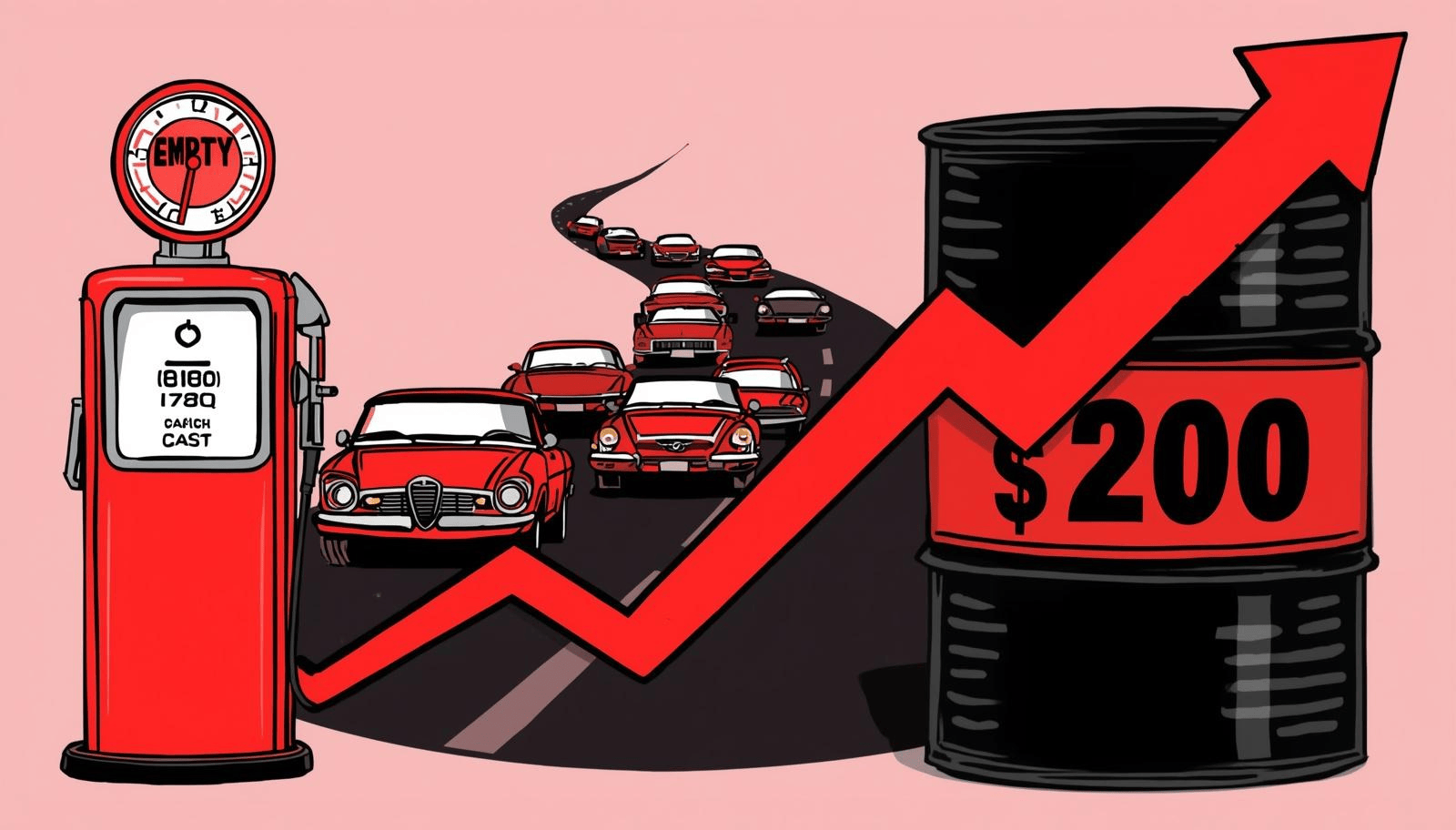
Imagine waking up to find that gas costs more than yesterday, groceries cost more than last week, and the company you work for just announced another round of layoffs. No raise is coming. Prices keep climbing anyway. The usual ways out have quietly closed.
That trap has a name. Economists call it stagflation, and it is one of the most painful economic conditions ordinary people can live through. The reason it hurts so much is not just the numbers. It is that every standard fix governments reach for makes the other half of the problem worse.
The 1970s showed America what that looks like. It took a decade, a brutal recession, and one of the most controversial decisions in Federal Reserve history to finally break it. Here is the full story of how it happened, why it haunts central bankers today, and whether it could ever come back.
Prefer to watch instead of read?
Subscribe to The Money Nudge on YouTube for plain-English videos on money, investing, and economic topics.
Table of Contents
What Is Stagflation? The Stagflation Definition in Plain Language
The word itself is a clue. Stagflation is a blend of two words: stagnation and inflation. Stagnation means the economy stops growing. Businesses slow down. Hiring freezes. Unemployment rises. Inflation means prices keep climbing. Groceries cost more. Gas costs more. Rent costs more. The stagflation definition combines those two conditions into a single term because they appeared together in a way that economists had not expected.
In a healthy economy, growth and price increases tend to move together. Companies hire when demand is strong. Prices rise gradually as wages rise. People spend, businesses expand, and the cycle continues. In a downturn, the opposite usually happens. Demand cools, hiring slows, and prices stop rising or even fall. Each side of the cycle has familiar pain points, but each one also has familiar tools to manage them.
Stagflation breaks that pattern. The economy contracts while the price level rises. Workers lose their jobs while the cost of feeding a family keeps rising. Savings lose value because every dollar buys less, and the labor market offers fewer ways to earn more dollars to compensate. Households get squeezed from both directions at once, and the squeeze can last for years.
That is the simplest way to understand stagflation. It is the rare economic storm in which two things that are not supposed to happen at the same time do, and the people caught underneath it pay the price.
This Definition Of Interest Rate Will Change Your Financial Lifestyle
Read Article →Why Stagflation Is So Unusual and So Hard to Manage
Most economic problems have a clear playbook. When the economy overheats and prices rise too quickly, the central bank can raise interest rates to cool demand. Borrowing becomes more expensive, consumers spend less, businesses invest less, and price pressure eases. When the economy stalls and unemployment rises, the central bank can lower interest rates to stimulate borrowing, spending, and hiring. Each problem has its own lever.
Stagflation breaks that toolkit. Raising interest rates to fight rising prices worsens the slowdown because borrowing becomes harder for households and businesses, leading to more layoffs and weaker growth. Cutting interest rates to fight unemployment makes the price problem worse because cheaper credit pushes more spending into an economy that is already producing too few goods at affordable prices.
This is the central tension at the heart of stagflation. The medicine for one disease worsens the other. Policymakers are forced to choose which problem to attack first, knowing that the other will get worse before it gets better.
That choice is not just economic. It is deeply political. Tackling inflation first means accepting higher unemployment, more business failures, and a recession that may last for months or years. Tackling unemployment first means accepting that prices will keep climbing, savings will keep losing value, and the cost of basic goods will continue to strain household budgets. There is no clean answer, and that is why stagflation is feared by every central banker who has studied it.
Have You Ever Wonder If We Are In A Recession?
This article explains in simple language how to determine a recession.
Read Article →What Normal Economic Conditions Look Like
Before the 1970s, economists believed there was a fairly reliable relationship between unemployment and inflation. The idea was straightforward. When unemployment was low, lots of people had jobs and money to spend, so prices tended to rise. When unemployment was high, fewer people had income to spend, so prices tended to flatten or fall.
This relationship was captured in a concept called the Phillips Curve, named after economist A.W. Phillips, who studied wage and unemployment data in Britain in the 1950s. The Phillips Curve described a trade-off between the two. Policymakers could choose. More inflation tended to accompany lower unemployment. Lower inflation tended to go with higher unemployment. The two moved in opposite directions, and governments could pick the mix they preferred.
For decades, that idea worked well enough to guide policy. Central banks and finance ministers used it as a dial. Loosen the money supply and reduce unemployment, but accept some inflation. Tighten the money supply and reduce inflation, but accept some unemployment. The trade-off was uncomfortable, yet it was at least understood. There was a logic to it.
Then came the 1970s, and the dial stopped working. Unemployment and inflation rose together. The Phillips Curve, which had been treated almost as a law of nature, suddenly seemed to describe a world that no longer existed. That broken assumption was the first sign that something fundamentally different was happening to the American economy, and it took years for economists to make sense of it.
The Historical Context: A World Unprepared for Stagflation
To appreciate how stunning the 1970s really were, it helps to understand the decades that came before. From the end of World War II through the late 1960s, the United States enjoyed one of the longest stretches of economic prosperity in its history. Wages grew. Homeownership expanded. Cars, appliances, and televisions filled American living rooms. Manufacturing dominated the global economy, and the U.S. dollar was the anchor of the international financial system.
During those years, inflation was generally low and steady. Recessions happened, but they tended to be short and shallow. Economists grew confident that they understood the levers of the economy well enough to prevent any return to the chaos of earlier decades. The Great Depression of the 1930s had taught hard lessons, and the post-war boom seemed to confirm that those lessons had been learned. Tools like monetary policy and government spending could smooth out the cycles. Crises were not gone, but they were manageable.
That confidence shaped the way economists thought about price stability. The idea that high inflation and high unemployment could coexist for an extended period was treated almost as impossible. The models did not account for it. The textbooks did not teach it. Even seasoned policymakers did not have a name for it until the term stagflation entered common use in the 1970s.
When the storm finally hit, the country was unprepared. The traditional tools failed to deliver their expected results. The economic profession went into a long period of self-examination. The conditions that had once seemed unthinkable were now lived experience for millions of American households, and a generation of economists had to rebuild their understanding from the ground up.
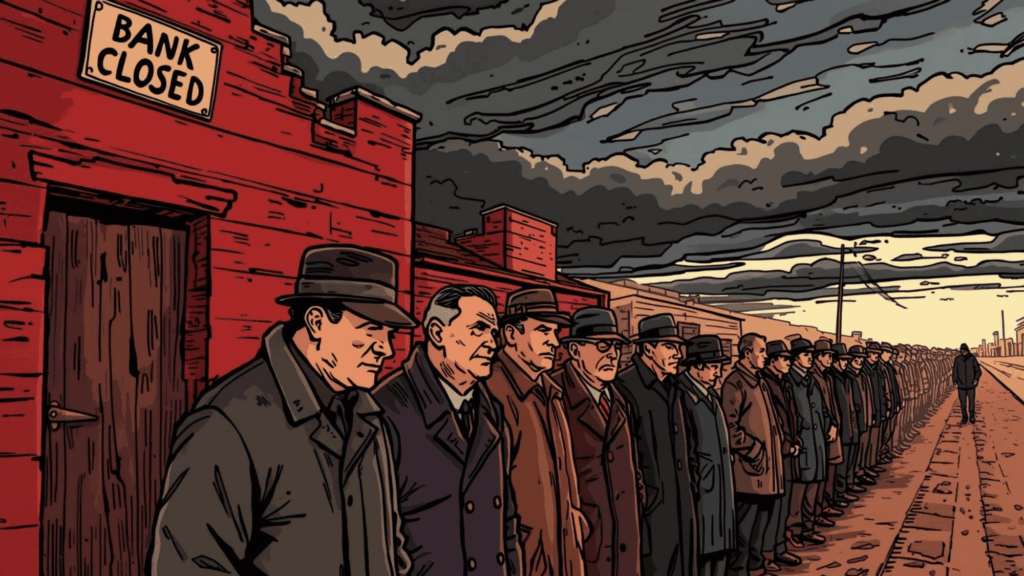
Do You Know What Really Happened During The Great Depression?
This article will tell you everything you need to know about the great depression.
Read Article →The 1970s Stagflation Crisis: What It Felt Like for Ordinary Americans
The 1970s opened with the U.S. economy already showing strain. Government spending on the Vietnam War, along with expansions of domestic programs, had pushed inflation higher than it had been in years. The U.S. had also abandoned the gold standard in 1971, which loosened a major anchor on the dollar’s value. Then, in 1973, the situation tipped from difficult into severe.
For ordinary Americans, the decade became a long lesson in economic anxiety. Gas station lines stretched around blocks. Some states rationed fuel by license plate number. Grocery prices climbed month after month. Housing costs rose sharply. Workers who had grown accustomed to steady raises found that their pay increases lagged far behind the rising cost of living. A 5% raise felt like a step backward when prices were climbing by 10%.
Unemployment crept upward at the same time. Factories closed. Steel mills laid off thousands of workers in the Midwest. Manufacturing towns that had thrived in the 1950s began to hollow out. Younger workers entering the labor market found fewer opportunities. Older workers who lost their jobs found it harder to start over. The standard American story of working hard and getting ahead began to break down for entire regions.
Savings accounts offered little protection. Interest rates on bank accounts did not keep up with inflation, so money sitting in savings actually lost purchasing power year after year. Households that had been careful and frugal watched their financial cushion shrink in real terms. The American middle class, which had taken pride in its stability, was being squeezed from every direction at once.
By the late 1970s, inflation was running above ten percent annually, and unemployment was also high. The combination created a sense that the economy had become unmoored. Politicians offered explanations and quick fixes, but nothing worked. Public trust in institutions eroded. Families adjusted by cutting back, doubling up, and delaying major life decisions. The mood of the decade, captured in films, music, and journalism of the time, carried a kind of weary frustration that ran through the culture.
The Role of the 1973 Oil Crisis in Triggering Stagflation
A single event in October 1973 turned a difficult decade into a defining one. The Organization of Arab Petroleum Exporting Countries announced an oil embargo against the United States and several other Western nations in response to American support for Israel during the Yom Kippur War. Within months, the price of crude oil quadrupled. For the full story of that moment, see our deep dive on the oil crisis of 1973.
Oil was not just a fuel. It was an input into nearly every part of the modern American economy. Trucks ran on it. Factories used it. Plastics, fertilizers, asphalt, and synthetic materials all depended on it. When the price of oil quadrupled almost overnight, the cost of producing and transporting nearly every product in the country went up with it.
This is what economists call a supply shock. A sudden disruption to a critical input forces prices up across the board, even when consumer demand has not changed. Unlike inflation driven by too much spending, supply-shock inflation cannot be cooled by raising interest rates without also crushing growth, because the source of the price pressure is not on the demand side at all.
The oil crisis pushed inflation higher and pushed economic activity lower. Factories that depended on cheap energy saw their costs explode. Some scaled back production. Others shut down entirely. Workers lost jobs while consumers paid more for everything from heating oil to groceries. The two halves of stagflation, the rising prices and the falling output, were now feeding each other.
The crisis also exposed how dependent the United States had become on imported energy. Domestic oil production had peaked years earlier, and the country was importing a growing share of its needs. That vulnerability would shape American foreign policy and economic strategy for decades afterward. Still, in the short term, it left households and businesses with no real shield against rising fuel costs.
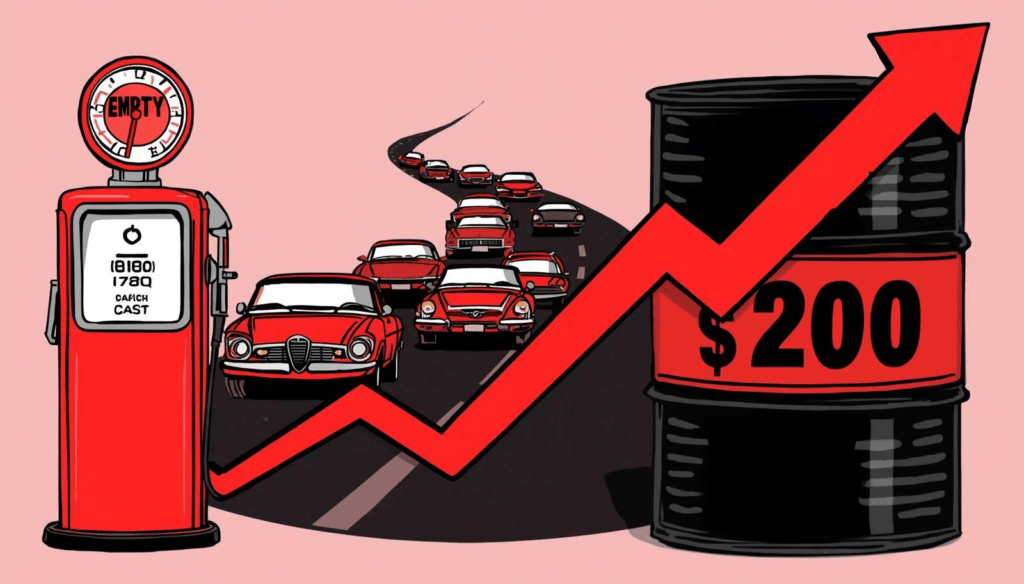
Do You Want To Know More About The 1973 Oil Crisis?
This article will talk about the 1973 oil crisis and how it shaped the world economy.
Read Article →The Federal Reserve Response: Raising Interest Rates Under Paul Volcker
By the end of the 1970s, the situation had reached a breaking point. Inflation was running near fourteen percent. Confidence in the dollar was shaken at home and abroad. President Jimmy Carter appointed a new Federal Reserve Chair in 1979 to confront the crisis. His name was Paul Volcker.
Volcker delivered a stark message. Inflation had to be broken, and the only way to do so was to make money so expensive that it choked off the price spiral. Under his leadership, the Federal Reserve raised the benchmark interest rate to historic levels. By 1981, the federal funds rate had reached nearly 20%. Mortgage rates climbed past eighteen percent. Loans of any kind became prohibitively expensive.
This was monetary policy taken to its absolute limit. The reasoning behind it was painful but consistent. If inflation were being driven by too much money chasing too few goods, then making money dramatically harder to borrow would force demand down across the entire economy. Businesses would cancel projects. Consumers would delay purchases. Hiring would freeze. The price spiral would break because the underlying demand fueling it would collapse.
Volcker knew this would cause severe short-term damage, and he accepted that as the cost of doing the job. His goal was not to manage inflation gently. It was to crush the expectation of inflation itself, because once people stopped believing prices would keep rising, the cycle would begin to unwind. Wages would stop chasing prices. Businesses would stop raising prices in anticipation of higher costs. The momentum behind the inflation would die.
The decision was not popular. Politicians from both parties criticized the Federal Reserve. Construction workers, farmers, and small business owners protested. Volcker received threats and required security protection. Yet he held the line. The interest rate stayed high until the inflation rate finally began to fall, and the country was forced to absorb the consequences of that decision.
The Human Cost of the Volcker Shock
The medicine worked, but the patient suffered. The early 1980s brought one of the deepest recessions since the Great Depression. Unemployment climbed past ten percent in 1982. Entire industries contracted. Farm foreclosures spread across the Midwest as agricultural producers, who had borrowed heavily at lower rates in the 1970s, could no longer afford their debt service.
Housing collapsed under the weight of mortgage rates that pushed homeownership out of reach for millions. Auto sales fell sharply because car loans became too expensive for ordinary buyers. Manufacturing towns that had already been wounded in the 1970s saw factories close permanently. Some communities never recovered, and the term Rust Belt entered the national vocabulary to describe regions left behind.
For ordinary Americans, the early 1980s recession was brutal. Workers laid off in 1981 or 1982 sometimes spent a year or more looking for new jobs. Families lost homes. Small businesses closed. The country’s mood, already battered by the 1970s, sank further before it began to rise.
What made it bearable for policymakers was the conviction that the alternative was worse. Allowing inflation to continue would have permanently damaged the dollar, destroyed long-term savings, and left the country with a chronic problem that would only deepen over time. The Volcker shock was treated as a painful but necessary trade-off, the kind of choice that comes only when easier options have all failed.
Economists and historians still debate the human cost of those years. Critics argue that the recession was deeper than it needed to be, that the burden fell unfairly on workers and homeowners, and that smarter policy could have eased the pain. Defenders respond that the country had already absorbed years of inflationary damage, and that ending it required a decisive break with the old pattern.
How Stagflation Was Finally Brought Under Control
By 1983, inflation had fallen sharply. The combination of high interest rates, a deep recession, and lower oil prices broke the cycle. Volcker began easing the federal funds rate as price pressures faded. Unemployment, which had peaked in 1982, started a long decline. The economy entered a long expansion that would carry through most of the rest of the decade.
The recovery did not erase the damage. Wages for many workers took years to catch up. Some industries never returned to their pre-crisis size. Yet the broader pattern of stagflation was over. Inflation expectations had been reset. Businesses stopped raising prices in anticipation of more inflation. Workers stopped demanding wage increases tied to expected price spikes. The cycle that had fueled the 1970s lost its momentum.
The lesson policymakers took away was a hard one. Once inflation becomes embedded in expectations, it is very difficult to remove without significant economic pain. Preventing it from taking root in the first place is far easier than breaking it after it has set in. That belief shaped central bank policy for decades afterward. Inflation targeting, a framework in which central banks publicly commit to keeping inflation near a specific target, emerged from the lessons of the 1970s and the Volcker years.
Another lesson was the importance of central bank independence. Volcker was able to act because the Federal Reserve was insulated from short-term political pressure. Had the central bank been forced to bow to elected officials desperate for relief, it would not have been able to maintain its course long enough to break the inflation cycle. That independence is now a defining feature of most major central banks worldwide.
The cost of fixing stagflation was high, but the precedent was established. Future generations of policymakers would carry that memory with them and treat the early signs of stagflation with deep concern.
Can Stagflation Happen Again? The Warning Signs Today
Modern economies are not immune to the conditions that produced the 1970s. Several developments in recent years have brought stagflation back into public conversation, even if the full combination has not returned.
Energy markets remain vulnerable to disruption. Conflicts in oil-producing regions, sudden shifts in production agreements among major exporters, and the long transition toward cleaner energy sources can all push prices higher, with ripple effects across the broader economy. A new oil shock today would carry many of the same risks it carried in 1973.
Supply chains have also shown their fragility. The pandemic years revealed how disruptions to global shipping, manufacturing, and labor markets can create sudden shortages of goods. Those shortages drove price increases across many categories at once, while growth in some sectors stalled. The conditions did not become a true stagflation episode, but they offered a preview of how supply shocks can mimic some of its features.
Labor markets matter too. When workers cannot find jobs while the cost of living keeps climbing, the squeeze begins to look familiar. Productivity growth, which raises living standards by letting workers produce more with the same effort, has slowed in many developed economies. If productivity stays weak while energy or material costs rise, the conditions for stagflation become easier to imagine.
Central banks closely monitor all of these signals. The memory of the 1970s shapes how the Federal Reserve and other monetary authorities react to early signs of persistent inflation. The willingness to raise interest rates aggressively, even at the cost of some growth, comes directly from the lessons of the Volcker era. The fear of a return to embedded inflation runs deep in the institutional memory of every major central bank.
Whether a full-blown stagflation event returns depends on factors hard to predict. Geopolitical shocks, climate disruptions, shifts in global trade, and demographic changes all play a role. What economists know for sure is that stagflation is not a relic of the past. It is possible to return whenever a major supply shock meets a slowing economy at the wrong moment.
How Stagflation Connects to Inflation, Recession, and Interest Rates
Stagflation does not exist in isolation. It sits at the intersection of three of the most important concepts in economics, and understanding the connections makes the whole picture clearer.
Inflation describes a general rise in prices. It can be driven by strong demand, rising input costs such as oil and labor, or an expansion of the money supply. Stagflation always includes inflation, but the inflation that drives it tends to come from the cost side rather than the demand side. That is why traditional inflation-fighting tools have such painful side effects during a stagflation episode.
A recession describes a sustained decline in economic activity. Jobs are lost, output falls, and consumer spending contracts. Stagflation always includes the conditions of a recession, but unlike a normal recession, the price level keeps rising. The recession itself becomes harder to end because the usual response of lowering interest rates would worsen the inflation problem.
Interest rates are the central tool that ties the other two concepts together. They are how central banks influence borrowing, spending, and investment across the whole economy. In a normal cycle, raising rates fights inflation and lowering rates fights recession. In stagflation, the central bank has to pick which problem to fight, and the choice forces real pain on real households.
The reader who understands these three concepts together understands why stagflation is treated with such respect in economic history. It is not a separate disease. It is a rare moment when the diseases that normally take turns showing up arrive together, and the medicines that normally treat them end up working against each other.
Final Thoughts: Why Stagflation Still Matters
Stagflation is the kind of economic story that lives on because the lessons it teaches still apply. It reminds people that economies are not just numbers in a chart. They are the lived experiences of households trying to plan, save, and build a stable life. When the rules of the economy seem to break, it’s those households who feel it first and longest.
The 1970s episode showed how a combination of bad luck, structural change, and policy mistakes can produce a crisis that takes more than a decade to resolve. The Volcker shock showed that the cure can be as painful as the disease, and that breaking inflation once it has set in requires a kind of resolve that is politically very hard to maintain. Together, those lessons shape how central banks, governments, and ordinary citizens think about price stability today.
For the general reader, understanding stagflation goes beyond history. It clarifies why central banks react the way they do to early warnings of rising prices. It explains why economists worry about supply shocks even when growth looks healthy. And it gives a deeper appreciation for how interconnected the parts of a modern economy really are.
Money talk doesn’t have to be intimidating. It just needs to be grounded in the real conditions that shape ordinary life. Stagflation is one of those conditions, and understanding it is one more step toward seeing the financial world for what it actually is.
Watch It Instead
The Money Nudge — YouTube Channel
Prefer watching over reading? Every topic on this blog also comes to life as an animated video on our YouTube channel — where we make money talk even more simply.
Visit Our Channel