Most people learn the warning about eggs and baskets long before they ever open a bank account or buy a single share of stock. A grandmother says it during a family dinner. A teacher repeats it during a lesson about risk. A friend mentions it after a bad investment decision. The phrase sounds almost too simple to matter. Yet, it describes one of the most important ideas in personal finance: diversification. Once you understand what diversification actually means, and why ignoring it creates damage that stays hidden until it is too late, you start making very different decisions with your money.
This article breaks down diversification in plain language, without investment jargon or a lecture on portfolio theory. It starts with the basket, moves into the money, and shows exactly why spreading things out protects you in ways that concentration never can. This is the logic behind one of the oldest pieces of financial wisdom, explained clearly enough that you will never look at your own money the same way again.
Prefer to watch instead of read?
Subscribe to The Money Nudge on YouTube for plain-English videos on money, investing, and economic topics.
Table of Contents
What Diversification Means Before It Ever Touches Your Money
For anyone asking what diversification is in the simplest possible terms, the answer has nothing to do with investing at first. Diversification means spreading resources across more than one place so a single failure cannot take everything down at once. It applies to almost every part of daily life, long before anyone thinks about stocks or savings accounts.
Consider a freelancer who works for only one client. The income feels stable until that client cuts the contract, changes direction, or closes the business entirely. In a single afternoon, the freelancer loses their entire source of income, not through any fault of their own, but because their livelihood depends on one relationship. A freelancer with five clients faces the same basic risk, yet losing one client only removes a fraction of the income instead of all of it. That difference is not luck. It is diversification.
A small restaurant shows the same pattern from a different angle. A restaurant that buys every vegetable it uses from a single supplier runs smoothly until that supplier has a bad harvest, raises prices sharply, or goes out of business. Suddenly, the entire menu is at risk because of a relationship with one supplier, even though nothing about the restaurant itself has changed. A restaurant that works with three or four different suppliers can absorb a problem with any one of them without shutting down the kitchen. The business is not necessarily better in either case. It is simply less exposed to a single point of failure.
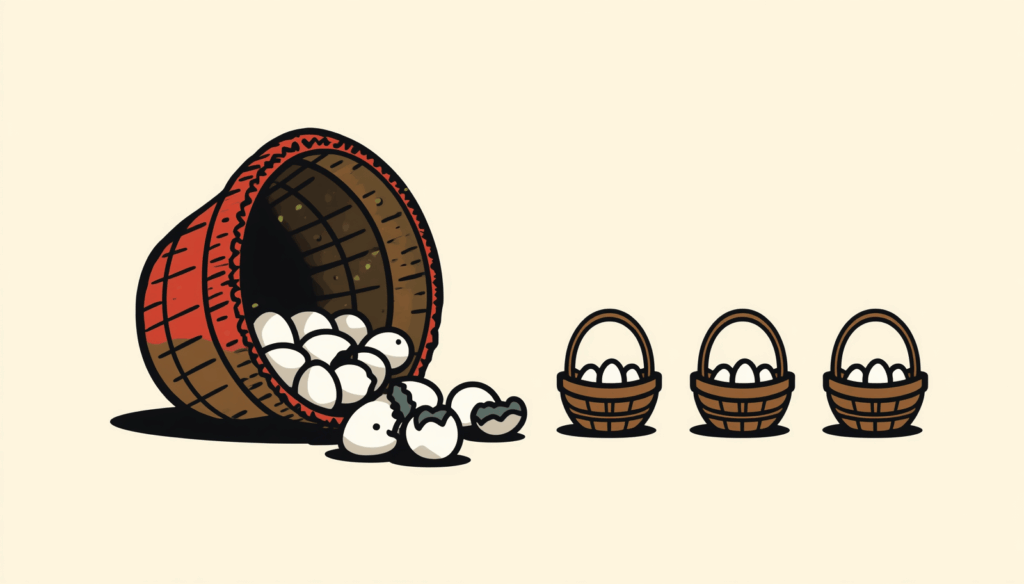
The same logic explains the phrase this article opened with. A farmer who fills one basket with every egg the henhouse produces is one dropped basket away from losing the entire harvest. A farmer who spreads those eggs across several baskets protects the harvest from a single accident. The eggs themselves do not change. Only the distribution changes, and that distribution is the entire concept of diversification captured in one simple image.
Money behaves the same way. When someone places all savings in a single stock, property, or business, they are filling a single basket. It does not matter how much trust that investment has earned. A single event, whether a company scandal, a market downturn, or a local economic shift, can damage or destroy that one basket entirely. Diversification is simply the financial version of using more than one basket. With diversification explained through a freelancer, a farmer, and a basket of eggs, the financial version becomes much easier to recognize.
Why Every Personal Budget You Have Tried Has Failed (And What to Do Instead)
Read Article →Why Concentrating Your Money in One Place Creates a Risk You Cannot See
Understanding why diversification matters starts with recognizing a kind of risk that rarely feels dangerous while things are going well. A person holding a large position in one stock watches the value climb and feels confident, even proud. Nothing on a bank statement or brokerage account warns that person that their financial future now depends entirely on one company staying healthy. That warning does not exist because the concentration risk remains invisible until something goes wrong.
Most financial risks come with a visible signal. A high credit card balance shows up as a steadily increasing number each month. A missed payment triggers a notice. Concentration risk works differently. No line item on a statement says that ninety percent of a person’s net worth depends on one company. That missing warning label is exactly what makes concentrated risk so dangerous. People rarely manage what they cannot see, and concentration hides in plain sight inside a portfolio that otherwise looks completely normal.
Familiarity often makes this worse. People tend to feel safest holding what they already know well, such as shares in their own employer or a company whose products they use every day. That familiarity feels like knowledge, and knowledge feels like safety. Neither of those feelings has much to do with how concentrated the actual risk has become. A company can be genuinely excellent and still pose a dangerous level of concentration if it accounts for most of a person’s net worth.
Imagine an employee who works for a large, respected company for twenty years. Over that time, the company matches retirement contributions with company stock. By the time the employee is ready to retire, most of that net worth sits in shares of the same employer. The company has always seemed stable.
Then a scandal breaks, or a new competitor disrupts the industry, and the stock price falls sharply within months. Most of that retirement account evaporates in a matter of weeks. On top of that, the paycheck that used to come from the same company may disappear. Two separate parts of that person’s financial life depended on the same source throughout. That is the hidden part of concentration risk. It is not only about one investment falling. It is about how many parts of a financial life secretly depend on a single outcome.
What Is Net Worth and Why Is It the Only Number That Truly Measures Your Financial Health
Read Article →How Diversification Works With Your Money
In practice, diversification means holding a mix of investments rather than committing money to a single one. Instead of buying shares in only one company, a diversified approach might spread money across many companies in different industries. Instead of holding only stocks, it might include bonds, cash, and other assets. The specific mix depends on individual goals and comfort with risk, but the underlying idea stays the same. No single investment should hold the power to make or break an entire financial future.
This does not require selecting dozens of individual investments by hand. Many people build a diversified base simply by owning funds that already hold hundreds or thousands of individual holdings. The mechanics matter less than the outcome. A diversified investor absorbs bad news about any single company, industry, or event without watching an entire financial picture collapse at the same time.
It also does not require a large amount of money to begin. A common misunderstanding is that spreading money around is only possible once someone has significant savings. In reality, a person contributing a small amount from every paycheck can still hold a mix of many different companies and asset types from the very first contribution. This works because a single modern fund already gathers small amounts from thousands of everyday investors and puts that combined pool to work across a wide range of holdings. The account’s size changes over time. The underlying principle does not need to change at all.

What Is an Index Fund and Why Is It the Most Recommended Investment for Beginners
Read Article →The Three Ways People Diversify Their Money
Diversifying investments generally happens across three layers. Understanding each layer makes the concept far less abstract and much easier to apply.
Asset Types
The first layer is the asset type. Stocks, bonds, real estate, and cash all behave differently under the same economic conditions. Stocks tend to grow faster over long periods but swing more sharply in the short term. Bonds tend to move more slowly and often hold up better when stock prices fall. Cash does not grow much, yet it stays stable and accessible. Spreading money across these different asset types means a downturn in one area does not automatically damage everything else.
Industries
The second layer is industry. Two companies can technically be different stocks, yet if both belong to the same industry, they often rise and fall together. A person who owns shares in ten different technology companies is still concentrated, just concentrated across ten names instead of one. Genuine diversification spreads money across industries that do not depend on the same conditions to succeed, such as healthcare, energy, consumer goods, and technology.
Geography
The third layer is geography. A country’s economy can slow, face political instability, or experience a currency crisis. At the same time, other regions of the world continue to function normally. Investors who hold everything in a single country face risks tied to that country’s specific conditions. Spreading investments across different geographies reduces the impact of any single national event on an entire portfolio.
A Concentrated Approach vs. a Diversified Approach When Something Goes Wrong
The difference between concentration and diversification becomes obvious the moment something goes wrong. Picture two fictional investors, each starting with $50,000.
The first investor, Investor A, places the entire amount into a single company stock after a coworker recommended it, and the price had been climbing for months. The second investor, Investor B, spreads the same $50,000 across a mix of companies, industries, and asset types.
A year later, the company’s investor A faces a major lawsuit and a leadership scandal simultaneously. The stock price drops by 70% within a few weeks. Investor A now holds around $15,000. Investor B experiences the same negative news because one of the many companies in that diversified mix is the same troubled business. That one company, however, only represented a small slice of the total holdings. The overall portfolio dips slightly and then continues moving with the broader market, leaving Investor B with close to forty-nine thousand dollars.
Concentrated vs. Diversified: Same Bad News, Different Outcome
| Investor A (Concentrated) | Investor B (Diversified) | |
|---|---|---|
| Starting amount | $50,000 | $50,000 |
| Where it went | One company stock | Many companies, industries, and asset types |
| What happened | Lawsuit and scandal at that company | Same event, but only a small slice of the mix |
| Result | Approximately $15,000 | Approximately $49,000 |
Both investors faced the same bad news. Only one of them suffered severe damage. Investor B did not predict the scandal in advance. Nobody could have predicted it. The protection came entirely from the fact that Investor B had already spread the money out before anything went wrong.
Starting an Emergency Fund When You Have Little or Nothing Saved
Read Article →Why Diversification Reduces Risk Without Requiring You to Predict the Future
One of the most common misconceptions about investing is that success requires predicting what happens next. Diversification removes that requirement almost entirely.
Nobody can reliably predict which company will face a scandal, which industry will slow down, or which country will face political turmoil next. Professional analysts with decades of experience and enormous research budgets still regularly get major predictions wrong. Diversification does not solve that problem by improving future prediction. It solves the problem by making the prediction unnecessary in the first place.
When money is spread across many holdings, an investor does not need to guess which one will struggle. Whatever struggles will only represent a portion of the total picture, and whatever performs well can offset some or all of that damage. Many financial educators describe diversification as a defense against uncertainty itself, rather than a strategy for outsmarting the market.
Correlation Explained in Plain Language
Diversification only works if the pieces inside a portfolio do not all move in the same direction at the same time. This relationship has a name: correlation.
Correlation describes how closely two things move together. If two investments almost always rise and fall together, they have a high correlation. If they tend to move independently of each other, or even in opposite directions, they carry a low or negative correlation. Owning 10 highly correlated investments provides very little real protection, even though it appears diversified on the surface.
An everyday example makes this easier to picture. Umbrella sales and rainfall move together closely. When rain increases in a city, umbrella sales rise right along with it, since one directly influences the other. Ice cream sales and rainfall move in opposite directions. Rainy days tend to push ice cream sales down while sunny days push them up, so the two move in roughly opposite directions. A vendor who sold only umbrellas would have a rough season every time a drought hit. A vendor who sells both umbrellas and ice cream would find that a dry summer boosts one product. In contrast, a rainy one boosts the other, which smooths out the bad seasons considerably.
Consider two airline companies. If jet fuel prices spike, both companies are likely to face higher costs and lower profits simultaneously, since they operate under nearly identical conditions. Owning shares in both airlines does not offer much protection against that specific event. Now compare that to owning one airline and one grocery store. Rising fuel costs might hurt the airline while barely touching the grocery discounter, since people prioritize essential spending during expensive periods. These two investments carry lower correlation, and holding both offers more real protection than holding two investments from the same industry.
This is the deeper reason industries and geographies matter so much when diversifying investments. Spreading money across unrelated categories increases the odds that when one part of a portfolio struggles, another part stays unaffected or even moves in the opposite direction.
The Oil Crisis of 1973: How an Energy Shortage Changed the Global Economy Forever
Read Article →Can Diversification Go Too Far?
Portfolio diversification is powerful, yet more is not automatically better. Spreading money across an excessive number of holdings can start working against an investor instead of for them.
Over-diversification happens when a portfolio becomes so spread out that no single holding, even a very successful one, can meaningfully affect the overall result. At that point, extra holdings add complexity without meaningfully reducing risk any further, because diversification captures most of its protective benefit well before reaching that level of spreading. The portfolio also becomes harder to track and understand, and sometimes more expensive to manage, due to additional fees or transaction costs associated with holding so many separate pieces.
The goal is not to own everything that exists. The real target is a mix broad enough that one bad outcome, on its own, cannot inflict serious harm, yet not so scattered that the whole thing becomes difficult to manage or understand. Many everyday investors reach a reasonable level of diversification through a fairly small number of broad holdings, long before over-diversification becomes a real concern.
A useful way to think about the balance is that diversification exists to address a specific problem: the danger of a single point of failure. Once a portfolio has enough variety that no single company, industry, or region can cause serious harm on its own, adding further variety mostly adds paperwork and confusion rather than additional protection. Recognizing when a portfolio has already reached that point matters as much as recognizing when it has not.
Why Diversification Is One of the Few Truly Free Protections in Investing
Most ways of reducing risk come with a cost attached. Insurance requires a premium. Emergency funds require setting aside cash that could otherwise grow elsewhere. Paying off debt early sacrifices the returns that money could have earned elsewhere. Spreading risk through diversification stands as one of the rare exceptions to that pattern.
Spreading money across different holdings does not require paying a fee for protection, nor does it require sacrificing expected long-term growth to get it. A portfolio spread across many companies, industries, and geographies can deliver similar long-term growth to a concentrated portfolio while carrying significantly less risk of a single catastrophic loss. Financial researchers sometimes call this idea the only free lunch in investing, because it reduces risk without demanding something painful in return.
This is precisely why diversification shows up in almost every serious conversation about building wealth responsibly. It does not ask an investor to be smarter than the market or to predict the next crisis correctly. It simply asks an investor to avoid depending on any single outcome in the first place.
Compare that to the alternative. A person could manage concentration risk by researching a single company obsessively, reading every earnings report, and following every piece of news about it. That approach costs enormous amounts of time and still cannot eliminate the risk of unpredictable events such as lawsuits, natural disasters, or sudden shifts in consumer preferences. Spreading the same money across many holdings achieves more protection with far less effort, which is part of why it remains such a widely recommended starting point for building a sound financial foundation.
Do You Know How To Spot A Recession?
This article will teach you how to identify a recession so you can be prepared.
Read Article →Diversification, Index Funds, and Long-Term Wealth Building
Diversification and long-term wealth building are closely connected, and one of the clearest real-world examples of that connection is the index fund. A single index fund can hold small stakes in hundreds or even thousands of companies at once. Instead of researching and selecting individual companies one at a time, an investor gains broad diversification instantly, just by owning that one fund.
This is part of why so many long-term investors treat broad, low-cost funds as a foundation for building wealth. They combine two things that are difficult to get simultaneously through individual stock picking: wide diversification and low ongoing cost. An investor does not need to analyze which specific companies will succeed. The fund already spreads that decision across all the companies it holds, and the outcome depends on the combined performance of all of them rather than any single pick.
Time plays a role here as well. A young saver contributing small amounts over several decades benefits from this structure differently than someone closer to retirement, since the long time horizon allows a diversified portfolio to absorb short-term setbacks and recover as the broader economy continues to grow. Diversification does the defensive work quietly in the background while that growth happens.
Wealth building rarely depends on a single brilliant decision. It depends far more on avoiding the kind of catastrophic, single-basket loss that erases years of progress in a single blow. Diversification protects the slow, steady progress that long-term wealth actually requires, which is exactly why it sits at the center of so many long-term financial strategies rather than at the edges.
Final Thoughts: The Basket Was Never Really About Eggs
The warning about eggs and baskets survives across generations because it captures something true about risk that has nothing to do with farming. Nobody should trust a single basket, a single company, a single client, or a single country to protect an entire future on its own. Diversification takes that old warning and turns it into a practical financial principle, one that does not require predicting the future, timing the market, or becoming an investment expert.
Understanding what diversification means and why it matters changes how a concentrated risk looks the moment it becomes visible, whether that risk lives inside a retirement account, a small business, or a single decision made without realizing how much was riding on it. Diversification will not protect against every kind of loss, and it will not eliminate risk from investing. What it does is remove the danger of a single point of failure controlling an entire financial future.
The next time that old warning comes up, whether at a family dinner or in a conversation about where to put a paycheck, it is worth remembering that it was never really about eggs at all. It was always about refusing to let one basket decide everything. That protection costs nothing extra to obtain, and it remains one of the most dependable ideas available to anyone building wealth over time.
Watch It Instead
The Money Nudge — YouTube Channel
Prefer watching over reading? Every topic on this blog also comes to life as an animated video on our YouTube channel — where we make money talk even more simply.
Visit Our Channel